

Sharing is caring!
Flawed Narrative, Loose Evidence: A Critique of The Washington Post’s LIC–Adani Story
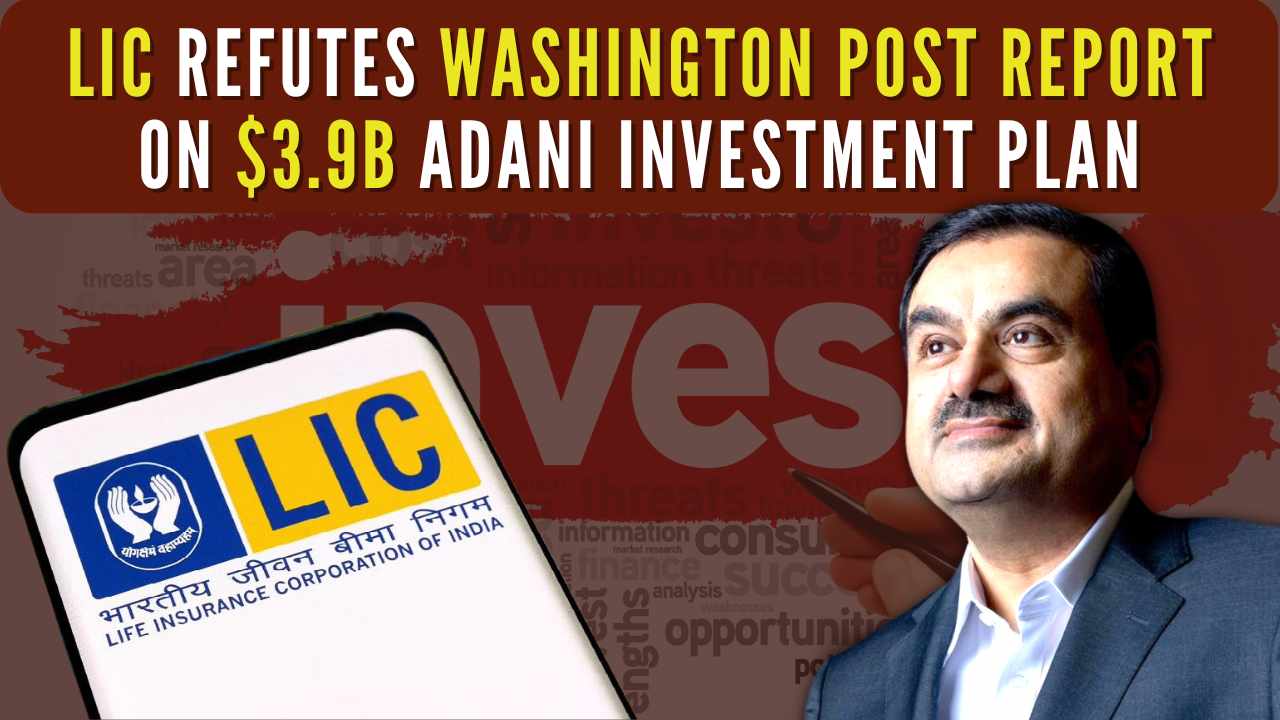
On 24 October 2025, The Washington Post published an investigation alleging that India’s government orchestrated a plan to channel about US$3.9 billion from LIC into Adani Group companies, via the Finance Ministry and other agencies. The piece caused considerable stir in India, with LIC issuing strong denials and calling the report “false, baseless and far from the truth”.
Given the magnitude of the claim — that a major state-run insurer was directed to support a corporate conglomerate via public policy intervention — it merits careful scrutiny.
The Life Insurance Corporation of India (LIC) and the Adani Group have vehemently denied a recent Washington Post story that alleged the Indian government pressured LIC to invest approximately $3.9 billion in Adani group companies.
Critics of the article, including LIC and Adani, argue the reporting has a “flawed narrative” and uses “loose evidence” because the claims are based on unverified documents that the insurer denies ever receiving or issuing.
In this article I argue that the WaPo piece is deeply flawed: it relies on weak evidence, uses selective framing, fails to engage with key counter-facts, and appears to echo a predetermined narrative of “crony capitalism” rather than balanced investigation.
1. Evidence and source issues:
One of the first concerns is the quality of the evidence in the WaPo article. The report claims that internal documents, interviews with current and former officials, and bank executives show the government drafting a “road-map” in May 2025 to direct LIC investments to Adani.
But:
LIC and the Adani Group both reject that any such document was ever prepared. LIC states: “No such document or plan … has ever been prepared by LIC that creates a roadmap for infusing funds by LIC into Adani group of companies.”
A proxy-advisory firm, InGovern Research, says the US$3.9 billion figure is unsupported and “surprising and far-fetched”.
The piece appears to make strong claims about motives (“to instil investor confidence”, “misuse of public funds”) while some of the underlying numeric assertions are not clearly traceable. For example, the figure of US$3.9 billion lacks full transparency as to how it was calculated.
In short: when an investigative piece accuses a major public institution of being steered by government for corporate benefit, the burden of proof must be very high. Here, the counter-claims from LIC and others raise serious questions about the reliability of the narrative.
2. Framing and narrative bias:
The WaPo article is framed heavily in the language of “government backing”, “bailout”, “misuse of public funds” and “crony capitalism”. For example, the sub-headline reads: “India’s $3.9 billion plan to help Modi’s mogul ally after U.S. charges”.
This framing gives the impression that LIC’s investment in Adani was principally politically motivated — rather than a standard investment decision. But several key contextual facts are omitted or downplayed:
LIC emphasises that it invests in many large Indian corporates, including firms in infrastructure, energy and others — and that its investment decisions are made on board-approved policies, with due diligence.
Many rating agencies gave strong ratings to the relevant Adani bonds. For instance, the bonds by Adani Ports & SEZ were AAA domestically.
The WaPo piece suggests that Adani was in a deep refinancing crisis and therefore needed a “bailout”. But some analyses — e.g., by IBTimes India — argue that the refinancing narrative in the WaPo piece is misleading: Adani Ports in FY25 had reduced its long-term debt, had large cash balance, and the bond raise in question was for buy-back of maturing bonds rather than a cover-up of liquidity distress.
By neglecting or under-emphasising these facts, the article predisposes the reader toward the conclusion of impropriety, rather than allowing a neutral assessment. That raises legitimate concerns about bias.
3. Omission of proportionality and context:
Another significant weakness: the WaPo article lacks adequate context regarding proportionality of the investment and LIC’s overall portfolio.
According to the Economic Times, LIC’s total book value of equity was ~₹7.3 lakh crore (and market value ~₹15 lakh crore) at the time of the report.
LIC’s exposure to Adani Group companies is stated to be less than 1 % of its total assets under management.
The IBTimes India piece points out that LIC regularly does large sole-subscriptions of corporate bond issues (including of other conglomerates), so that LIC’s behaviour here is not unprecedented.
In other words: if an institutional investor with hundreds of thousands of crores AUM makes an investment that is small in proportion, that alone mitigates the concerns of “systemic misuse of policyholder funds”. But the WaPo article does not sufficiently emphasise this. Because the article instead uses large headline numbers (“$3.9 billion”, “₹ 32,000–33,000 crore”) without consistently anchoring them in the full LIC portfolio context, the reader may get a distorted sense of scale.
4. Questions of timing and selective data:
The article ties the alleged “plan” to an investment in May 2025 in which LIC subscribed fully (~₹5,000 crore) to a bond issue of Adani Ports and SEZ Ltd (APSEZ) with a 7.75 % coupon over 15 years.
But critics note:
The IBTimes India report states that the WaPo piece incorrectly claims that this was about refinancing existing debt. IBTimes says APSEZ’s own announcement shows the issue was for buy-back of bonds maturing 2027-29, not for refinancing major distress.
The WaPo piece links the bond issue to broader “$3.9 billion” plan, but it is unclear how the figure relates to disclosed transactions. Some observers say the figure may include possible equity holdings or proposed exposure increases, but LIC or others have asked for the methodology. For example:
I don’t believe the Washington Post article provides any data to support the USD 3.9 billion figure; the source of this figure is unknown.” — Shriram Subramanian (InGovern)
The article also includes references to US-based legal/regulatory issues for Adani Group (e.g., DOJ, SEC investigations) but does not consistently link those issues to the specific investment decisions by LIC.
The implication is of weakness / malfeasance, but the direct lines of causality are not clearly substantiated.
Because of this, the article appears to cherry-pick data points (May bond issue, legal/regulatory issues of Adani) and weave them into a narrative of government intervention — without fully substantiating the step-by-step chain of decision-making, alternative explanations or the normal practice of institutional investing.
5. Failure to balance and engage with rebuttal:
One of good journalistic practice is to present major contrary voices and engage with them. In this case:
LIC’s public statement rejects the key claims of the WaPo article — stating that no such roadmap existed, no external body directed the investment decisions, and that investment decisions are independent and done with due diligence.
Former LIC Chairman Siddhartha Mohanty called the WaPo report “misleading” and challenged the newspaper to withdraw the unverified content.
Yet the WaPo article does not appear to strongly engage with these rebuttals in the body—rather, the article continues to elevate the narrative of government-steering.
In other words: the article appears imbalanced—giving more weight to the hypothesis of interference while treating denials as less compelling. For a piece alleging serious institutional wrongdoing, the rebuttal deserves deeper treatment, and the lack thereof raises questions of fairness.
6. Implications of bias and agenda:
Beyond the immediate factual issues, one must ask: what narrative is the WaPo promoting, and with what potential bias?
The framing leans heavily toward a Western-media lens of “emerging-market cronyism”, which may appeal to readers in the US / Europe. That doesn’t automatically invalidate the article, but it should make one alert to potential predispositions in choice of language, framing, and emphasis.
A critique published by IBTimes India observes: “The article contains multiple false information, factual inaccuracies, misleading claims and false narratives.”
The timing is also interesting: the story appears ahead of major domestic electoral cycles (e.g., Bihar Assembly elections) and parliamentary sessions, increasing the potential for political ramifications. While this does not prove bias, it underscores the need for extra caution.
Thus, the WaPo article might be seen not purely as straight business-investigation journalism, but part of a larger discourse on India, corporate governance, and global capital flows — which can colour both selection of facts and style of presentation.
Conclusion:
To summarize: while the Washington Post story on LIC’s alleged ₹30,000–33,000 crore funnel into Adani Group via government direction raises important questions, it falls short in several key respects:
It relies on claims that are counter-asserted by LIC and the Adani Group, and lacks full transparency around the numbers and documents used.
Its framing leans heavily toward impropriety, without sufficient proportionality or context (e.g., LIC’s overall portfolio, normal institutional investing practice).
It appears selectively to emphasise evidence supporting a predetermined narrative, without deeply engaging with rebuttal or alternative explanations.
The style of presentation (large headline numbers, “bailout”, “cronies”, “government pressure”) suggests a predisposition that might distort neutral judgement.
In short: the report may spark headlines, but a serious and sober reader should treat its claims with caution, and demand deeper verification before accepting the core allegations. The reputational stakes — for LIC, for Indian institutional governance, and for foreign media credibility — are high. By prioritising sensational framing over rigorous balanced investigation, the Washington Post piece weakens rather than strengthens the public interest in accurate and accountable reporting.
A note on what should be done:
Readers and stakeholders should call for full transparency: what documents did WaPo rely upon? How were interviews conducted? What NUMERIC basis supports the US$3.9 billion claim?
LIC and the Indian government should consider publishing a full independent audit or third-party review of the transaction(s) in question — not just a press release denial.
Media outlets (both Indian and foreign) should commit to balanced treatment: when making serious allegations of policy capture, they must present not just the “accusation” side but also the full “denial” side, with equal depth.
Investors and policy-holders should be alert to how institutional investing (especially in sovereign or quasi-sovereign entities) can become entangled in political narratives, and push for stronger institutional safeguards and transparency.
Team: Yuvamorcha.com
Follow us on LinkedIn:
https://www.linkedin.com/
https://www.linkedin.com/
www.StartupStreets.com, www.GrowMoreLoans.com, www.GrowMoreFranchisees.com, www.intellexCFO.com, www.CreditMoneyFinance.com, www.StartupIndia.Club, www.EconomicLawsPractice.com



Can you be more specific about the content of your article? After reading it, I still have some doubts. Hope you can help me.
If you’re into slots, 193betslots has a solid selection. Found a few new favorites there. Site loads quickly and the selection is great. Worth checking out at 193betslots.