

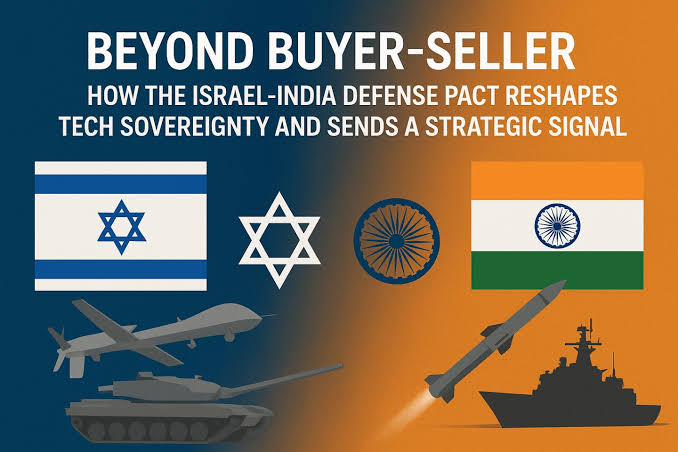
Israel Turns to India to Rebuild Defence Supply Chains Amid Tightening European Export Restrictions

As European defence export restrictions tighten, Israel is increasingly looking to India to rebuild and diversify its defence supply chains. This shift highlights India’s growing role as a global defence manufacturing and technology partner.
Israel Turns to India to Rebuild Defence Supply Chains Amid Tightening European Export Restrictions.
Israel is increasingly looking toward India to rebuild and future-proof its defence supply chains as several European countries impose tighter restrictions on the export of military components and sub-systems.
The shift marks a significant realignment in Israel’s defence procurement and industrial strategy, underscoring both the growing fragility of traditional European supply routes and India’s emergence as a reliable global defence manufacturing partner.
Also Read: SIDBI – Powering India’s MSME Growth: Funding, Schemes & Business Support.
European Restrictions and Supply Chain Vulnerabilities.
While most European nations are not primary suppliers of complete Israeli weapons platforms, they play a crucial role in providing high-value sub-systems, components, materials, and advanced technologies. These include avionics, propulsion elements, sensors, precision electronics, and specialised manufacturing inputs that are essential for Israel’s defence industry.
Recent political, legal, and public pressures across Europe have led to stricter export controls and delays in licensing for military-related supplies to Israel. For Israeli defence firms, this has translated into uncertainty, longer production timelines, and increased operational risk, especially during periods of heightened security demand.
As a result, Tel Aviv is reassessing the resilience of its defence supply chains, prioritising diversification away from Europe and seeking partners capable of offering scale, reliability, and long-term industrial collaboration.
Why India Is Emerging as a Strategic Alternative.
India stands out as a natural partner for Israel’s defence sector due to a combination of industrial capacity, policy alignment, and a long history of bilateral military cooperation.
Over the past decade, India has invested heavily in strengthening its domestic defence manufacturing ecosystem under initiatives such as Make in India and Atmanirbhar Bharat. These efforts have significantly improved India’s ability to produce complex defence components, electronics, structures, and systems at scale.
For Israel, India offers several strategic advantages:
Large and skilled industrial base capable of producing both low-cost and high-precision components.
Political reliability with fewer export uncertainties compared to Europe
Cost competitiveness without compromising on quality
Established defence cooperation, including joint development and licensed production
Israeli firms already have deep footprints in India, working with both public sector undertakings and private defence companies. Expanding these relationships from system integration and sales to supply-chain manufacturing is a logical next step.
From Buyer–Seller to Industrial Partnership.
Traditionally, India–Israel defence ties were structured around direct procurement, with India importing Israeli systems such as missiles, UAVs, radars, and electronic warfare equipment. Today, the relationship is evolving into a more balanced industrial partnership.
Israeli defence companies are increasingly exploring:
Local manufacturing of sub-systems and components in India
Technology transfer agreements for electronics, sensors, and precision engineering
Joint ventures with Indian private firms for global export markets
Co-development of next-generation systems, particularly in air defence, loitering munitions, and unmanned platforms.
For Israel, this approach not only reduces dependence on Europe but also enhances supply chain resilience during crises. For India, it accelerates technological learning and positions the country as an integral node in global defence manufacturing networks.
Also Read
IIT Bombay Launches First-of-Its-Kind ₹250 Crore Deep-Tech VC Fund to Empower Early-Stage Startups
Geopolitical and Strategic Implications.
The growing defence supply chain alignment between Israel and India has broader geopolitical implications. It reflects a global trend in which defence-producing nations seek politically aligned, industrially capable partners outside traditional Western supply hubs.
For Europe, tighter export controls may have unintended consequences, pushing advanced defence manufacturing and collaboration toward Asia. For India, the opportunity strengthens its ambition to become a defence production and export hub serving not only domestic needs but also international partners.
At the same time, Israel’s recalibration highlights the importance of supply chain sovereignty in modern defence planning, where access to components can be as critical as battlefield capabilities.
Challenges Ahead.
Despite strong momentum, the transition is not without challenges. Israeli firms will need to ensure quality control, intellectual property protection, and timely delivery across extended supply chains. India, meanwhile, must continue improving regulatory clarity, certification processes, and infrastructure to meet the stringent demands of global defence customers.
However, the strategic logic driving the partnership suggests these hurdles are manageable and worth overcoming.
Conclusion.
As European defence export restrictions tighten, Israel’s pivot toward India represents a strategic adaptation to a changing global environment. By integrating India into its defence supply chains, Israel enhances resilience, reduces political risk, and secures access to scalable manufacturing capacity.
For India, the shift reinforces its rising status as a trusted defence industrial partner and accelerates its integration into global military production networks.
Together, the evolving Israel–India defence partnership reflects a broader reordering of global defence supply chains, one shaped as much by geopolitics as by industrial capability.
Team: YuvaMorcha.com
Other Featured Articles:
How Ex-Bankers Can Build a High-Income Second Career Through a Corporate DSA Partner Program
Summary of Borivali East (Mumbai) Real Estate project on Joint Venture basis:
Birla Open Minds – Pre-School and K-12 School franchise opportunity in India and Worldwide




Если вы страдаете от [url=https://potlivost-podmyshek.ru/]потливости подмышек[/url], важно понять, что это состояние, известное как гипергидроз, часто можно эффективно контролировать и лечить с помощью специальных средств и методов.
является одним из самых распространенных и неприятных симптомов, с которыми сталкиваются многие люди . Эта проблема может быть результатом сочетания различных факторов, включая наследственность, образ жизни и окружающую среду . Потливость подмышек может иметь значительное влияние на качество жизни, вызывая психологический дискомфорт и влияя на социальные взаимодействия.
Потливость подмышек может быть более заметной в моменты эмоционального напряжения или в ситуации, когда человек испытывает физическую нагрузку. В таких случаях необходимо применять различные средства и методы, чтобы контролировать потоотделение и минимизировать его влияние на жизнь . Решение проблемы потливости подмышек предполагает использование различных стратегий, начиная от коррекции образа жизни и заканчивая применением медицинских препаратов .
## Раздел 2: Причины потливости подмышек
Причины потливости подмышек могут быть довольно разнообразными и зависят от многих факторов, включая генетические особенности организма, состояние здоровья и образ жизни . Основными причинами потливости подмышек могут быть генетическая предрасположенность, избыточный вес, наличие определенных заболеваний и estilo жизни . Потливость подмышек также может быть спровоцирована consumption определенных продуктов питания, такими как острые или соленые блюда, а также напитков, содержащих кофеин или алкоголь .
Потливость подмышек может быть как временной, так и постоянной проблемой, в зависимости от ее причин и индивидуальных особенностей . Решение проблемы потливости подмышек включает в себя выявление и устранение основной причины и использование различных средств и методов для контроля потливости.
## Раздел 3: Методы борьбы с потливостью подмышек
Борьба с потливостью подмышек предполагает использование различных стратегий, начиная от изменений в ежедневном уходе и заканчивая применением медицинских препаратов . Одним из эффективных методов является применение средств по уходу за кожей, таких как антиперспиранты и дезодоранты, для контроля потливости и предотвращения запаха .
Потливость подмышек может быть снижена с помощью изменения образа жизни, включая сбалансированную диету и регулярные физические упражнения . Кроме того, существуют различные медицинские процедуры и препараты, которые могут быть использованы для лечения гипергидроза, если он сильно влияет на качество жизни .
## Раздел 4: Прогноз и перспективы лечения потливости подмышек
Прогноз лечения потливости подмышек зависит от основной причины потливости и от того, насколько хорошо пациент реагирует на применяемые методы лечения . В большинстве случаев может быть достигнуто значительное улучшение с помощью комбинации изменений в образе жизни, средств по уходу за кожей и, если необходимо, медицинского лечения .
Потливость подмышек не является неизлечимой проблемой, и правильный подход к ее решению может существенно улучшить качество жизни человека . Важно решать эту проблему с помощью комплексного подхода, включающего изменение образа жизни, применение специальных средств и, при необходимости, консультации со специалистами.