India’s Rise as a Global Superpower: How Narendra Modi’s Leadership Is Shaping the 21st Century.
Explore how India is emerging as a global superpower in the 21st century through economic growth, technological leadership, defence strength, and strategic diplomacy under Prime Minister Narendra Modi.
India’s Rise as a Global Superpower: A New Chapter in Global History.
For decades, global power was concentrated in a few nations. The world revolved largely around Western economies and the geopolitical influence of major powers. However, the 21st century is witnessing a dramatic shift.
Today, India is no longer just a developing nation , it is steadily emerging as one of the most influential global powers.
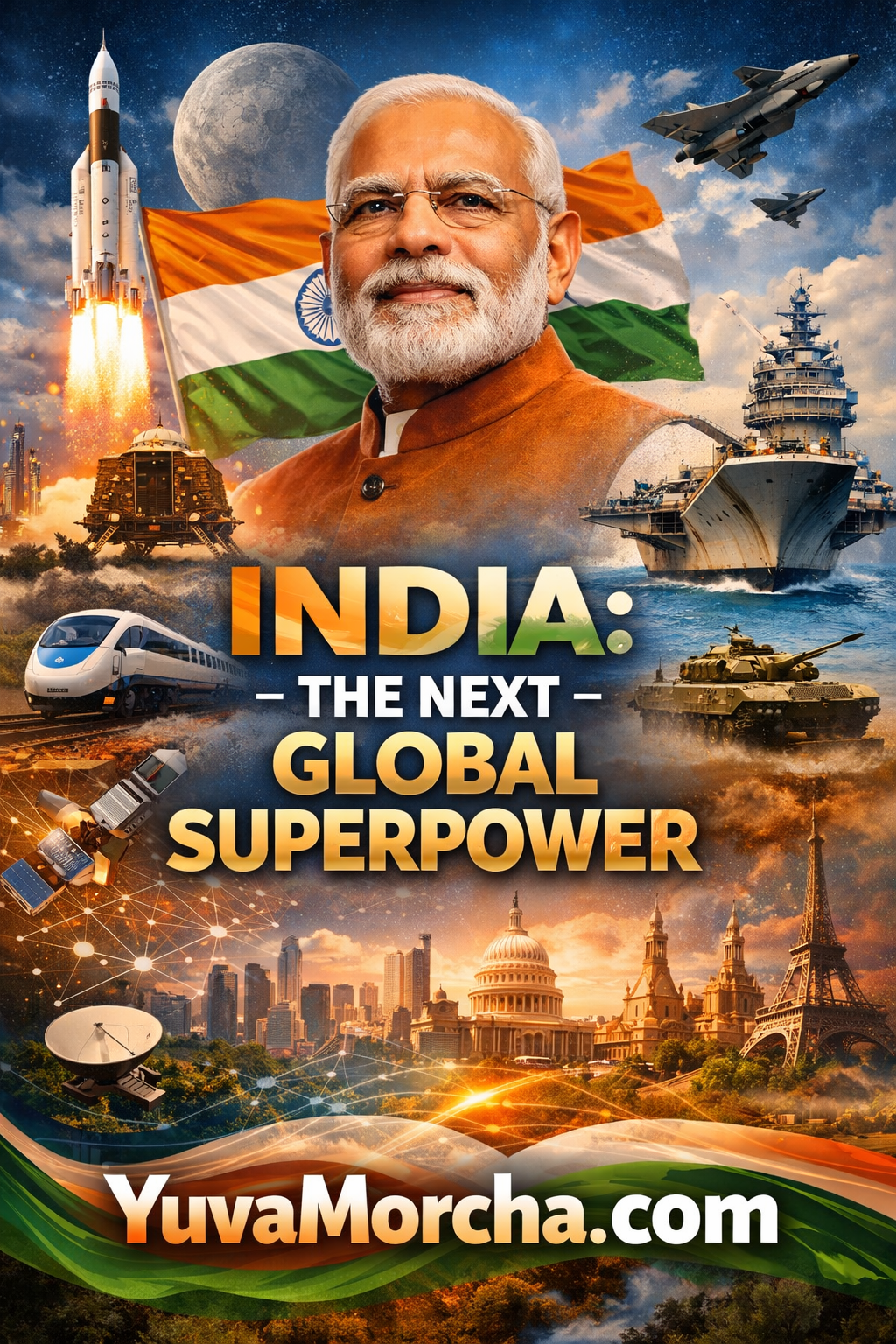
Under the leadership of Narendra Modi, India has begun transforming its economy, strengthening its military capabilities, expanding technological leadership, and reshaping global diplomacy.
This transformation is not accidental. It is the result of strategic policy reforms, global partnerships, and a growing national confidence that is positioning India at the centre of the emerging world order.
India’s Economic Rise: From Emerging Economy to Global Growth Engine.
India’s economic growth is one of the strongest indicators of its rising global influence.
Over the past decade, India has moved rapidly up the global economic ladder. The country has become the world’s fifth-largest economy, surpassing the United Kingdom and steadily closing the gap with larger economies.
Key drivers of this growth include:
1. Structural Economic Reforms
Several structural reforms have transformed India’s economic landscape:
Implementation of Goods and Services Tax (GST) creating a unified national market,
Launch of Make in India to boost domestic manufacturing,
Expansion of digital payments through Unified Payments Interface (UPI),
Insolvency reforms through Insolvency and Bankruptcy Code, etc.
These reforms have improved ease of doing business, increased transparency, and attracted global investment.
2. India as the World’s Fastest Growing Major Economy.
India has consistently remained among the fastest growing major economies, with strong domestic demand, a young workforce, and rapid urbanization.
International institutions such as the International Monetary Fund and World Bank project India to remain one of the main drivers of global economic growth over the coming decades.
3. The Rise of India’s Startup Ecosystem.
India now hosts one of the world’s largest startup ecosystems.
Cities like Bengaluru, Hyderabad, and Mumbai have become major innovation hubs producing unicorn startups in fintech, SaaS, AI, and digital services.
Government initiatives such as Startup India have further accelerated this transformation.
India’s Technology Leadership: Building the Digital Future.
India is rapidly emerging as a global technology powerhouse.
The country’s digital transformation has been one of the most remarkable in the world.
1. Digital Public Infrastructure Revolution
India’s digital infrastructure model is now studied globally.
Programs like:
Digital India
Aadhaar
Unified Payments Interface
have created the world’s largest digital identity and payments ecosystem.
Millions of Indians now access banking, healthcare, government services, and financial systems through mobile technology.
2. Global IT Leadership
India continues to dominate the global IT services industry.
Companies such as:
Tata Consultancy Services
Infosys
Wipro
are major technology partners for global corporations and governments.
India is also rapidly investing in Artificial Intelligence, semiconductors, space technology, and digital innovation.
3. India’s Growing Space Power
India’s achievements in space exploration have captured global attention.
The successful landing of Chandrayaan-3 on the Moon demonstrated India’s advanced capabilities at a fraction of the cost of many global missions.
India’s space agency, Indian Space Research Organisation, has become a respected player in the global space industry.
Strengthening Defence: India’s Strategic Military Power.
No global superpower can exist without strong defence capabilities. India has significantly strengthened its military preparedness.
India today has one of the world’s largest armed forces and is investing heavily in indigenous defence manufacturing.
Programs such as:
Atmanirbhar Bharat
Make in India
are encouraging domestic production of advanced military equipment.
India has also modernized its defence forces with advanced fighter jets, missile systems, naval capabilities, and cyber defence infrastructure.
Strategically located in the Indo-Pacific region, India plays a key role in maintaining stability and balancing power dynamics in Asia.
India’s Expanding Global Diplomacy.
India’s diplomatic reach has expanded significantly in recent years.
Under Narendra Modi, India has adopted a multi-aligned foreign policy, building partnerships with countries across the world.
1. Strategic Partnerships with Global Powers
India has strengthened ties with:
United States
Japan
France
Australia
India also plays a key role in the Quadrilateral Security Dialogue (QUAD), aimed at promoting stability in the Indo-Pacific region.
2. Leadership of the Global South
India has increasingly positioned itself as the voice of developing nations.
During the presidency of the G20 Summit 2023 hosted in New Delhi, India successfully pushed for the inclusion of the African Union as a permanent member.
This move strengthened India’s reputation as a bridge between developed and developing countries.
India’s Strategic Influence in Asia.
Asia is the centre of the global economic and geopolitical shift.
India’s geographic location and economic strength make it a key stabilizing power in the region.
India is expanding economic and strategic partnerships across:
Southeast Asia
Middle East
Africa
Indo-Pacific region.
Infrastructure initiatives, defence cooperation, and trade partnerships are strengthening India’s presence across these regions.
A Young Nation with a Massive Demographic Advantage.
India has another major advantage , its young population.
With a median age of around 28 years, India has one of the youngest populations in the world.
This demographic dividend can power:
innovation,
entrepreneurship,
economic productivity, and
global workforce leadership.
By contrast, many developed nations face aging populations and shrinking workforces.
The Vision of Viksit Bharat: India’s Future as a Global Power.
The vision of “Viksit Bharat 2047” aims to transform India into a fully developed nation by the 100th anniversary of independence.
Key pillars include:
Economic expansion,
Infrastructure development,
technological leadership,
defence self-reliance, and
global diplomatic influence.
Under the leadership of Narendra Modi, India is positioning itself not only as a major economic power but also as a civilizational force that shapes global values and international cooperation.
Conclusion: The World Is Witnessing the Rise of a Confident India.
The story of the 21st century is still being written. But one thing is becoming increasingly clear:
India is no longer waiting for a place at the global table , it is helping design the table itself.
With economic strength, technological innovation, strategic diplomacy, and national confidence, India is steadily moving toward becoming one of the defining superpowers of the modern world.
The coming decades may well belong to a confident, innovative, and globally influential India.
Team: YuvaMorcha.com
More Featured Articles:
India Stops Ravi River Water Flow to Pakistan: Impact and Details of the Shahpur Kandi Project.
SME IPOs in India: Insights from Regulators, Bankers & Advisors
How Ex-Bankers Can Build a High-Income Second Career Through a Corporate DSA Partner Program
CFO Services for Startups: Why Virtual CFOs are Becoming a Game-Changer in India
The Ultimate Guide to Collateral-Free Business Finance: Scaling Beyond Physical Assets.