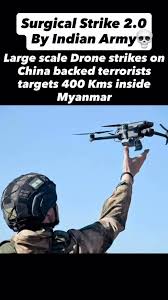
Indian Army conducts surgical strikes on ULFA-I and NSCN-K camps in Myanmar using over a hundred UAVs, ULFA-I says thee senior leaders killed.
Indian Army conducted major surgical strikes on ULFA-I (United Liberation Front of Asom- Independent) and NSCN-K (National Socialist Council of Nagaland-Khaplang) bases inside Myanmar territory on early hours of Sunday.
Reports from regional media and social media indicate that the Indian Army may have conducted surgical strikes on bases of the United Liberation Front of Asom-Independent (ULFA-I) and the National Socialist Council of Nagaland-Khaplang (NSCN-K) inside Myanmar territory on July 13, 2025.
As per reports, India forces launched a series of drone strikes on the militant bases. ULFA-I said that it lost three senior leaders in the strike.
The strikes targeted camps in the Naga Self-Administered Zone near the India-Myanmar border. As per sources, over a hundred unmanned aerial vehicles were used in the surgical strikes. The operation was reportedly carried out in close coordination with the Myanmar military.
Some of the camps targeted by strike were ULFA-I’s Eastern Command Headquarters (ECHQ) at Hoyat Basti and the 779 Camp located at Waktham Basti. Two other camps of the outfit were also attacked in the operation. It is believed that ULFA-I’s top commander Nayan Medhi, alias Nayan Asom, may have been killed in the strike. He is considered a key strategist and military trainer of the banned outfit led by Paresh Baruah.
Similarly, some several NSCN-K camps were also hit in the drone attack.
ULFA-I confirmed the drone strikes in a press statement, saying that the attacks were carried out with drones in the early hours at several mobile camps. The outfit said that while one senior leader has been killed, around 19 others were injured.
Current situation:
The Indian Army’s official denial leaves the situation unconfirmed despite ULFA-I’s claims and the reports. Some intelligence sources suggest that the casualties may be a result of the ongoing internal conflict within Myanmar. The conflicting reports highlight the complex and sensitive nature of cross-border operations and the ongoing instability in the India-Myanmar border region.