

Sharing is caring!
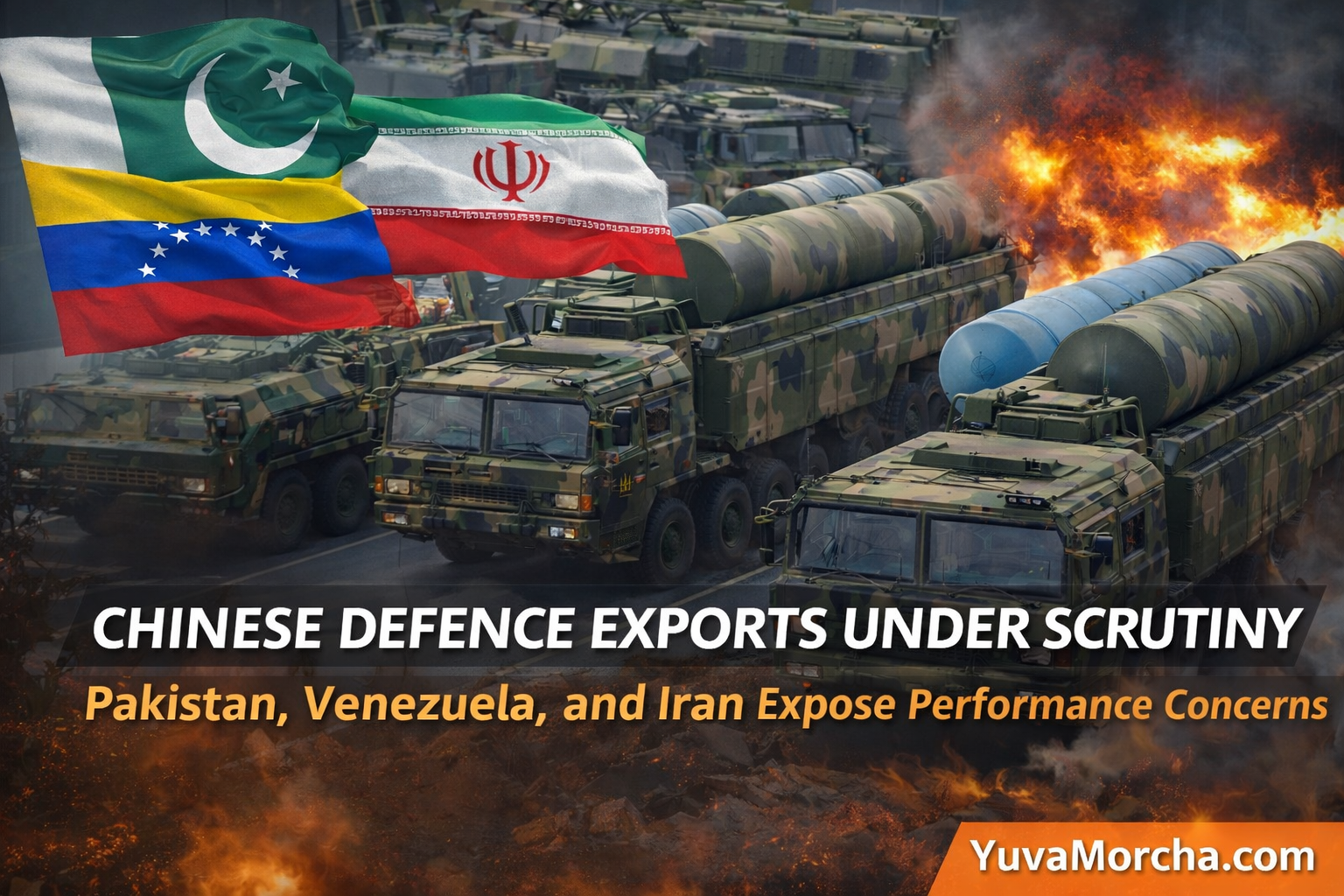
Chinese Defence Exports Under Fire: Performance Gaps in Pakistan, Venezuela and Iran Raise Global Questions.
Chinese defence exports face renewed scrutiny as reported performance gaps in Pakistan, Venezuela, and Iran raise questions about reliability, export variants, and battlefield effectiveness amid growing global tensions.
Scrutiny Intensifies on Chinese Defence Exports.
China has emerged as one of the world’s largest arms exporters over the past two decades, supplying cost-effective military hardware to developing nations across Asia, Africa, Latin America, and the Middle East. However, recent geopolitical developments and battlefield experiences in countries such as Pakistan, Venezuela, and Iran have sparked renewed debate about the real-world performance of Chinese-made defence systems.
While Beijing has positioned itself as a competitive alternative to Western and Russian arms suppliers, analysts argue that combat conditions are revealing potential gaps between marketing claims and operational effectiveness. As tensions involving the United States and its allies continue to evolve, Chinese defence exports are facing greater international scrutiny.
China’s Rise as a Major Arms Exporter
According to global defence trade assessments, China is among the top arms exporters worldwide.
Its growth has been driven by:
Competitive pricing,
Flexible financing arrangements,
Fewer political conditions compared to Western suppliers,
Rapid delivery timelines, and
Technology transfers and local production partnerships.
Chinese companies such as AVIC (Aviation Industry Corporation of China), NORINCO (China North Industries Corporation), and CASC (China Aerospace Science and Technology Corporation) have aggressively expanded into foreign markets.
Countries that face sanctions or limited access to Western weapons systems often turn to China as a viable supplier.
Pakistan: A Strategic Defence Partner Under the Spotlight.
Pakistan has long been one of China’s closest military partners. Key systems supplied include:
JF-17 Thunder fighter jets (jointly developed),
Air defence systems,
Naval frigates,
Armoured vehicles, and
Missile systems.
While cooperation between Islamabad and Beijing remains strong, analysts have increasingly debated the performance of certain export platforms under operational stress.
Questions have been raised in defence circles regarding:
Maintenance cycles,
Spare parts availability,
Sensor and radar effectiveness,
Electronic warfare resilience,
It is important to note that operational effectiveness depends not only on equipment quality but also on training, doctrine, integration, and logistics.
However, any perceived shortcoming affects global confidence in export systems.
Venezuela: Operational and Maintenance Challenges.
Venezuela has procured a variety of Chinese defence systems, including:
Air defence radars,
Armoured vehicles,
K-8 trainer aircraft,
Surveillance systems,
Economic instability and sanctions have significantly impacted Venezuela’s ability to maintain and service advanced military systems. In such cases, performance concerns may stem as much from logistical constraints as from hardware limitations.
Nonetheless, global observers often conflate operational difficulties with platform performance, adding to reputational risk for Chinese exporters.
Iran: Conflict Conditions and Real-World Testing.
Iran’s military ecosystem is complex, combining indigenous systems with foreign-supplied technologies, including Chinese-origin components in certain areas. In environments marked by high-intensity tensions and proxy conflicts, defence systems face real-world stress testing.
Where performance falls short of expectations, it fuels narratives about export-grade variants differing from domestic-use models. This debate is not unique to China; most major arms exporters provide downgraded versions of advanced systems for foreign clients.
However, in the era of open-source intelligence and rapid information sharing, battlefield performance , whether positive or negative becomes instantly global news.
The “Export Variant” Debate.
One recurring theme in defence analysis is the concept of export variants. Countries typically retain their most advanced capabilities for domestic use while offering modified versions for foreign customers.
Key differences may include:
Radar range limitations,
Software restrictions,
Reduced electronic countermeasure capabilities,
Lower-grade materials,
Limited integration flexibility, etc
China is not alone in following this practice; the United States, Russia, France, and others do the same. The issue becomes sensitive when marketing claims create expectations that real-world conditions fail to meet.
Affordability vs. Advanced Capability.
China’s defence export strategy has focused heavily on affordability and accessibility. For many countries, Chinese systems provide:
Modernisation at lower cost,
Faster acquisition timelines,
Independence from Western political leverage,
However, critics argue that lower acquisition cost can sometimes translate into:
Shorter system lifespan,
Higher long-term maintenance costs,
Performance ceilings in high-intensity conflict,
Supporters counter that many developing countries prioritize cost-efficiency over cutting-edge capability and that Chinese systems are designed to meet those budget realities.
Information Warfare and Narrative Competition.
It is also crucial to recognise that defence trade operates within a highly politicised global information environment. Allegations of “failing systems” often emerge amid strategic competition between major powers.
If concerns about Chinese defence exports persist, several outcomes are possible:
Increased demand for performance transparency,
Greater emphasis on after-sales support,
Enhanced quality control in export models,
More diversified procurement strategies among buyer nations,
Conversely, China may respond by:
Upgrading export variants,
Offering enhanced maintenance packages,
Expanding joint-production agreements,
Increasing technology-sharing arrangements, etc
However, the growing debate underscores a broader reality: modern warfare is unforgiving, and defence exports are ultimately judged by battlefield performance, not brochure specifications.
Conclusion: Reputation at a Crossroads.
China’s defence export industry stands at an inflection point. As global tensions rise and conflicts intensify, real-world performance will increasingly define market credibility.
Whether the current scrutiny represents isolated operational challenges or deeper systemic issues remains a subject of ongoing analysis. What is certain is that transparency, reliability, and lifecycle support will determine long-term trust in any defence supplier , Chinese or otherwise.
In the global arms marketplace, reputation is as powerful as firepower.
Team: Yuvamorcha.com
More Featured Articles:
Air Force use would’ve slowed Chinese offensive in 1962 war: Chief of Defence Staff Chauhan
Satellite Deception Tactics: How China Disguises Nuclear ICBM Launchers as Construction Cranes.
India Stops Ravi River Water Flow to Pakistan: Impact and Details of the Shahpur Kandi Project.
How Ex-Bankers Can Build a High-Income Second Career Through a Corporate DSA Partner Program
IIT Bombay Launches First-of-Its-Kind ₹250 Crore Deep-Tech VC Fund to Empower Early-Stage Startups
CFO Services for Startups: Why Virtual CFOs are Becoming a Game-Changer in India


Hi! You always deliver joy.