Sharing is caring!
Nuclear propulsion, AI, next-gen warfare: India unveils 15-year defence plan
Defence Ministry has launched a 15-year plan to modernise India’s armed forces with cutting-edge technologies. This ambitious roadmap aims to strengthen national security and future combat readiness amid evolving global threats.
The Defence Ministry has unveiled India’s 15-year defence plan, a comprehensive modernisation roadmap centred on AI, hypersonic technology, and next-generation warfare, charting the country’s next major leap in military capabilities to meet evolving challenges and responsibilities in the decades ahead.
Released four months after India’s Operation Sindoor against Pakistan, the plan underscores the integration of advanced indigenous technologies to enhance future combat readiness. Key acquisitions under consideration include nuclear propulsion for naval vessels, next-generation tanks, and unmanned combat systems, according to the ministry.
India has unveiled an ambitious 15-year defence modernization plan (Technology Vision and Capability Roadmap) that focuses on integrating next-generation warfare technologies, including nuclear propulsion and artificial intelligence (AI), with a strong emphasis on indigenous development.
The comprehensive roadmap aims to transform India’s military into a “future-ready force” and position the country as a leading global military power by 2040.
Key focus areas of the 15-year defence plan
Naval modernization: Nuclear propulsion and EMALS
Nuclear-powered ships: Plans include developing nuclear propulsion systems for at least 10 future Indian Navy surface combatants, most notably a new, third aircraft carrier. A nuclear-powered carrier would enable extended deployments throughout the Indo-Pacific without refueling.
Advanced launch systems: The roadmap calls for Electromagnetic Aircraft Launch Systems (EMALS) on the proposed 65,000-tonne Indigenous Aircraft Carrier III. India’s Defence Research and Development Organisation (DRDO) has already successfully tested EMALS demonstrators.
Technological advancements: Hypersonics and directed energy
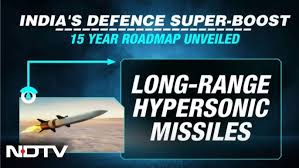
Hypersonic missiles: The plan outlines the acquisition of at least 500 hypersonic missiles for high-speed, precision strikes. DRDO has successfully tested scramjet engines capable of sustained flight above Mach 5 for record durations.
Directed energy weapons: India has demonstrated progress in directed energy weapons (DEWs) through its DURGA program. The “Sahastra Shakti” laser system has proven effective against aerial threats like drones, and India is developing both tactical and strategic versions of this technology.
AI and autonomous warfare
Autonomous combat systems: The plan includes the indigenous development of the Ghatak stealth Unmanned Combat Aerial Vehicle (UCAV), capable of carrying precision-guided munitions over long ranges. The Indian Air Force plans to acquire 150 of these systems.
AI integration: With over 75 AI projects underway, the armed forces are focusing on AI-enabled voice transcription, battlefield management, predictive maintenance, and enhanced cyber capabilities.
AI governance: The Defence AI Council (DAIC) and Defence AI Project Agency (DAIPA) were established in 2019 to provide institutional guidance for AI adoption.
Ground and space-based capabilities.
Next-generation combat vehicles: The Indian Army plans to acquire 1,800 Future-Ready Combat Vehicles (FRCVs) to replace its aging T-72 tank fleet. These will feature AI-powered fire control systems, integrated drones, and advanced network capabilities.
Enhanced space surveillance: By April 2026, India plans to launch 52 dedicated defence satellites to significantly boost its intelligence, surveillance, and reconnaissance (ISR) capabilities. The plan also emphasizes cyber defences for satellites and on-orbit refueling.
Focus on indigenous production
Self-reliance (Atmanirbhar Bharat): The roadmap is closely aligned with the government’s self-reliance initiative, with an emphasis on domestic development and production of military hardware.
Industry collaboration: The plan stresses the importance of public-private partnerships, urging the Indian defence industry to prioritize the “Make-in-India” initiative and accelerate R&D efforts.
Strategic context
The modernization plan, announced in early September 2025, follows India’s “Operation Sindoor,” a series of precision strikes against terror bases in Pakistan-Occupied Kashmir in response to a terror attack in April 2025. This context underscores India’s strategic intent to bolster its military capabilities amid evolving threats from neighboring countries and the broader Indo-Pacific region.
Sudheendra Kumar ( Mobile /WhatsApp: 91-9820088394)
Follow us on LinkedIn:
https://www.linkedin.com/
https://www.linkedin.com/
https://www.linkedin.com/