

Sharing is caring!
Karur’s Deadly Wait: How a Star’s Delayed Arrival Turned Hope into Horror
Karur Stampede: A Tragedy of Delay, Mismanagement — and Accountability
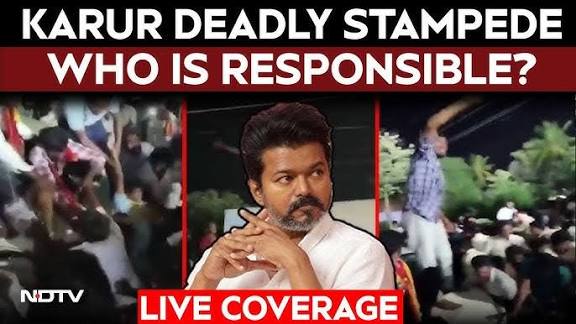
Karur, Tamil Nadu — On the evening of 27 September 2025, what was meant to be a triumphant political rally turned into a scene of chaos and heartbreak.
A massive crowd gathered at Veluswamypuram on the Karur–Erode highway to hear actor-turned-politician Vijay (founder of Tamilaga Vettri Kazhagam, TVK).
But the wait became agonizing. For over six to eight hours, supporters stood under searing sun, many without food, water, shade or basic amenities. In the suffocating heat and frustration, a sudden surge led to a catastrophic stampede, leaving at least 40 to 41 people dead and many more injured.
The Build-Up: Hours of Waiting, Growing Anxiety
Crowd Assembles Early
Attendees began arriving around 11 a.m., expecting Vijay to address them by noon. But he did not appear until evening — reports place his arrival between 7:40 p.m. and 7:45 p.m. As time dragged on, the crowd swelled far beyond the permitted number of 10,000 — official estimates suggest 27,000 had gathered.
Lack of Essentials, Frayed Patience
Under relentless heat, people fainted. Many lacked water, shade or even restroom access. The Tamil Nadu Director General of Police, G. Venkataraman, explicitly linked the crisis to Vijay’s delayed arrival — he said that the crowd had swelled while waiting under harsh conditions, escalating tension and restlessness.
The Moment It Broke: Surge, Crush, Tragedy
Three surges deepened the disaster, as later investigations and reports suggest.
1. Initial Push Toward Stage: People tried to get closer to see Vijay, pressing toward barricades.
2. Sound/Signal Failures: As stage audio or spotlight issues hindered clarity, people pushed forward to catch glimpses.
3. Vehicular Movement & Mass Chase: As Vijay’s campaign vehicle began to leave, hundreds rushed after it — the crush erupted near a generator shed and broadcast van area.
In the panic and pressure, many victims were trampled, some suffocated or crushed. Some died before even reaching hospitals.
Who Bears Responsibility?
FIR & Legal Action: Leaders Named
A First Information Report (FIR) named three senior TVK party functionaries — ‘Bussy’ Anand, C.T.R. Nirmal Kumar, and V.P. Mathiazhagan — as key suspects. The Karur district secretary Mathiazhagan was arrested on the night of 29 September. Charges reportedly include culpable homicide, endangering life, and violating crowd rules.
The FIR also criticized Vijay’s own conduct — alleging he remained inside his campaign vehicle for a prolonged time, delaying the address and adding to restlessness.
State & Police Criticism
Tamil Nadu’s DGP pointed directly at the delayed arrival by Vijay, calling it a principal “trigger” of the crush. Opposition leader Edappadi K. Palaniswami (EPS) also criticized Vijay’s timing and organizational lapses, stressing that his delay and failure to read the crowd were contributory. EPS asserted that “full police protection” and timely leadership could have averted the disaster.
However, Vijay has not been formally named in the FIR so far. He has spoken publicly, calling the stampede the most painful moment of his life, and requesting that any punitive measures target him personally rather than his functionaries.
Aftermath & Inquiry
The Tamil Nadu government has appointed Retired Justice Aruna Jagadeesan of the Madras High Court to head a one-man commission to probe the tragedy.
Compensation has been declared: the Chief Minister announced ₹10 lakh (1 million) per deceased’s family.
Political blame-game is intense. EPS is calling the commission an “eyewash” and demanding a CBI probe.
The opposition is accusing ruling party apparatus of bias and negligence in permitting the event without adequate crowd control.
Vijay, meanwhile, has appealed to Chief Minister M.K. Stalin not to penalize TVK workers harshly, asserting that he will take personal responsibility.
Analysis: How Delay & Responsibility Intersect
The Karur tragedy stands out not merely because of the large loss of life, but because a prominent leader’s schedule appears to have played a central role:
1. Delay as a Catalyst
The crowd was assembled long before Vijay’s arrival — that extended idle time under harsh conditions exacerbated distress, fatigue and desperation. The police and DGP have pointed directly to his delay as a spark.
2. Poor Crowd Control & Logistics
Organizers apparently underestimated turnout, failed to provide buffer zones, essential amenities, and safe exit routes.
3. Leadership Accountability vs. Legal Liability
While the FIR doesn’t currently name Vijay, many see moral and political responsibility resting on him — especially because his scheduling influenced the conditions. Legal processes may be slower to name him, but public sentiment is already placing him under scrutiny.
4. Systemic Failures
The incident reflects recurring issues in India’s mass gathering management: lack of clear protocols, overambitious crowd projections, and weak regulatory enforcement. Even high-profile events face such risks.
Questions Still Unanswered
Will Vijay eventually be named in charges, particularly for indirect responsibility?
Did security or police advice to TVK get ignored or overridden?
What did the commission find regarding administrative lapses — and will the state or central government take accountability?
How will this tragedy reshape rules for political rallies, especially in Tamil Nadu?
This tragedy in Karur is more than a stampede — it’s an indictment of how celebrity politics, crowd management, and leadership accountability collided with devastating consequences.
Yuvamorcha.com, Creditmoneyfinance.com , Economiclawspractice.com

Can you be more specific about the content of your article? After reading it, I still have some doubts. Hope you can help me.