

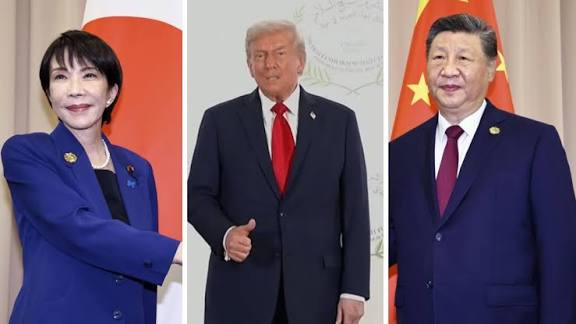
Unshakable Alliance: US Reaffirms Support for Japan Amid China’s Taiwan Flashpoint.
In a dramatic escalation of regional tensions, the United States has publicly reaffirmed its “unwavering” commitment to Japan, following fiery condemnations from China over Japanese Prime Minister Sanae Takaichi’s remarks on Taiwan.
The US has reaffirmed its “unshakable” support for Japan amid rising tensions with China over the Taiwan Strait. This came after Japanese Prime Minister Sanae Takaichi stated that a Chinese attack on Taiwan could be a “survival threatening situation” for Japan, potentially allowing it to exercise collective self-defense. In response to China’s “provocative” reaction, including economic coercion, the US reiterated its commitment to the security alliance and defended Japan’s right to self-defense,
Beijing’s reaction from trade reprisals and travel warnings to diplomatic protests underscores the growing volatility of East Asia’s security landscape. The U.S. response, meanwhile, signals a firm backing of Tokyo’s defense posture and the broader strategic alliance.
Background: What Sparked the Row:
On November 7, 2025, Prime Minister Sanae Takaichi made headlines in Tokyo’s parliament by suggesting that a Chinese military assault on Taiwan could constitute a “survival-threatening situation” for Japan. She implied that under such a scenario, Japan’s Self-Defense Forces (SDF) might intervene invoking Japan’s 2015 security law that allows for collective self-defense when Japanese survival is at stake.
Beijing reacted swiftly and sternly.
China’s foreign ministry called Takaichi’s comments “egregious” and “serious interference” in China’s internal affairs, demanding an immediate retraction. In a sharp warning, China said Japan would have to “bear all consequences” if it continued on this path.
China’s Escalation: From Diplomacy to Coercion
China has not limited its response to diplomatic protests. The backlash has included:
Travel advisory: Beijing has advised its citizens to avoid traveling to Japan, citing risks to personal safety.
Trade retaliation: China has reinstated a ban on Japanese seafood imports, signaling economic coercion to penalize Tokyo.
Diplomatic showdown: Relations soured further when a Chinese diplomat in Osaka made a particularly inflammatory post, later removed, but strong enough to draw Tokyo’s ire.
Military signaling: Chinese coast guard vessels have increased patrols near the Senkaku Islands (Diaoyu Islands), a disputed territory administered by Japan but claimed by China.
Beijing’s narrative is clear. It views Takaichi’s comments as a direct challenge to its “One China” policy, and it’s willing to leverage economic and diplomatic tools to push back.
US Response: Standing Firm with Japan
Against this backdrop, the United States has made a decisive move to shore up its alliance with Japan:
1. Official reaffirmation: U.S. State Department Deputy Spokesperson Tommy Pigott declared that Washington’s commitment to the U.S.-Japan alliance is “the cornerstone of peace and security in the Indo-Pacific.”
2. Defense guarantees: The U.S. reiterated its “ironclad” defense commitment to Japan, explicitly incorporating the Senkaku Islands in its security assurances.
3. Extended deterrence: Washington reaffirmed its extended deterrence commitments not just to Japan, but also to South Korea, reinforcing trilateral security cooperation.
U.S. Ambassador to Japan George Glass echoed this resolve, calling China’s retaliatory actions “very unhelpful” and saying they “undermine regional stability.”
Strategic Implications: Why This Matters
This diplomatic showdown is more than a bilateral spat — it signals a broader geopolitical recalibration in the Indo-Pacific:
Alliance strength: The U.S. is projecting that its alliance with Japan remains rock-solid. In a region increasingly defined by great-power rivalry, such assurances are critical.
Deterrence signaling: By backing Japan so firmly, the U.S. is sending a clear message to China that any coercion will be met with collective resolve.
Economic coercion risk: China’s use of trade restrictions (seafood bans) demonstrates how economic tools are part of its broader toolkit to influence its neighbors.
Security posture: The tension underscores Japan’s evolving security role. With its leadership now openly linking Taiwan’s fate to Japanese survival, Tokyo may increasingly lean on its alliance with Washington and other like-minded partners.
Analysis: What Could Happen Next
De-escalation or continued brinkmanship? Tokyo has avoided rash retaliation so far, preferring dialogue over tit-for-tat. But if China ramps up pressure, Japan may deepen coordination with the U.S. and other regional allies.
Broader alliance dynamics: The crisis could accelerate security cooperation not just bilaterally, but trilaterally (U.S.-Japan-Korea) and possibly beyond.
Economic fallout: If China sustains economic pressure, Japan may seek to diversify export markets, reducing dependence on Beijing.
Regional risk: A miscalculated move military or diplomatic could heighten the risk of unintended escalation, especially in flashpoints like the Taiwan Strait or the East China Sea.
Conclusion
The U.S. reaffirmation of support for Japan amid rising tensions over Taiwan marks a significant moment in Indo-Pacific geopolitics. Beijing’s sharp reaction to Prime Minister Takaichi’s remarks reflects not just bilateral friction, but a broader challenge to the post-war regional order. Meanwhile, Washington’s steadfast backing of Tokyo especially on defense commitments underscores the centrality of the U.S.-Japan alliance in deterring coercion and preserving stability.
As this diplomatic drama unfolds, the world watches closely: Will China step back, or double down? And how far is Japan willing to go with U.S. backing to defend its interests?

One thought on “Unshakable Alliance: US Reaffirms Support for Japan Amid China’s Taiwan Flashpoint”