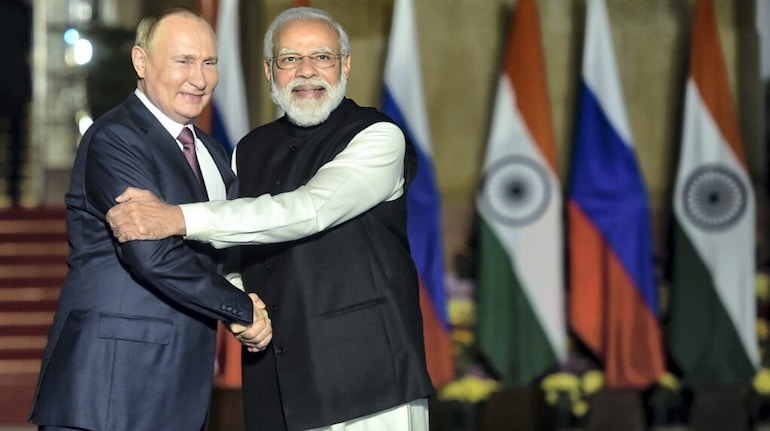
What to Expect from Putin’s December 2025 Visit: A New Chapter in India-Russia Strategic Partnership.
🇮🇳🇷🇺 The Roots of Indo-Russian Friendship
The partnership between India and Russia (and earlier the Soviet Union) is long-standing and multifaceted built over decades on energy, defence and diplomatic cooperation.
Energy cooperation has been central: post the Ukraine war, Russia offered discounted crude, making India heavily reliant on Russian energy accounting for a large share of India’s oil imports.
On defence: a significant portion of India’s military hardware from aircraft to missiles is of Russian origin. This underpins India’s strategic dependency on Moscow for spare parts, upgrades and new systems.
Beyond defence and energy, India–Russia relations have expanded to civil nuclear cooperation, space, scientific and cultural exchanges, reflecting a broad “Special and Privileged Strategic Partnership.”
In short: the friendship isn’t just transactional , it’s structural, rooted in decades of mutual interests, shared geostrategic perspectives , especially on multipolar world order and complementary needs.
Snapshot: Where Things Stand Ahead of the 2025 Visit
Bilateral trade surged after 2022, from around US$10–12 billion before the Ukraine war to around US$50–60 billion (or more) recently mostly driven by discounted Russian oil to India.
But this trade remains lopsided: India’s exports to Russia are small (around US$5 billion), and the bulk of trade is energy imports.
Geopolitical pressure especially from the West , particularly the U.S., has complicated the dynamic. Russia faces sanctions; India faces calls to reduce dependence on Russian energy. But India appears committed to maintain strategic autonomy.
Both sides have signalled desire to diversify cooperation: from energy and defence toward trade in goods, civil nuclear energy, technology collaboration, skilled-labour mobility, and even new payment and financial mechanisms.
Thus, the partnership stands at a crossroads: stay anchored in traditional strengths (energy + defence), or adapt to evolving global pressures by broadening the relationship.
What’s on the Table: Key Issues for Putin’s 2025 Visit (4–5 December)
The upcoming 23rd India–Russia Annual Summit (New Delhi) , the first such high-level meeting since 2021 is loaded with expectations.
Likely agenda and expectations
Domain Key Focus / Issues
Defence & Security – Delivery schedule for remaining deliveries under existing deals (e.g. additional units of S-400 Triumf systems) + possible discussions about future systems (e.g. Su-57 stealth jets).
Ratified logistics pact: Reciprocal Exchange of Logistics Support (RELOS) Agreement allowing mutual base / port access, easing joint exercises, operations, humanitarian missions. Upgrades, maintenance and spare-parts support for existing Russian-origin platforms important for sustenance of Indian military readiness.
Energy & Nuclear – Discussion on long-term crude supply agreements with non-sanctioned Russian firms to ensure stable energy supply, possibly reviving Indian investment in Russian energy projects.
Expanded civil nuclear cooperation: potential agreement beyond existing reactors (e.g. at Kudankulam Nuclear Power Plant) and cooperation on smaller modular reactors.
Economic & Trade Diversification – Push to reduce trade imbalance by increasing Indian exports (pharmaceuticals, processed goods, consumer goods, machinery) to Russia.
Establishment of new payment architecture to support bilateral trade (e.g. use of alternative currencies or systems to bypass sanctions/dollar-denomination risk).
Agreements on labour mobility: enabling skilled/semi-skilled Indian workers to migrate to Russia , a boost for Indian labour force and remittances.
Strategic & Diplomatic Cooperation – Joint statements reaffirming the “Special and Privileged Strategic Partnership,” covering technology, science, space, humanitarian cooperation.
Coordination on global/regional issues, possibly including deliberations on the Ukraine conflict, global peace, and aligning positions in multilateral forums.
Also Read SME IPO in India 2025: Complete Guide for Investors & Growing Businesses
Scenarios for the Outcome: Managed Upgrade vs Strategic Deepening
Analysts broadly frame two possible trajectories emerging from the summit:
Managed Upgrade , a cautious, pragmatic approach. This would involve confirming timelines for defence deliveries & maintenance, stabilising energy supply with fixed contracts, easing trade payments with alternative currency arrangements, and modest expansion into trade diversification and skilled-labour mobility. Essentially, this preserves the status quo but ensures stability.
Strategic Deepening , a far more ambitious path. Could see joint manufacturing of defence equipment, Indian investment in major Russian energy projects (e.g. Arctic LNG, Far Eastern initiatives), deeper civil-nuclear cooperation, expansion of connectivity corridors (e.g. parts of maritime or transport cooperation), and widening cooperation to space, technology and critical minerals. This path would mark a more structural realignment.
At present, many expect the summit to result in the “managed upgrade” given global pressures, cautious diplomacy and the complexity of sanctions. But strategic deepening remains a possibility if both sides decide to lean in.
What India and Russia Might Gain and the Risks
Potential Gains
More certainty in defence supplies and upgrades, helping India maintain readiness without depending heavily on other suppliers.
Energy security: long-term crude and nuclear fuel supply could help fuel India’s growth ambitions and mitigate global volatility.
Economic diversification: boosting Indian exports to Russia could open new markets for Indian goods and reduce current trade imbalance.
Strategic buffer: maintain strong ties with Russia is an important counterbalance in a multipolar world, especially given shifting global alignments.
Skilled-labour mobility: opportunities for Indian workers abroad, helping remittances and employment.
Risks / Challenges
Continued Western pressure (especially from the U.S.) sanctions or tariffs that could complicate Russia-India economic dealings.
Over-dependence on Russia for defence & energy which may limit India’s strategic flexibility and capacity to diversify suppliers.
Global diplomatic cost: as India deepens ties with Russia, there could be friction with Western partners or multilateral trade/financial regimes.
Execution risk: Russia’s internal constraints (economy, sanctions, logistics) may hinder actual delivery timelines undermining trust or causing delays.
Also Read Is the US Losing Africa to Russia and China? A Deep Dive into the New Great Power Competition
Broader Significance: What This Means for Global Geopolitics
The visit and its outcomes reflect the ongoing re-shaping of global alliances highlighting how countries like India are asserting strategic autonomy, refusing to be forced into binary alignments, and seeking diversified partnerships.
A deeper India–Russia axis could reinforce a multipolar world order, providing ballast against pressures from Western blocs especially important in context of conflicts, sanctions and global power shifts.
For Russia, strengthening ties with a rising power like India helps mitigate its isolation post-Ukraine conflict, provides access to large markets, and helps sustain its global relevance.
For India, it balances its Western engagements (US, EU, Quad) with legacy ties and opens up alternate supply chains, defence sources, energy options giving it more bargaining power internationally.
What to Watch During & After the Visit
Will there be firm, binding agreements e.g. long-term energy contracts, defence procurement/rate-charts, labour-mobility pacts or only broad, aspirational statements?
How India manages internal and external pressure (from Western nations) while going ahead with deals, especially with defence & energy.
Whether there is a tangible rise in Indian exports to Russia (beyond oil/energy). Success here would indicate a real shift in trade balance.
Whether cooperation expands beyond the traditional three pillars (energy, defence, diplomacy) into newer domains manufacturing, technology, space, civil nuclear, connectivity etc.
Global reaction: how Western powers respond diplomatically or economically, given the deepening ties between India and Russia.
Team: Yuvamorcha.com
Also Read India: The Land That Once Powered the World’s Wealth , A Forgotten Economic Superpower