

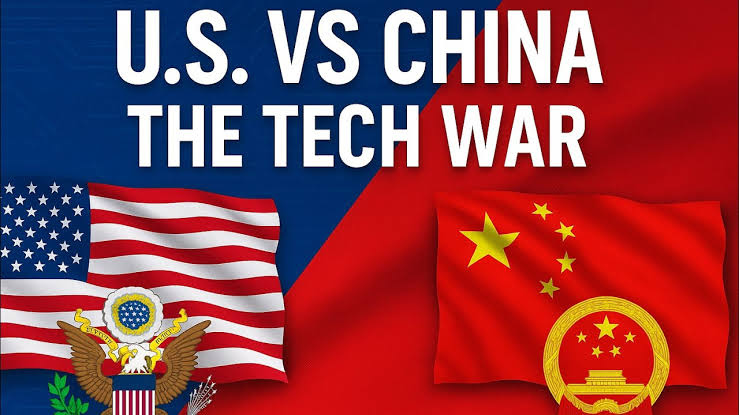
US–China Rivalry Escalates: A Battle for Tech Dominance, Global Influence and Indo-Pacific Control
The geopolitical landscape is undergoing a major transformation.
The escalating rivalry between the United States and China has shifted from traditional trade competition to a multi-layered struggle for technological superiority, economic dominance and strategic power projection.
Today, this contest influences global supply chains, military alliances, innovation ecosystems and diplomatic decisions in nearly every region from Washington and Beijing to Brussels, Canberra and New Delhi.
As relations continue to deteriorate, nations around the world are increasingly forced to evaluate their positions. The consequences of this rivalry will define the future of international politics, affecting everything from semiconductor markets to nuclear security frameworks.
A New Cold War? Understanding the Foundations of US–China Competition
The competition between the US and China is often described as a modern Cold War, but it has evolved beyond ideological rhetoric to become a race for control over emerging technologies and global governance systems.
Technology as the New Battlefield
Artificial Intelligence, quantum computing, semiconductor manufacturing and cybersecurity form the front line of this rivalry. The US has long enjoyed dominance in digital innovation and chip design, while China has rapidly risen as a technological powerhouse through heavy state-backed investment.
To maintain its lead, Washington launched the CHIPS and Science Act, directing billions toward domestic semiconductor production. By reshoring advanced chip manufacturing, the US hopes to secure supply chains and prevent dependence on foreign fabrication plants.
China, meanwhile, is accelerating its Made in China 2025 strategy, investing heavily in home-grown chip firms and AI platforms aimed at reducing reliance on Western technology while expanding global exports.
This competition is no longer confined to private industry it is deeply geopolitical.
Military and Strategic Power: The Indo-Pacific Flashpoint
While the tech war frames the rivalry, the Indo-Pacific region represents its military front line. China’s expanding naval presence, island militarization in the South China Sea and strategic investments through the Belt and Road Initiative (BRI) have triggered alarm in Washington and allied capitals.
In response, the US has intensified its presence in Asia and strengthened security frameworks such as:
QUAD partnership (US, India, Japan, Australia)
AUKUS pact (Australia, UK, US)
A landmark move under AUKUS involves Washington and London supplying nuclear-powered submarines to Australia, directly aimed at counterbalancing China’s growing dominance in maritime defence.
This announcement marked one of the clearest indicators of how far the US–China conflict has expanded beyond economics into military deterrence and alliance building.
Economic Fragmentation: From Trade War to Supply Chain Decoupling
The rivalry first intensified publicly in 2018 through tariff disputes and accusations of unfair trade practices.
However, the conflict has become far more structural, with both economies intentionally reducing mutual dependence.
US Strategy: “De-risking” from China
Washington is actively incentivizing companies to relocate manufacturing bases away from China promoting reshoring to America or near-shoring to allied nations like Mexico, Vietnam, India and South Korea.
Sanctions and export controls continue to target Chinese access to:
Advanced chips
Chip-making machines
AI software
Military-linked technologies
China’s Counter Strategy: Economic Resilience and Regional Influence
Beijing is deepening ties through:
BRICS expansion
The Regional Comprehensive Economic Partnership (RCEP)
Investments in energy, infrastructure and digital connectivity through Belt and Road
This dual strategy enhances political leverage while insulating its economy from Western dependencies.
Europe at the Crossroads: Neutrality or Alignment?
Europe represents one of the biggest geopolitical wild cards.
European nations benefit from Chinese markets while depending on US military and digital ecosystems.
A growing number of European citizens and policymakers now favour strategic autonomy, reluctant to fully take sides.
Surveys indicate increasing public sentiment for neutrality, especially as economic pressures mount and global conflicts intensify.
AI, Cybersecurity and Digital Hegemony
Arguably, the most consequential dimension of US–China competition is control over digital infrastructure and artificial intelligence.
The actor who shapes:
global data standards,
AI regulation,
5G/6G networks,
and cybersecurity governance,
will hold unparalleled influence over future economies.
The US dominates software, cloud computing and chip architecture, while China leads in digital payments, drones and 5G rollouts particularly across developing economies.
Both nations seek to export digital ecosystems to partner states to lock in long-term influence.
How Smaller Nations Navigate the Rivalry
Countries such as India, Singapore, Vietnam, Indonesia and Gulf states balance cooperation with both powers.
Their strategies often include:
Military alignment with the US for security,
Economic engagement with China for trade and investment,
Building domestic self-reliance in technology.
Australia’s alignment through AUKUS shows how security fears can drive nations closer to Washington, while ASEAN states emphasize neutrality to avoid entanglement.
Implications for Global Markets and Innovation
The world is moving toward tecno-economic fragmentation.
Key trends include:
Redundant supply chains: Companies build duplicate manufacturing lines in multiple countries.
Rise of regional tech blocs: Competing standards in AI, cybersecurity and telecom networks.
Innovation acceleration: Governments are investing billions in research to avoid falling behind.
This fragmentation poses risks higher costs, slower globalization but also stimulates innovation.
The Future of US–China Relations: Cooperation or Collision?
Despite intense hostility, full decoupling remains unlikely.
Both powers require cooperation on:
Climate change
Global finance stability
Public health
Nuclear arms control
However, competition will remain dominant.
Analysts foresee Cold War-style blocs forming, though more economically intertwined than during the US–USSR era.
The defining question is whether rivalry will stay managed or turn confrontational—particularly over Taiwan, South China Sea or cyberspace conflict.
Conclusion: A Rivalry That Shapes the World
The US–China rivalry is no longer a bilateral dispute ,it is a system-redefining confrontation.
Governments, corporations and citizens across the world are impacted by it daily, from supply chain shifts to rising defence budgets, AI regulation and uncertain energy security.
As global responses diversify, Europe, India, and Southeast Asia are emerging as balancing powers. Their strategic choices may ultimately determine whether rivalry stabilizes or becomes destructive.
One thing is certain:
The outcome of this competition will define geopolitics, technology leadership, and economic power for decades to come.
Team: YuvaMorcha
Also Read the Following Articles:
SIDBI – Powering India’s MSME Growth: Funding, Schemes & Business Support.
CFO Services for Startups: Why Virtual CFOs are Becoming a Game-Changer in India
Startup Funding Advisory Services for well managed startups with good market traction..
How to Attract Top Talent to Your Startup (Even as a New Founder)

Hey everyone,
I came across this [b]free AI-powered calculator[/b] that gives [b]instant, accurate results[/b] for everyday tasks — from finance to fitness.
It’s part of the [b]SmartCalc[/b] collection — built for speed, accuracy, and simplicity.
[b]Try it here:[/b]
[url=https://international-time-converter.blogspot.com/]SmartCalc Online Tool[/url]
No signup, no ads — just clean and simple calculators that actually work.
If you like data-driven tools or quick results without spreadsheets, this is worth a look.
Give it a try and see what you think!
I rarely post big stories on forums, but right now I thought I’d share my experience about a lucky run at an internet casino.
I’ve been spending some time at [url=https://nllalabet.com/]nllalabet.com[/url], mostly in the evenings and with low bets. I joined because the first deposit bonus looked pretty good and the terms seemed fair enough compared to many other online casinos. The signup process was straightforward: some basic info and email confirmation, then I was ready to deposit.
For my opening deposit I played it safe and loaded a small amount into my balance. I jumped into the slots section because that’s what I tend to play. I sorted by trending games and picked a slot with high volatility, hoping for a good session.
At first it was nothing special: tiny hits and dead spins and free spins with low payout, and I was ready to log out because my balance was slowly dropping. Then it finally happened: I hit a crazy free spins round with multipliers all over the screen, the slot kept dropping wins and the multiplier sent my balance to a new high. For me it was a big boost compared to my usual stakes.
I didn’t stay too long; after a few more small spins I decided to cash out and send a payout request. The withdrawal process was quite normal: the casino asked me to complete KYC with proof of address. I sent everything within an hour, and the verification was approved without any issues. After that the money was transferred to my wallet and I got it in a decent timeframe.
I’m not saying this casino is the best in the world, and of course you can also have bad days, but in this case my experience was pretty fair: transparent rules, decent support and no payout drama. This is not a promise you’ll win: there is always a risk in gambling, so only play with limits and see it as fun, not income.