

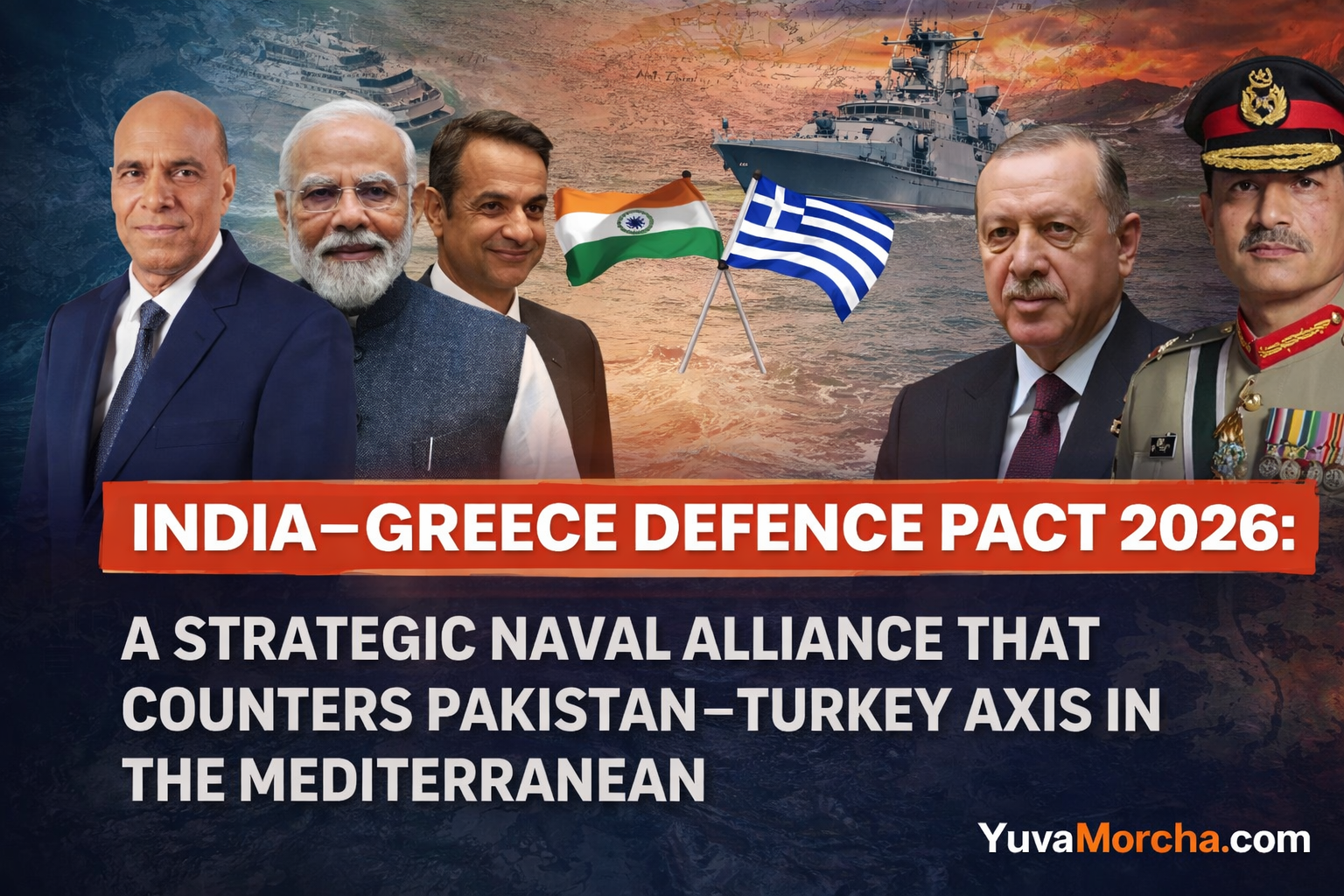
India–Greece Defence Pact 2026: A Strategic Naval Alliance That Counters Pakistan-Turkey Axis in the Mediterranean.
India and Greece sign a landmark defence cooperation pact with a 5-year roadmap focused on naval ties, joint defence manufacturing, and Mediterranean strategy.
This alliance reshapes geopolitics and counters the Pakistan–Turkey axis.
India’s Strategic Outreach Reaches the Mediterranean:
In a significant geopolitical development, India and Greece have signed a new defence cooperation agreement in New Delhi, marking the beginning of a structured military partnership for 2026 and beyond.
The agreement, signed by Indian Defence Minister Rajnath Singh and Greek Defence Minister Nikos Dendias, lays out a five-year roadmap focused on naval cooperation, defence manufacturing, military exchanges, and strategic alignment.
While the pact appears bilateral on the surface, its strategic undertones are global. This partnership signals India’s growing influence in the Mediterranean region and quietly challenges the emerging Pakistan–Turkey defence understanding, which has gained momentum in recent years.
Why Greece Matters to India’s Defence Strategy:
Greece is not just another European nation. It sits at the crossroads of Europe, Asia, and Africa, commanding crucial sea lanes in the Mediterranean. For India , a maritime power in the Indian Ocean extending defence cooperation to Greece is a calculated move to gain strategic maritime depth beyond its traditional zone.
Key reasons Greece is important to India:
Greece controls access routes between the Mediterranean and Black Sea,
It is a NATO member with deep naval capabilities,
It has ongoing tensions with Turkey, a country that has increasingly aligned with Pakistan on defence and diplomatic fronts,
It offers India a strategic foothold in European maritime security.
This pact enables India to project soft naval influence into the Mediterranean while strengthening ties with a nation that shares similar concerns about regional stability and sovereignty.
The Naval Focus: Core of the 5-Year Roadmap.
The most critical element of the agreement is naval cooperation.
India’s Navy is among the most capable in the Indo-Pacific. Greece’s Navy is highly experienced in Mediterranean operations. Collaboration between the two opens doors for:
Joint naval exercises,
Maritime intelligence sharing,
Port access and logistical support,
Cooperation in anti-submarine warfare, and Maritime surveillance and security.
This cooperation allows India to gain operational familiarity in Mediterranean waters, something strategically valuable in the long run.
Countering the Pakistan-Turkey Defence Axis
In recent years, Turkey has emerged as a vocal supporter of Pakistan on international platforms, especially on issues concerning India. Defence ties between Turkey and Pakistan have deepened, including naval shipbuilding support and military technology cooperation.
India’s defence understanding with Greece sends a clear diplomatic and strategic signal:
India will build partnerships with nations that value stability, rule of law, and balanced regional power.
Greece’s tense relationship with Turkey creates a natural alignment with India’s strategic outlook. Without direct confrontation, India has effectively created a counter-weight partnership in the same theatre where Turkey seeks influence.
Joint Defence Manufacturing: A Step Towards Atmanirbhar Bharat:
Another crucial pillar of the agreement is joint defence manufacturing.
India’s push for Atmanirbhar Bharat in defence production aligns perfectly with Greece’s capabilities in shipbuilding, naval systems, and European defence integration.
Potential cooperation areas include:
Naval ship systems,
Electronics and radar technology,
Defence components manufacturing,
R&D collaboration, and
European market access for Indian defence products.
This opens the possibility for India to use Greece as a gateway for defence exports into Europe.
Shared Values: Stability and Rule of Law:
Defence Minister Rajnath Singh emphasized that this partnership is built on shared values like stability and rule of law. This is not a transactional deal, but a value-driven strategic alignment.
Both countries:
Support international maritime law,
Believe in sovereignty and territorial integrity,
Oppose destabilising regional behaviour, and
Value democratic governance,
This philosophical alignment strengthens the durability of the pact.
A Broader Message: India Is Now a Global Security Partner:
This pact reinforces a larger trend: India is no longer confined to South Asian or Indo-Pacific security dynamics. It is now emerging as a global security partner.
From the Quad in the Indo-Pacific to partnerships in the Middle East, Europe, and now the Mediterranean, India is building a web of strategic relationships that enhance its geopolitical weight.
The India–Greece defence pact is part of this expanding strategic footprint.
Implications for the Future:
Over the next five years, we can expect:
Increased naval exchanges and exercises,
Defence industry collaboration,
More political coordination in global forums, and
Stronger maritime security architecture linking Indian Ocean to Mediterranean.
This is not just a defence deal. It is the beginning of a long-term maritime and strategic corridor between India and Europe.
Conclusion: A Quiet but Powerful Strategic Move:
The India–Greece defence agreement may not dominate headlines globally, but in strategic circles, it is seen as a smart geopolitical chess move.
By aligning with Greece, India has:
Extended its naval reach,
Strengthened its defence manufacturing vision,
Built a counter-balance to hostile alignments, and
Enhanced its global strategic relevance.
This pact represents the maturity of India’s foreign and defence policy calm, calculated, and deeply strategic.
India is no longer reacting to global power shifts. India is shaping them.
Team: Yuvamorcha.com
More Featured Articles;
The Mother of All Deals: Decoding the Historic India-Europe Free Trade Agreement of 2026.
India-UAE Strategic Defense Pact: A New Geopolitical Axis Redefining West Asia.
SME IPOs in India: Insights from Regulators, Bankers & Advisors
How Ex-Bankers Can Build a High-Income Second Career Through a Corporate DSA Partner Program
Top 10 Angel Investment Networks in India (2026): The Ultimate Founder’s Guide to Fundraising.
Israel Turns to India to Rebuild Defence Supply Chains Amid Tightening European Export Restrictions
Funding and Strategic Advisory Services to NBFCs and Fintechs



Weatistheph90, haven’t heard of that one. Hopefully, it’s something cool! Either way, good luck exploring!weatistheph90