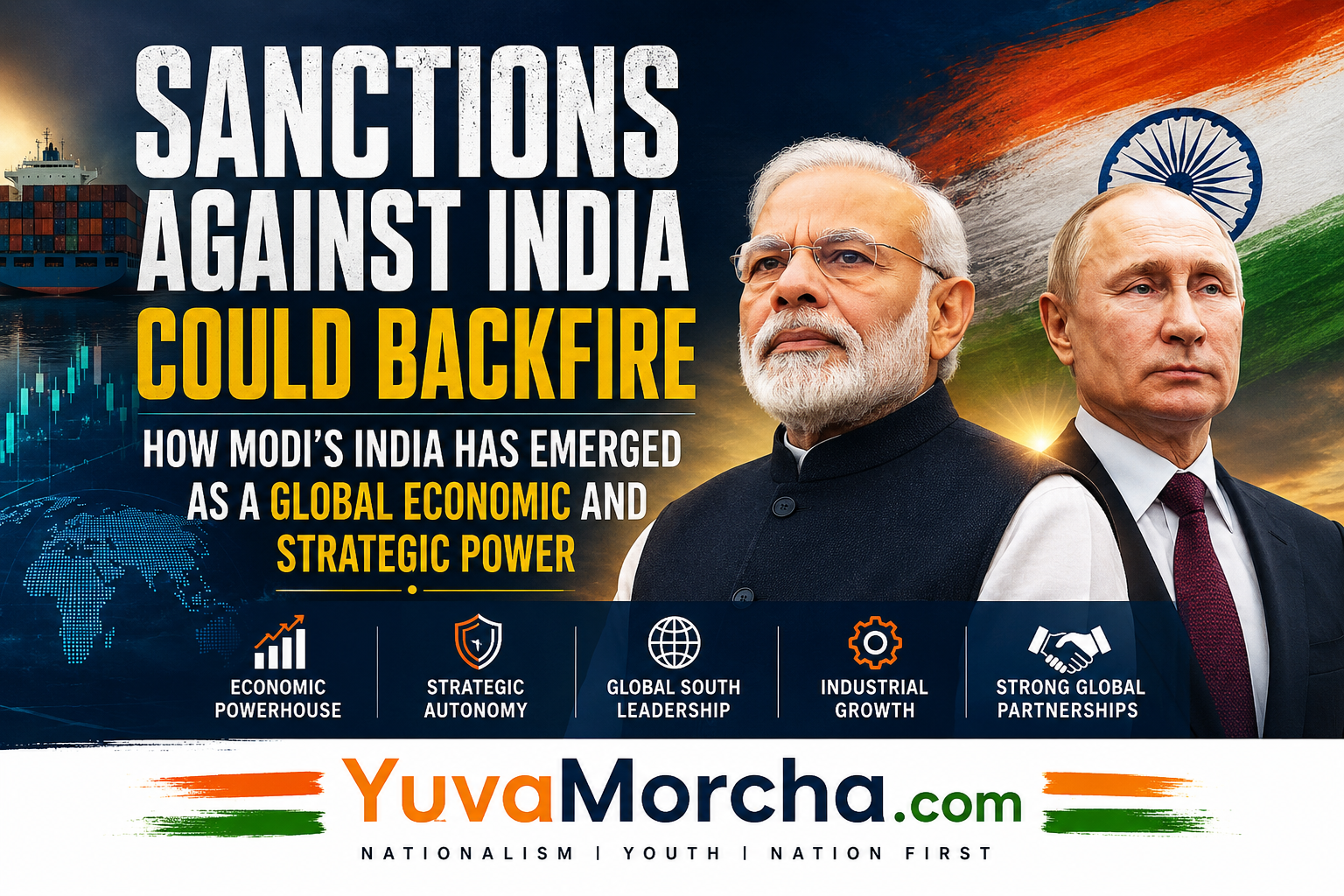
Russian President Putin says Sanctions Against India Could Backfire: How Modi’s India Has Emerged as a Global Economic and Strategic Power
Sanctions Against India? Why Threats of Economic Pressure May Backfire in a Rising Global Power
As geopolitical tensions rise, discussions around sanctions against India have resurfaced. This in-depth analysis examines why economic sanctions on India could backfire, India’s growing strategic importance, and how New Delhi’s independent foreign policy is reshaping the global order.
Introduction
Recent remarks by Vladimir Putin suggesting that sanctions or external pressure against India would “boomerang” have once again highlighted India’s growing geopolitical importance. The statement comes at a time when India is balancing relations with major global powers while firmly safeguarding its national interests under the leadership of Narendra Modi.
For decades, developing nations often found themselves vulnerable to economic sanctions, diplomatic pressure, and external influence. However, India’s rise as the world’s fastest-growing major economy, a leading technology hub, a manufacturing destination, and a critical geopolitical player has significantly altered this equation.
Today, any attempt to economically isolate or pressure India would not only impact India but could also create significant consequences for global trade, supply chains, energy security, and international diplomacy.
India’s Rise as a Global Power
Over the past decade, India has undergone a remarkable transformation.
The country has emerged as:
- The world’s most populous nation
- One of the fastest-growing major economies
- A leading digital economy
- A key defense and strategic partner for multiple nations
- A major consumer market of over 1.4 billion people
- A critical player in global supply chains
India’s economic strength has increased substantially through reforms, infrastructure expansion, digital governance initiatives, and manufacturing incentives.
From semiconductors and pharmaceuticals to information technology and renewable energy, India’s role in the global economy continues to expand.
Strategic Autonomy: India’s Independent Foreign Policy
One of the defining characteristics of modern Indian diplomacy is “Strategic Autonomy.”
Unlike during the Cold War era when countries often aligned with competing blocs, India today engages with multiple power centers simultaneously.
India maintains strong ties with:
- The United States
- Russia
- European nations
- Middle Eastern countries
- Japan
- ASEAN nations
- African partners
This balanced approach allows India to pursue its national interests without becoming dependent on any single alliance.
The government’s position has consistently emphasized that foreign policy decisions are driven by India’s interests rather than external pressure.
Why Sanctions Against India Would Be Difficult
1. India’s Massive Consumer Market
India represents one of the largest consumer markets in the world.
International corporations across sectors depend heavily on Indian consumers, including:
- Technology companies
- Automobile manufacturers
- Pharmaceutical firms
- Consumer goods companies
- Financial institutions
Any broad sanctions regime would likely hurt international businesses seeking access to India’s growing market.
2. Global Supply Chains Depend on India
India plays a vital role in global manufacturing and services.
Key sectors include:
Pharmaceuticals
India is often referred to as the “Pharmacy of the World.”
The country supplies affordable medicines and vaccines to dozens of nations.
Information Technology
Indian IT companies provide services to businesses worldwide.
Many Fortune 500 companies rely on Indian technology expertise.
Engineering and Manufacturing
India is increasingly becoming an alternative manufacturing destination as companies seek to diversify supply chains.
3. Energy Security Considerations
India is among the world’s largest energy consumers.
Its decisions significantly impact global energy markets.
In recent years, India has demonstrated a pragmatic approach toward energy procurement, prioritizing affordable supplies for its citizens and industries.
Attempts to restrict India’s energy options could disrupt global markets and increase volatility.
The Global South Looks to India
India has emerged as a prominent voice for developing nations.
Through platforms such as:
- G20
- BRICS
- Shanghai Cooperation Organisation
India has advocated for:
- Fairer global governance
- Development financing
- Food security
- Energy security
- Technology access
Many countries across Asia, Africa, and Latin America increasingly view India as a partner that understands their developmental priorities.
Economic Resilience in the Face of Pressure
India’s economy today is substantially stronger than it was several decades ago.
Key strengths include:
Large Domestic Market
Domestic demand provides a strong buffer against external shocks.
Foreign Exchange Reserves
India maintains substantial reserves that help stabilize the economy.
Diversified Trade Relations
India trades with countries across all major regions of the world.
Growing Manufacturing Base
Initiatives such as “Make in India” have strengthened industrial capacity.
Digital Transformation
The country’s digital infrastructure has become a global model for scale and efficiency.
The Geopolitical Reality
The international system is increasingly multipolar.
Unlike previous decades when a small number of countries dominated global decision-making, today’s world features multiple influential centers of power.
India’s strategic significance stems from:
- Geographic location
- Economic scale
- Military capability
- Technological innovation
- Demographic strength
As a result, many analysts believe engagement with India is far more practical than attempts at isolation.
National Interest Above External Pressure
A recurring theme in India’s foreign policy is the prioritization of national interests.
Whether on energy purchases, trade agreements, defense procurement, or diplomatic initiatives, New Delhi has consistently emphasized independent decision-making.
This approach has earned respect even among countries that may disagree with specific policy choices.
The message from India’s leadership has been clear: decisions affecting India will be made in India.
What This Means for the Future
As geopolitical competition intensifies, India is expected to remain a pivotal player in shaping the emerging world order.
Rather than being a passive participant, India increasingly acts as:
- A bridge between East and West
- A voice for the Global South
- A major economic engine
- A strategic security partner
- A technology and innovation hub
Any attempt to impose broad economic pressure on India would likely generate consequences extending far beyond India’s borders.
The interconnected nature of today’s global economy means that measures targeting a nation of India’s scale could produce unintended consequences for global trade, investment, and supply chains.
Conclusion
The debate surrounding sanctions and external pressure on India reflects a larger reality: India is no longer merely an emerging power—it is a major global stakeholder whose decisions influence international economics, diplomacy, and security.
Under Prime Minister Narendra Modi’s leadership, India has pursued a policy of strategic autonomy, economic expansion, and national self-confidence. As India’s global influence continues to grow, attempts to pressure or isolate the country may prove increasingly difficult and potentially counterproductive.
The future global order is likely to be shaped not by coercion, but by cooperation among major powers—and India will undoubtedly remain at the center of that transformation.
YuvaMorcha.com
More Featured Articles:
Putin’s Praise for Indian Coders Signals India’s Rise as a Global Technology Superpower
UAE’s $3.5 Billion Demand from Pakistan: Geopolitical Shockwaves and the Emerging India Factor.
India’s Rise as a Global Superpower: How Narendra Modi’s Leadership Is Shaping the 21st Century.
India Stops Ravi River Water Flow to Pakistan: Impact and Details of the Shahpur Kandi Project.
India-UAE Strategic Defense Pact: A New Geopolitical Axis Redefining West Asia.
Top 10 Angel Investment Networks in India (2026): The Ultimate Founder’s Guide to Fundraising.
IIT Bombay Launches First-of-Its-Kind ₹250 Crore Deep-Tech VC Fund to Empower Early-Stage Startups
CFO Services for Startups: Why Virtual CFOs are Becoming a Game-Changer in India
Startup Funding Advisory Services for well managed startups with good market traction..