

US Announces $11 Billion Arms Sale to Taiwan: Strategic Deterrence, China’s Fury, and the Shifting Balance of Power in the Indo-Pacific
The United States has unveiled an $11bn arms sale to Taiwan, including advanced missile systems and artillery. This article explores the strategic rationale, military impact, and far-reaching geopolitical consequences for US-China relations and Indo-Pacific security.
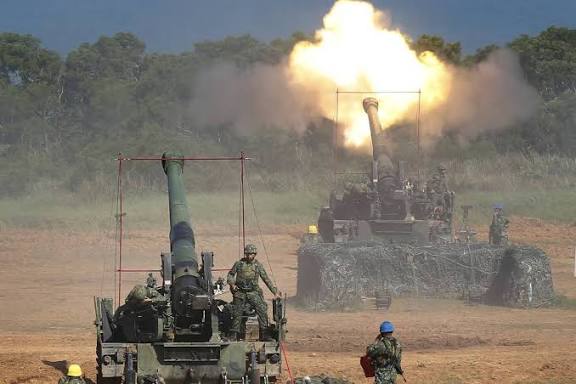
The United States has announced a major arms package to Taiwan valued at approximately $11 billion (£8.2 billion), marking one of the most substantial military transfers to the island in recent years. The proposed sale includes advanced rocket launch systems, self-propelled howitzers, and a range of missile capabilities, significantly enhancing Taiwan’s defensive and deterrent posture.
The announcement has drawn swift and fierce condemnation from China, which regards self-governed Taiwan as a breakaway province and considers any military support to Taipei a violation of its sovereignty. Beijing warned that the move “severely undermines China’s sovereignty, security, and territorial integrity,” reigniting tensions in an already volatile Taiwan Strait.
This arms package pending approval by the US Congress represents the second major arms sale to Taiwan since Donald Trump returned to the White House in January, signaling a clear continuity and possible intensification of Washington’s Taiwan policy.
Beyond the immediate military implications, the decision carries profound strategic and geopolitical consequences, reshaping power dynamics across the Indo-Pacific and deepening the great-power rivalry between the United States and China.
Also Read:
SIDBI – Powering India’s MSME Growth: Funding, Schemes & Business Support.
What the Arms Deal Includes
The proposed $11bn package is notable not only for its size but also for the type of weaponry involved, which is tailored to Taiwan’s evolving defense doctrine.
Key Components
Advanced Multiple Rocket Launch Systems (MRLS) capable of precision strikes against amphibious landing forces
Self-propelled howitzers, improving mobile artillery and survivability
Surface-to-surface and surface-to-air missiles, enhancing layered defense
Logistics, training, and maintenance support, ensuring long-term operational readiness
These systems are designed primarily for defensive and deterrent purposes, aligning with Taiwan’s emphasis on asymmetric warfare—a strategy aimed at making any potential invasion by the People’s Liberation Army (PLA) prohibitively costly.
Why Taiwan Matters Strategically
Taiwan occupies a critical geostrategic position at the heart of the first island chain, stretching from Japan through the Philippines into Southeast Asia. Control over Taiwan would allow China to project naval and air power deep into the Pacific, potentially undermining US alliances and freedom of navigation.
From Washington’s perspective, Taiwan is:
A key democratic partner in East Asia
A linchpin in regional deterrence architecture
Central to the global semiconductor supply chain, producing the majority of the world’s advanced chips.
Any disruption to Taiwan’s security would have global economic and technological repercussions, making its defense a matter of international concern rather than a purely regional issue.
US Strategic Rationale Behind the Arms Sale
1. Strengthening Deterrence
The primary objective of the arms sale is to raise the cost of military action against Taiwan. By equipping Taipei with advanced artillery and missile systems, the US seeks to deter Beijing from considering force as a viable option.
2. Reinforcing Strategic Ambiguity
While the United States maintains a policy of strategic ambiguity—neither explicitly committing to defend Taiwan nor ruling it out—arms sales serve as a concrete signal of support without crossing formal red lines.
3. Signaling Resolve to Allies
The deal reassures regional allies such as Japan, South Korea, and the Philippines that Washington remains committed to Indo-Pacific security amid growing Chinese assertiveness.
4. Domestic and Political Considerations
US arms sales to Taiwan enjoy bipartisan support in Congress, framed as defending democracy and countering authoritarian expansion. The Trump administration’s decision also reflects a broader emphasis on hard power and transactional diplomacy.
Also Read:
China’s Response and Strategic Calculations
Beijing’s reaction was immediate and uncompromising. Chinese officials accused Washington of violating the One China principle, which underpins US-China diplomatic relations.
Potential Chinese Countermeasures
Diplomatic protests and sanctions against US defense contractors
Increased PLA military exercises near Taiwan
Economic pressure on Taiwanese industries
Heightened gray-zone tactics, including cyber operations and airspace incursions
China views arms sales to Taiwan not as defensive measures but as steps toward “hollowing out” the One China framework, increasing the risk of miscalculation.
Military Balance in the Taiwan Strait
While the arms sale enhances Taiwan’s capabilities, it does not fundamentally overturn the overall military imbalance between China and Taiwan.
Current Reality
China possesses overwhelming numerical superiority in ships, aircraft, and missiles
Taiwan relies on quality, mobility, and precision rather than scale
US support aims to delay and complicate, not decisively defeat, a PLA invasion.
The new systems improve Taiwan’s ability to:
Target amphibious landing forces
Sustain resistance during early stages of conflict
Buy time for international diplomatic and military responses
Geopolitical Implications for the Indo-Pacific
1. Intensification of US–China Rivalry
The arms sale reinforces the perception that US-China relations are entering a phase of structural confrontation, particularly in security matters.
2. Regional Arms Buildup
Countries across the Indo-Pacific may accelerate their own defense spending, fearing spillover instability.
3. Pressure on ASEAN Neutrality
Southeast Asian nations face increasing difficulty maintaining strategic neutrality amid growing polarization.
4. Global Precedent
The deal underscores how great powers support partners without formal alliances, potentially influencing conflicts elsewhere.
Implications for Taiwan’s Domestic Politics
Within Taiwan, the arms sale is likely to:
Strengthen confidence in US support
Bolster political factions favoring robust defense investment
Intensify debates over conscription, defense spending, and civil resilience.
However, it may also increase Chinese pressure on Taiwanese society, including disinformation campaigns and economic coercion.
Risks of Escalation and Miscalculation
While intended as a deterrent, large-scale arms transfers carry inherent risks:
China may accelerate military timelines
Increased military activity raises chances of accidents
Diplomatic channels may narrow amid nationalist rhetoric.
The Taiwan Strait remains one of the most dangerous flashpoints in global geopolitics, where perception and signaling matter as much as hardware.
Conclusion
The proposed $11bn US arms sale to Taiwan represents far more than a routine defense transaction. It is a strategic statement about America’s role in the Indo-Pacific, a test of China’s red lines, and a reinforcement of deterrence in one of the world’s most sensitive regions.
While the weapons themselves may not change the fundamental military balance, their political and symbolic weight is substantial. As US-China competition deepens, Taiwan continues to sit at the center of a high-stakes geopolitical struggle, one that will shape regional stability, global trade, and the future of international order for years to come.
In an era of intensifying great-power rivalry, the Taiwan question is no longer just about cross-strait relations, it is a defining issue of 21st-century geopolitics.
Team: YuvaMorcha
Similar Interesting Articles:
SME IPOs in India: Insights from Regulators, Bankers & Advisors
SME IPO in India 2025: Complete Guide for Investors & Growing Businesses
Birla Open Minds – Pre-School and K-12 School franchise opportunity in India and Worldwide


I don’t think the title of your article matches the content lol. Just kidding, mainly because I had some doubts after reading the article.
Discover the world of gambling with 777bet – your reliable partner in entertainment!
Whether you are into traditional casino games or the latest video slots, there’s a game for everyone.