


Suspension of Indus Water Treaty by India to adversely affect Pakistan big time.
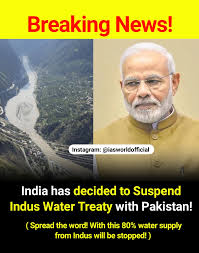
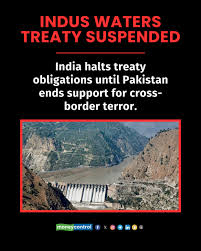
India has suspended the Indus Waters Treaty (IWT) with Pakistan, placing it “in abeyance” following a terror attack in Pahalgam, according to Indian media. This decision, communicated on April 23, 2025, was a direct response to Pakistan’s alleged support for cross-border terrorism. The treaty, which has been in place since 1960, allocates water resources between the two countries.
IWT treaty divides the Indus River system, allocating the eastern rivers (Sutlej, Beas, and Ravi) to India and the western rivers (Indus, Jhelum, and Chenab) to Pakistan.
Suspending the Indus Waters Treaty (IWT) between India and Pakistan has significant potential consequences, particularly for Pakistan, which is a lower riparian state heavily reliant on the Indus River System for its water needs.
Here’s a breakdown of the potential impacts:
Impact on Pakistan:-
Water Scarcity and Agricultural Disruption: Pakistan’s agriculture, contributing significantly to its GDP and employment, relies heavily on the Western Rivers (Indus, Jhelum, Chenab), according to the Indian Council of World Affairs (ICWA). A suspension could disrupt water flows, potentially affecting crop yields, food security, and rural livelihoods.
Economic Instability: The agricultural sector’s importance means that disruptions could have ripple effects on trade, employment, and food prices, leading to economic downturn.
Limited Storage Capacity: Pakistan’s current water storage capacity is limited, making it vulnerable to any disruption in water supply.
Urban Water Supply: Major cities in Pakistan also depend on the Indus River system for drinking water, and reduced flows could lead to shortages.
Reduced Hydropower Generation: Pakistan generates a significant portion of its electricity from hydropower, and disruptions could lead to power shortages.
Loss of Predictability and Planning Difficulties: Suspending hydrological data sharing (water flow, snowmelt, river discharge) could hinder Pakistan’s ability to plan for irrigation, hydropower, and flood preparedness.
Impact on India:-
Increased Control over Western Rivers: Suspension would give India greater flexibility in using the Western Rivers, potentially increasing hydropower generation and enabling flood control measures without some treaty-imposed restrictions.
Potential for Enhanced Hydropower and Irrigation: India could potentially utilize more water from the Western Rivers for irrigation in regions like Jammu and Kashmir, and potentially divert water to water-scarce states like Punjab, Haryana, and Rajasthan.
Strained International Relations: A unilateral suspension could severely strain relations with Pakistan and potentially damage India’s international standing as a responsible riparian state.
Legal Challenges: The IWT does not have a provision for unilateral suspension, and India’s action has sparked debate about its legality under international law.
Infrastructure Investment Required: To fully utilize the potential benefits from increased control over the Western Rivers, India would need to undertake significant infrastructure investments in building new storage facilities and diversion canals.
Overall regional and geopolitical impact
Increased Geopolitical Tension: The suspension of the treaty significantly heightens tensions between the two nuclear-armed neighbors and raises the risk of water conflicts.
Environmental and Ecological Consequences: Altering natural river flows can have adverse environmental consequences, including potential impacts on biodiversity, soil fertility, and sedimentation issues.
Uncertainty and Potential for Further Escalation: The long-term effects of the suspension are uncertain, and it could lead to further escalation of disputes, including potential military responses.
In conclusion, While India’s decision to suspend the IWT may be seen as a strategic move to address national security concerns and demand action against cross-border terrorism, it comes with the risk of significant negative consequences, particularly for Pakistan’s water security, and potentially impacting regional stability and India’s international relations.

Follow us on LinkedIn:





Thanks for sharing. I read many of your blog posts, cool, your blog is very good.