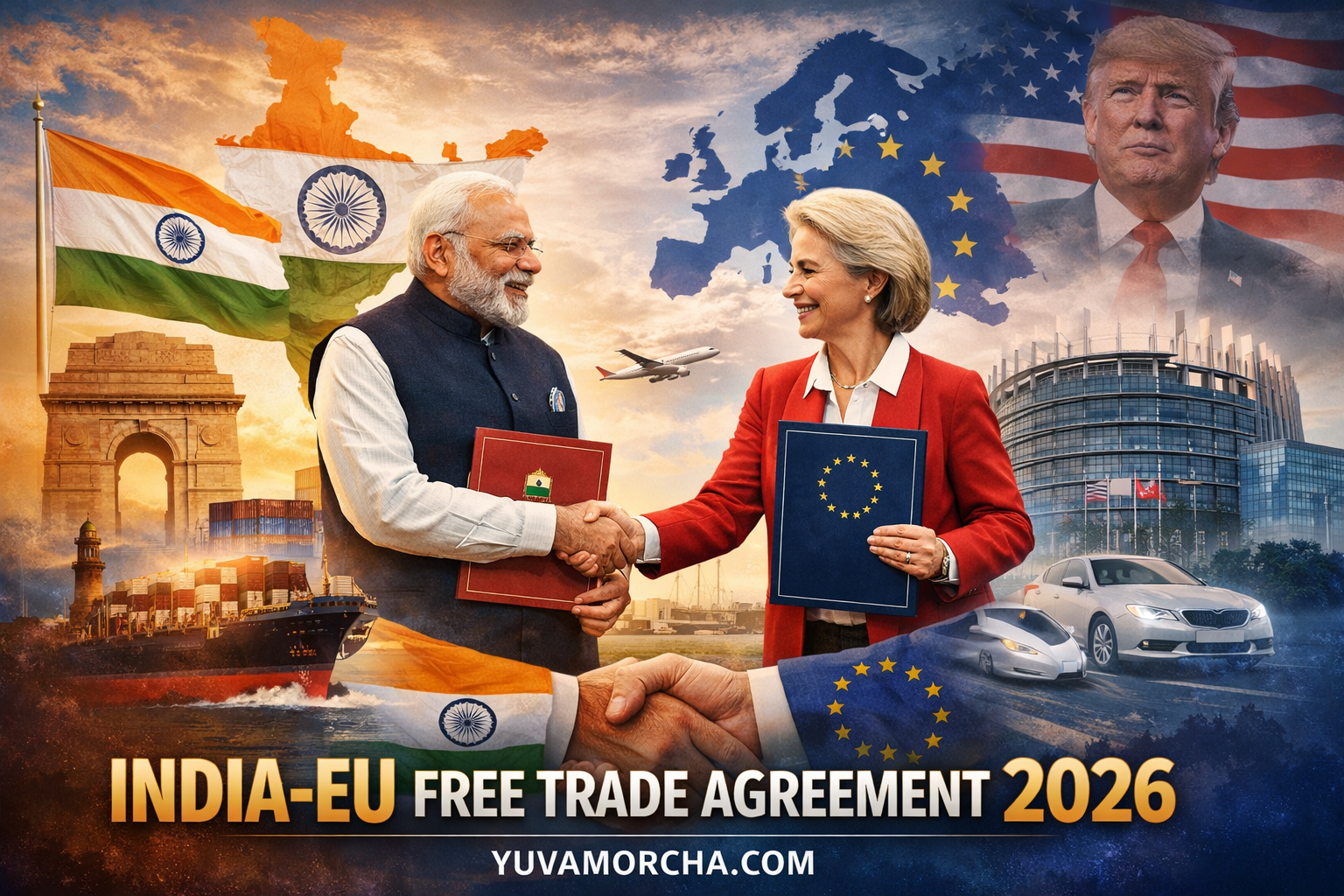


The Mother of All Deals: Decoding the Historic India-Europe Free Trade Agreement of 2026
Explore the historic India-EU Free Trade Agreement signed on January 27, 2026. This comprehensive guide covers the “Mother of All Deals,” detailing tariff cuts on cars and wine, benefits for textiles and tech, and the sharp reaction from the US Trump administration.
On January 27, 2026, the global economic landscape shifted significantly as India and the European Union (EU) officially concluded negotiations for a landmark Free Trade Agreement (FTA). After nearly two decades of “on-again, off-again” talks, Prime Minister Narendra Modi and European Commission President Ursula von der Leyen announced the finalization of what has been dubbed the “Mother of All Deals.”
This agreement creates a free-trade zone encompassing 2 billion people, representing roughly 25% of global GDP and one-third of world trade. As the world grapples with shifting geopolitical alliances and rising protectionism, this pact signals a deepening of the strategic and economic partnership between the world’s largest democracy and the world’s largest trading bloc.
1. The Context: A 19-Year Journey to “Yes”
The road to this signing was anything but smooth. Negotiations originally began in 2007 but hit a major stalemate in 2013 over disagreements regarding market access for automobiles, spirits, and the mobility of Indian professionals.
The revival of these talks in June 2022 was driven by a shared need for supply chain diversification. For Europe, India represents the fastest-growing large economy and a critical alternative to China. For India, the EU is a primary destination for its services and manufactured goods. The urgency reached a fever pitch in 2025 and early 2026, as both parties sought to hedge against the aggressive tariff policies of the second Trump administration in the United States.
2. Key Terms of the Agreement
The deal is comprehensive, covering 24 chapters that include goods, services, investment protection, and geographical indications.
Major Tariff Reductions
- European Exports to India: India has agreed to reduce or eliminate tariffs on 96.6% of EU goods.
- Automobiles: The prohibitive 110% tariff on fully built European cars will be slashed to 10% over a five-year period (subject to specific quotas).
- Alcohol & Spirits: Tariffs on European wines, currently at 150%, will drop to 75% immediately and eventually to 20%. Spirits will see a flat reduction to 40%.
- Agri-Food: Duties on olive oil, chocolate, pasta, and processed foods will be largely eliminated.
- Indian Exports to the EU: The EU will eliminate tariffs on 99.5% of Indian goods over seven years.
- Immediate Zero-Duty Access: Indian textiles, leather, gems, jewelry, and marine products will enjoy zero-tariff entry into the EU market from day one of the deal’s implementation.
Services and Investment
The pact includes the most ambitious commitments on financial services India has ever offered. It eases regulatory barriers for EU banks and insurers while providing a framework for the mutual recognition of professional qualifications, making it easier for Indian engineers, doctors, and IT professionals to work in Europe.
Sustainability and Climate
In a first-of-its-kind move, the EU has pledged €500 million in support over the next two years to assist India in its green transition, focusing on cutting greenhouse gas emissions and meeting climate targets.
3. Potential Benefits for the Parties
For India
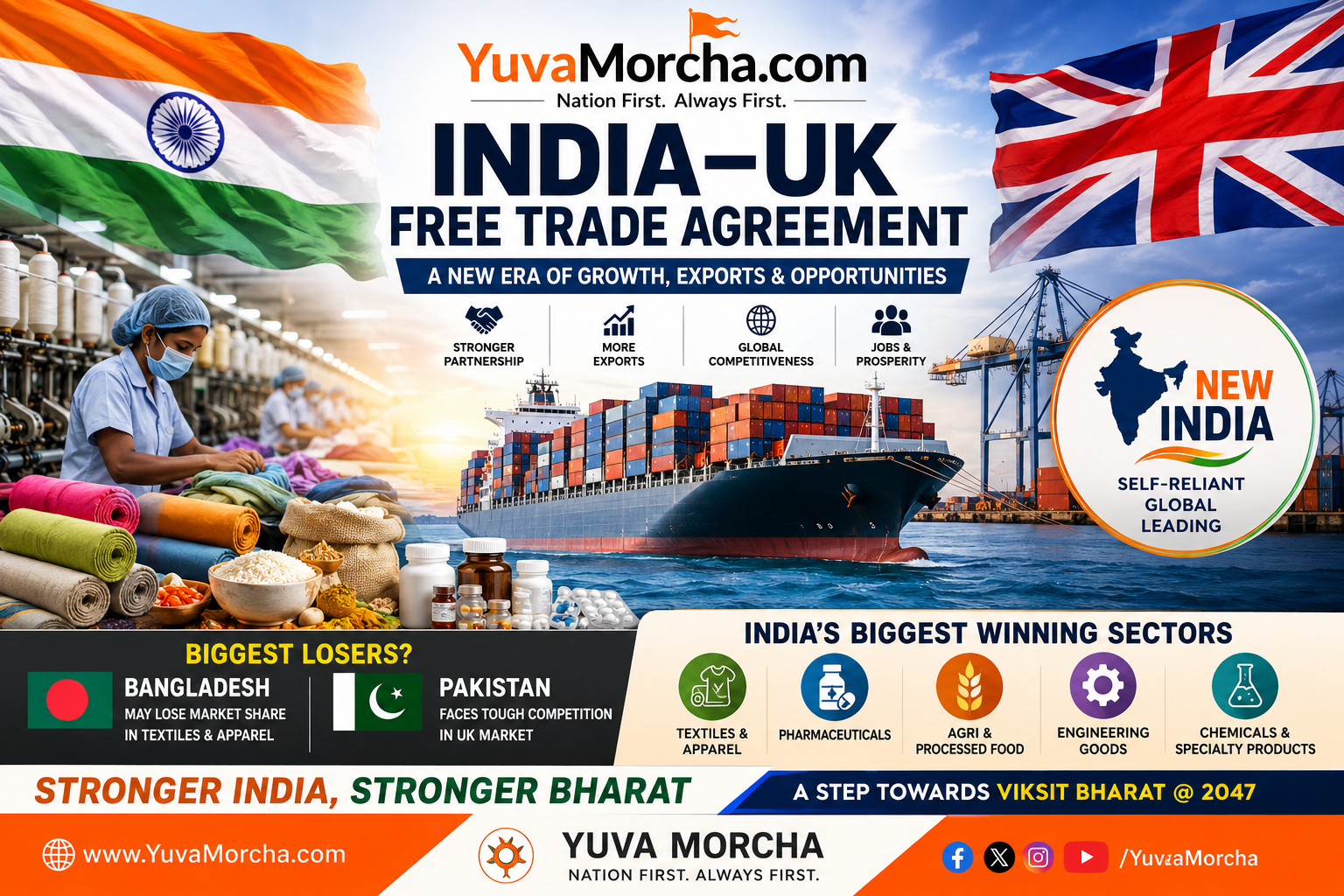
- Textile & Apparel Boom: India currently faces a 10-12% duty in Europe, placing it at a disadvantage against Bangladesh and Vietnam. The FTA levels the playing field, potentially adding billions to India’s export revenue.
- Global Value Chain Integration: By lowering duties on high-tech machinery and chemicals from Europe, Indian manufacturers can reduce production costs and integrate more deeply into global supply chains.
- Job Creation: Labor-intensive sectors like leather, handicrafts, and footwear are expected to see a massive surge in demand, creating millions of jobs.
For the European Union
- Market Access: EU companies gain “privileged access” to a market of 1.45 billion consumers.
- Strategic Hedging: The deal provides a stable, rules-based trading environment at a time when trade relations with the US and China are increasingly volatile.
- Savings: European exporters are expected to save approximately €4 billion ($4.75 billion) annually in avoided duties.
4. Potential Disadvantages and Risks
For India
- Dairy and Agriculture: There are lingering concerns that an influx of subsidized European dairy and processed food products could hurt small-scale Indian farmers.
- Intellectual Property (IP): Stricter IP enforcement required by the EU could potentially impact India’s robust generic pharmaceutical industry, leading to higher medicine prices over time.
For the European Union
- Trade Imbalance: Some European critics fear that the sheer volume of Indian textile and service exports could widen the trade deficit for certain EU member states.
- Regulatory Alignment: Aligning India’s diverse state-level regulations with EU standards remains a significant bureaucratic challenge.
5. The US Reaction: “Daddy” is Not Happy
The signing has drawn a sharp and “ballistic” reaction from Washington. US Treasury Secretary Scott Bessent lashed out at the deal, accusing Europe of “financing the war against themselves” by deepening trade ties with India while India continues to purchase Russian oil.
The Trump administration, which has already imposed 50% tariffs on several Indian goods (including a 25% penalty specifically targeting India’s energy trade with Moscow), views the India-EU FTA as a move to bypass US economic pressure. While the US and India share a strategic bond, the economic friction is palpable. The US sees this deal as a “defiance” of their tariff-driven strategy, especially as the EU has simultaneously stalled its own trade negotiations with the United States.
6. Conclusion: A New Economic Era
The India-EU FTA is more than just a trade document; it is a geopolitical statement. It signals that in a world of “America First” and Chinese dominance, middle powers and established blocs are willing to forge their own paths.
What happens next? The deal now enters a “legal scrubbing” phase lasting 5–6 months. It will then require ratification by the European Parliament and the Indian Cabinet. If all goes according to plan, the “Mother of All Deals” will be fully operational by early 2027.
Team: Yuvamorcha.com
More Featured Articles:
Top 10 Angel Investment Networks in India (2026): The Ultimate Founder’s Guide to Fundraising.
India-UAE Strategic Defense Pact: A New Geopolitical Axis Redefining West Asia.
Yoko Sizzlers, a popular restaurant chain specializing in sizzlers, offers franchise opportunities.
SME IPO in India 2025: Complete Guide for Investors & Growing Businesses
SIDBI – Powering India’s MSME Growth: Funding, Schemes & Business Support.