


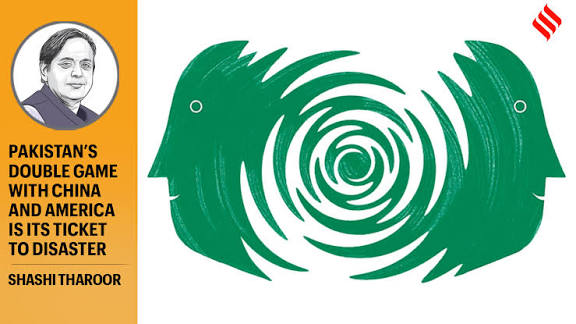


The Pasni Paradox: Pakistan’s Risky Double Game Between China and the U.S.
Pakistan’s foreign policy today resembles a high-stakes trapeze act over a geopolitical chasm. On one side stands China — the “all-weather friend” whose investments, military-industrial ties, and strategic support have made it Islamabad’s primary anchor. On the other looms the United States — a historically fickle partner whose aid, diplomacy and intelligence cooperation Pakistan has leveraged for decades.
Now the reported offer by Pakistan to permit U.S. commercial development of the port at Pasni, just a short distance from the Chinese-run Gwadar port, adds a fresh twist to this delicate balancing act. It risks becoming what might be called “The Pasni Paradox” — an attempt to court both great powers that may instead leave Pakistan trusted by neither.
The Great Balancing Act
Gwadar, under China’s aegis via the China–Pakistan Economic Corridor (CPEC) framework, is the crown jewel of Sino-Pak cooperation: a deep-sea port, linked to rail & road corridors, enabling Beijing’s access to the Arabian Sea. China has invested tens of billions in Pakistan’s infrastructure and military systems.
By contrast, Pasni — currently a modest fishing/trade port town in Balochistan — is gaining attention as a potential development zone for U.S. investment, especially for mineral extraction and maritime logistics. Reports suggest an informal pitch to Washington for turning Pasni into a U.S.–Pakistan strategic / commercial node.
On its face, Pakistan’s objective seems clear: diversify partnerships, reduce over-dependence on China, lure U.S. capital and thereby increase its leverage. But the paradox is that such an approach may undermine the very allegiances and credibility Pakistan has built.
A Game of Trust and Survival:
Pakistan’s survival strategy has long been predicated on geography — the idea that its location between South Asia, Central Asia, the Arabian Sea, Iran and the wider Gulf region gives it outsized value. Thus it has sought to remain flexible: neither fully aligned with the U.S. nor solely dependent on China. Indeed, as one analysis puts it:
“The message remained consistent: Pakistan would assist each super-power in achieving specific goals without tying itself exclusively to one camp.”
But in the current era of intensifying U.S.–China rivalry, such hedging is becoming more difficult and more risky. Analysts argue that Pakistan is now encountering the consequences of trying to serve two masters.
As one succinct account asks:
“After seven decades of successful balancing, Pakistan must finally choose which set of costs it can bear, discovering perhaps too late that trying to keep everyone happy can leave a nation friendless and dangerously exposed.”
The Economic Imperative:
Beyond power politics, the domestic dimension is equally critical. Pakistan is burdened by economic fragility: import dependency, foreign-currency shortages, inflation and limited options for financing large-scale infrastructure.
In this context, Pakistan sees its mineral deposits (particularly in Balochistan) and its maritime geography as untapped assets.
Thus the Pasni proposal is as much about economic survival as foreign-policy ambition: “Playing the US and China off each other is seen as the viable path to attract capital flows necessary to stave off economic collapse.”
However, this kind of transactional approach—“What’s in it for me?” diplomacy—carries long-term risks even if the short-term payoff seems tempting.
The Strategic Risk: Aliens on the Same Coast
The reported Pasni proposal deeply concerns China. For China, Pakistan has long been a strategic partner—defence-ties, nuclear cooperation, diplomatic cover.
CPEC’s Gwadar is a strategic node for China’s Belt & Road Initiative, and Beijing has invested heavily in securing that corridor.
So when Pakistan quietly offers a U.S. commercial/strategic foothold in Pasni — located just some 70 miles from Gwadar — the signal to China is unmistakable: Pakistan is hedging, perhaps even pivoting.
From the U.S. vantage point, the Pasni offer is attractive—but also precarious. The U.S. may see a chance to regain influence in the region, access minerals, and counter Chinese presence. But Washington also knows Pakistan’s history of shifting allegiances and divided loyalties. Analysts caution that the U.S. may prove reluctant to commit deeply without assurance of Pakistani consistency.
Hence Pakistan is caught: Lean toward China and risk losing U.S. favour; lean toward the U.S. and risk Chinese disengagement or worse; maintain the hedge and risk losing trust from both.
Internal Instability and Regional Flashpoints
The geography in question — Balochistan, the Makran coast — is not just geopolitically important, but also politically volatile. Local insurgencies, separatist movements, under-development and grievances already challenge Islamabad’s authority. Investment by either China or the U.S. in Pasni or the region will intensify interest and scrutiny, and raise the stakes.
For example, China has publicly urged Pakistan to improve security for Chinese nationals working on its projects, including those in Balochistan, signalling growing frustration with Islamabad’s ability to guarantee Chinese interests.
If Pakistan offers Pasni to the U.S., it risks inflaming local resistance — which might see foreign-backed infrastructure as exploitation. It also risks making Balochistan a focal point in the U.S.–China strategic competition.
What Happens Next?
Pakistan’s attempt to straddle rival superpowers underscores a fundamental dilemma: can a state survive by serving two masters whose interests are increasingly at odds? The Pasni Paradox reflects this moment of tension.
If Pakistan continues down this path without clarity, it may find itself isolated—rather than empowered. The really hard test will come when China asks: what are you doing for me? And the U.S. asks: what are you committing to me? Without credible answers, Pakistan’s strategic autonomy may shrink rather than expand.
Moreover, the domestic consequences are significant. A failed external strategy may trigger internal instability—especially in Balochistan—which Pakistan cannot afford.
In the final analysis: Pakistan’s current geopolitical dance is short-term survival tactics masquerading as clever diplomacy. For all the immediate gains, the long-term cost may be loss of strategic trust, reduced autonomy, and heightened vulnerability.
Team: Yuvamorcha.com





Thank you for your sharing. I am worried that I lack creative ideas. It is your article that makes me full of hope. Thank you. But, I have a question, can you help me?
Can you be more specific about the content of your article? After reading it, I still have some doubts. Hope you can help me.