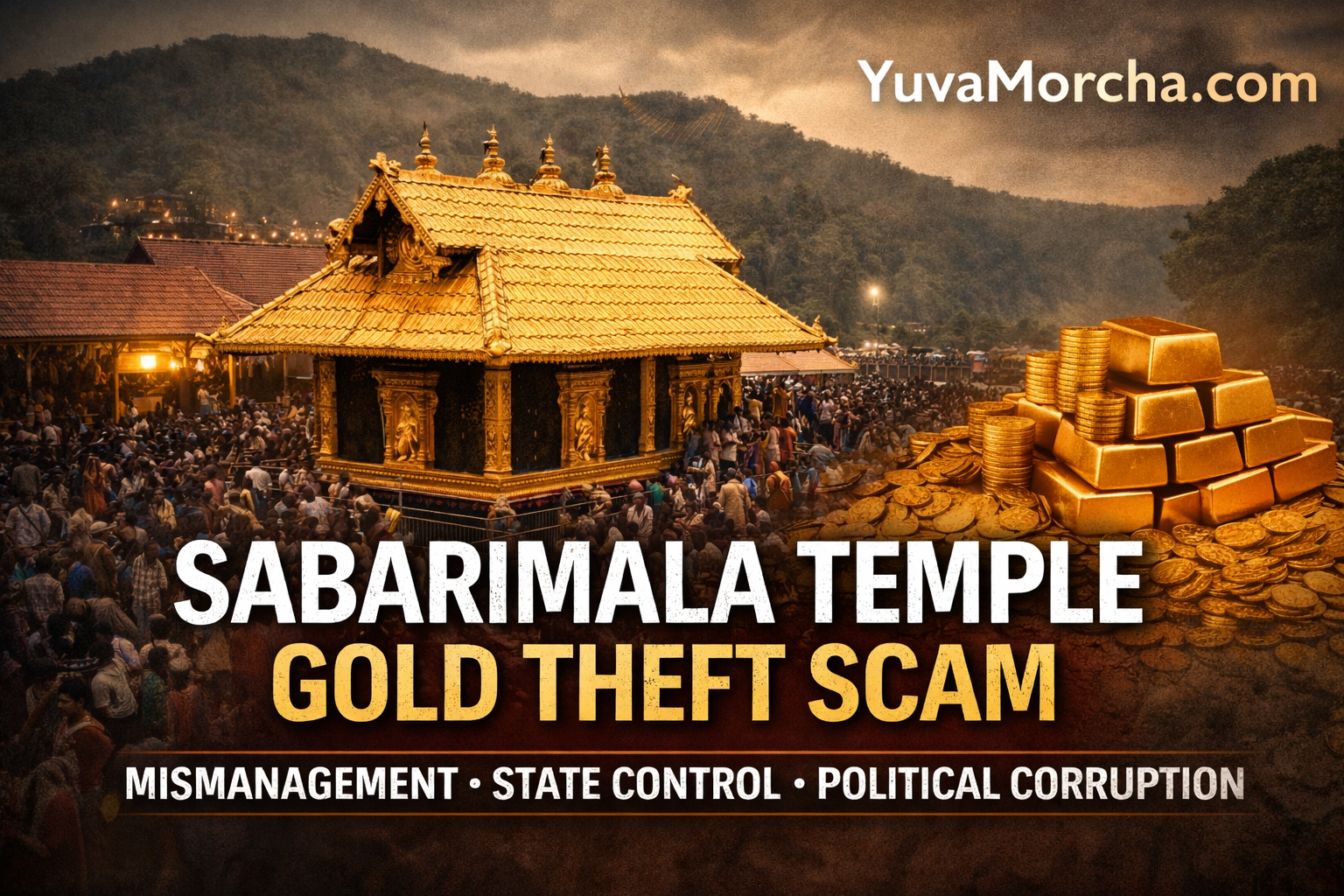
Sabarimala Temple Gold Theft Scam – How a Sacred Shrine Was Plundered Under State Control and Political Silence:
An explosive investigation into the Sabarimala Temple gold theft scam- missing assets, audit failures, political interference, and how temple management and the Kerala government failed devotees.
A Temple of Faith Turned Into a Crime Scene:
For millions of devotees, Sabarimala is not just a temple, it is a vow, a discipline, and a sacred journey of sacrifice. But behind the chants of “Swamiye Saranam Ayyappa” lies a disturbing reality that authorities have worked hard to bury under bureaucracy, delay, and silence.
The Sabarimala Temple gold theft scam is not a single incident. It is a pattern, of missing assets, questionable audits, institutional apathy, and political protection. It is a textbook example of how state-controlled Hindu temples have become soft targets for mismanagement and exploitation, with almost no fear of consequences.
Also Read:
The central question remains unanswered to this day:
How does gold donated by millions simply vanish without accountability?
Sabarimala: From Sacred Custodianship to State Capture:
Historically, Sabarimala was managed under the Travancore royal family, whose role was custodial, not extractive. The king ruled as Padmanabha Dasa, a servant of the deity. The idea that temple wealth belonged to the deity, not the administrator, was fundamental.
That philosophy collapsed after independence.
Control shifted to the Travancore Devaswom Board (TDB), a statutory body effectively operating under the Kerala government. What followed was not reform, but bureaucratisation of faith where sacred institutions were treated like government departments, minus transparency and accountability.
Unlike private trusts or religious bodies elsewhere, Hindu temples like Sabarimala were placed under direct state control, creating a dangerous imbalance of power without scrutiny.
The Enormous Wealth Nobody Wants to Account For:
Sabarimala is among the richest pilgrimage centres on Earth.
Its wealth includes:
Massive quantities of gold jewellery, coins, and ornaments,
Continuous daily gold offerings from devotees across India and abroad,
Hundreds of crores in annual revenue,
Vast land assets and infrastructure,
High-value ritual objects accumulated over decades,
Despite this scale, there is no publicly accessible, real-time inventory of temple assets.
Let that sink in.:
A temple handling wealth greater than many corporations operates with opaque books, delayed audits, and internal reporting systems that ordinary devotees are not allowed to see.
Missing Gold, Missing Answers:
Over the years, audit reports, vigilance observations, and whistleblower accounts have raised serious alarms:
Discrepancies between recorded gold stock and physical verification,
Delays of years in reconciling gold inventories,
Poor documentation of melting, storage, and movement of gold,
Gold ornaments allegedly missing or replaced without explanation,
No criminal accountability fixed conclusively
Each time questions arose, the response followed a predictable script:
Committees were formed,
Clarifications were promised,
Files moved slowly,
Public memory faded,
And the matter quietly died.,
No full disclosure. No names. No punishment.
Also Read:
Travancore Devaswom Board: An Untouchable Authority:
The Travancore Devaswom Board sits at the heart of the scandal.
Entrusted with protecting one of Hinduism’s most revered temples, the Board has instead become a symbol of unchecked power and administrative arrogance.
Key failures include:
Politically influenced appointments,
Absence of independent financial and forensic experts,
Resistance to public disclosure of asset registers,
Treating devotees as outsiders with no right to question,
When gold theft allegations surfaced, the Board did not act like a custodian under suspicion, it acted like a fortress under siege.
This is not stewardship.
This is institutional entitlement.
Kerala Government: Control, Interference, and Convenient Distance
The Kerala government cannot escape responsibility.
It:
Appoints Devaswom Board members,
Exercises administrative oversight,
Retains legal control over temple functioning,
Yet when questions of missing gold arise, the government suddenly claims “autonomy of the Board.”
This selective distancing is not accidentalrather it is strategic.
If the state controls Hindu temples, it must also bear responsibility for failures. Instead, the system allows politicians to enjoy power without liability, while devotees are expected to remain silent.
No Chief Minister has ever ordered a time-bound, court-monitored forensic audit of Sabarimala’s gold and released it to the public.
Why? Political Parties and the Hypocrisy of Silence
Perhaps the most damning aspect of the Sabarimala gold scam is the collective silence of political parties.
Parties that cry “institutional autonomy” for minorities say nothing about state-run temples.
Parties that weaponise corruption elsewhere show no urgency here
Devotee concerns are dismissed as “communal” or “agenda-driven”
This silence is not neutrality, it is complicity through inaction.
If this were a church, mosque, or private trust, the outrage would be deafening.
When it is a Hindu temple, accountability is optional.
Why Hindu Temples Are Especially Vulnerable
Also Read:
Israel Turns to India to Rebuild Defence Supply Chains Amid Tightening European Export Restrictions
Sabarimala exposes a structural problem across India:
Hindu temples are controlled by governments,
Other religious institutions are autonomous,
State control creates political interference,
Lack of ownership breeds negligence:
This asymmetry ensures one thing:
Hindu temple wealth is easy to manage and easier to mismanage.
The Sabarimala gold scandal is not an anomaly. It is a warning.
Devotees Deserve Truth, Not Tokenism:
Every gram of gold at Sabarimala was donated by someone who believed they were offering it to Lord Ayyappa and not to an audit file, a vault with missing keys, or a system allergic to transparency.
Faith does not demand blind trust in administrators.
Faith demands integrity from those in power.
When administrators hide information, delay audits, and resist scrutiny, they insult the very devotion they claim to protect.
What Accountability Should Look Like
Anything less than the following is a cover-up:
Independent forensic audit by nationally reputed agencies,
Public release of complete gold and asset inventory,
Digitised tracking of all future offerings,
Criminal liability where negligence or theft is proven,
Removal of political control from temple administration,
Transparency is not anti-faith.
It is the only way to save it.
Conclusion: Sabarimala Is Bigger Than Politics:
The Sabarimala Temple has survived centuries of history, invasions, and social change. What threatens it today is far more insidious: bureaucratic decay and political indifference and organised theft of temple gold and assets.
The gold theft scam allegations are not an attack on the temple, they are an indictment of those who run it.
If faith can survive 41 days of austerity, it can survive scrutiny.
What cannot survive scrutiny is corruption.
And until the truth about Sabarimala’s missing gold is fully and publicly known, every chant of “Swamiye Saranam Ayyappa” will carry an unanswered question with it.
Team: YuvaMorcha.com
More Featured Articles:
India Enters the Hypersonic Elite: DRDO’s ET-LDHCM Missile Test Redefines Future Warfare
How Ex-Bankers Can Build a High-Income Second Career Through a Corporate DSA Partner Program
Birla Open Minds – Pre-School and K-12 School franchise opportunity in India and Worldwide
SME IPOs in India: Insights from Regulators, Bankers & Advisors