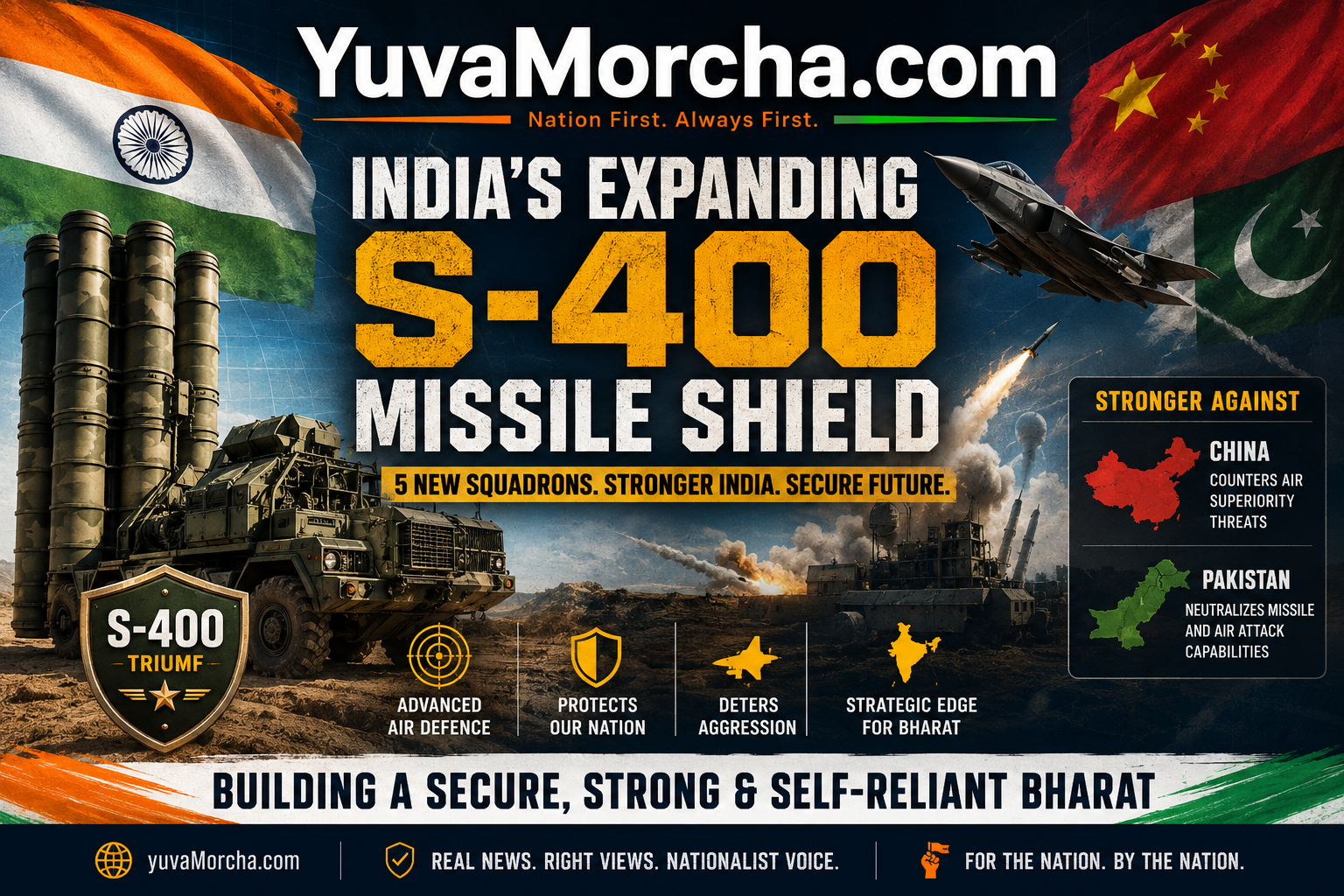
India’s Expanding S-400 Missile Shield: How Five New Squadrons Could Transform Indo-Pacific Air Power and Strengthen India’s Strategic Edge Against China and Pakistan.
India is reportedly planning to expand its S-400 air defence network with five additional squadrons. Discover how the move could strengthen India’s national security, enhance deterrence against China and Pakistan, and reshape the Indo-Pacific military balance.
India’s Expanding S-400 Missile Shield: How Five New Squadrons Could Transform Indo-Pacific Air Power and Strengthen India’s Strategic Edge Against China and Pakistan
India’s security environment is becoming increasingly complex. With China rapidly modernising its military capabilities along the Line of Actual Control (LAC) and Pakistan continuing to invest heavily in advanced fighter aircraft, missiles, and drone warfare, New Delhi faces the challenge of maintaining a credible deterrent on two active fronts.
Against this backdrop, reports indicating India’s intention to acquire five additional S-400 Triumf air defence squadrons represent far more than a routine defence purchase. Such an expansion could significantly strengthen India’s layered air defence architecture, provide enhanced protection to strategic assets, and alter the military balance across South Asia and the wider Indo-Pacific region.
The move would also signal India’s determination to maintain technological superiority against adversaries increasingly relying on long-range missiles, stealth aircraft, drones, and precision-guided weapons.
Understanding the S-400 Triumf: Russia’s Most Advanced Exported Air Defence System
The S-400 Triumf is widely regarded as one of the most capable long-range air defence systems in the world.
Designed to detect, track, and destroy multiple aerial threats simultaneously, the system can engage:
- Fighter aircraft
- Stealth aircraft
- Cruise missiles
- Ballistic missiles
- Surveillance aircraft
- UAVs and drones
- Electronic warfare platforms
The system uses multiple missile types, allowing operators to engage targets at varying ranges and altitudes.
Key Capabilities
- Detection range exceeding 600 km
- Engagement range up to 400 km
- Ability to track hundreds of targets simultaneously
- Multi-layered missile interception capability
- High resistance to electronic jamming
- Rapid deployment and mobility
The S-400 acts as a protective umbrella over critical military and civilian infrastructure, making enemy air operations significantly more difficult.
Why India Wants Additional S-400 Squadrons
India originally contracted five S-400 squadrons to strengthen national air defence.
However, strategic realities have evolved dramatically.
Growing Chinese Military Presence
China has deployed advanced assets across Tibet and Xinjiang, including:
- J-20 stealth fighters
- Long-range bombers
- Ballistic missile forces
- Advanced drone systems
- Integrated air defence networks
Beijing’s infrastructure development along the border has significantly improved its ability to sustain military operations.
Pakistan’s Modernisation Efforts
Pakistan continues to enhance its air capabilities through:
- JF-17 Block III fighters
- Long-range stand-off weapons
- Precision-guided munitions
- Armed drones
- Growing missile inventory
A stronger S-400 network would help India maintain overwhelming defensive superiority.
Protection of Strategic Assets
India must secure:
- Nuclear command infrastructure
- Air force bases
- Naval installations
- Strategic industrial centres
- Major metropolitan areas
- Missile storage facilities
Additional S-400 deployments would create wider protective coverage across the country.
How Additional S-400 Squadrons Could Strengthen India’s Defence
1. Creation of a Near-Nationwide Air Defence Shield
One of the biggest advantages of acquiring five more S-400 squadrons would be broader geographic coverage.
Strategic deployment could provide protection for:
- Northern sector against China
- Western sector against Pakistan
- Indian Ocean coastal regions
- Major military hubs
- National capital region
This would significantly complicate enemy air attack planning.
2. Strengthening Two-Front War Preparedness
Indian military planners have long recognised the possibility of a simultaneous challenge from China and Pakistan.
Additional S-400 batteries would allow India to:
- Defend multiple sectors simultaneously
- Reduce vulnerability to saturation attacks
- Maintain operational flexibility
- Preserve offensive air assets
This is especially important in a two-front conflict scenario.
3. Enhanced Protection Against Ballistic Missiles
Both China and Pakistan possess extensive missile arsenals.
Additional S-400 systems could improve India’s capability to intercept:
- Short-range ballistic missiles
- Medium-range ballistic missiles
- Cruise missiles
- Precision strike weapons
This strengthens India’s overall deterrence posture.
4. Countering China’s Air Superiority Ambitions
China seeks dominance through:
- Stealth aircraft
- Long-range missile systems
- Network-centric warfare
- Advanced surveillance platforms
The S-400 creates a high-risk environment for hostile aircraft operating near Indian airspace.
Chinese planners would be forced to allocate greater resources to suppression operations, increasing operational costs and risks.
5. Force Multiplier for the Indian Air Force
The S-400 is not merely a defensive weapon.
It acts as a force multiplier.
When protected by S-400 coverage:
- Indian fighters can operate more aggressively
- Airbases become harder to neutralise
- Command centres remain functional longer
- Logistics networks stay protected
This improves overall combat effectiveness.
Impact on Pakistan: Strategic Challenges for Islamabad
Reduced Freedom of Air Operations
Pakistan’s Air Force relies heavily on rapid offensive operations during conflict.
Expanded S-400 coverage would:
- Restrict penetration routes
- Increase aircraft vulnerability
- Force longer stand-off engagements
- Reduce surprise attack options
Pressure on Missile Strategy
Pakistan has traditionally invested in missile capabilities to offset India’s conventional superiority.
A larger S-400 network could undermine this strategy by increasing interception capabilities.
As a result, Pakistan may need to invest substantially more resources into overcoming India’s air defence shield.
Increased Defence Spending Burden
To counter expanded Indian air defences, Pakistan may require:
- New aircraft
- Advanced electronic warfare systems
- Additional missiles
- Stealth technologies
This could place significant financial strain on its defence budget.
Impact on China: A More Complex Strategic Environment
Greater Risks for PLA Air Force Operations
The People’s Liberation Army Air Force (PLAAF) would face increased operational challenges near India’s borders.
Any attempt to achieve air superiority would require:
- More aircraft
- More support assets
- More electronic warfare resources
- Longer preparation times
Reduced Effectiveness of Coercive Military Pressure
China has increasingly used military pressure as a strategic tool.
A robust S-400 shield strengthens India’s deterrence posture and reduces the effectiveness of military intimidation tactics.
Challenge to Regional Air Dominance
China seeks to emerge as the dominant military power in the Indo-Pacific.
A stronger Indian air defence network creates a powerful counterbalance and supports a multipolar regional security structure.
Strategic Impact Across the Indo-Pacific
The implications extend beyond India, China, and Pakistan.
An expanded Indian air defence capability could influence:
- Indian Ocean security
- Regional power balance
- Quad cooperation
- Maritime security architecture
- Strategic stability in Asia
Countries concerned about China’s military expansion may view a stronger India as an important stabilising force.
Integration with India’s Indigenous Defence Ecosystem
India’s long-term objective remains defence self-reliance.
Additional S-400 systems would likely complement indigenous projects such as:
- Akash missile systems
- Akash-NG
- XRSAM development
- Ballistic Missile Defence programme
- Integrated Air Command and Control System
Together, these systems can create a comprehensive multi-layered defence architecture.
Economic and Strategic Benefits for India
Beyond military advantages, enhanced security contributes to:
Protection of Economic Centres
Major cities and industrial hubs become more secure against strategic attacks.
Investor Confidence
A secure nation attracts greater domestic and foreign investment.
Strategic Stability
Strong deterrence reduces the likelihood of conflict by raising the cost of aggression.
Diplomatic Leverage
Military strength often translates into greater influence in international negotiations and regional security arrangements.
Potential Challenges and Considerations
While the benefits are substantial, some challenges remain:
High Procurement Costs
Additional squadrons would require significant investment.
Maintenance and Logistics
Long-term operational readiness depends on sustained support and training.
Dependence on Foreign Systems
India continues to pursue indigenous alternatives to reduce dependence on external suppliers.
Adversary Countermeasures
China and Pakistan may respond by investing in:
- Hypersonic weapons
- Stealth aircraft
- Drone swarms
- Advanced electronic warfare systems
The military competition is therefore likely to continue evolving.
Conclusion
India’s potential acquisition of five additional S-400 Triumf squadrons could represent one of the most consequential developments in South Asian defence strategy in recent years.
The expansion would significantly enhance India’s ability to protect its airspace, strategic infrastructure, military assets, and population centres. It would strengthen deterrence against both China and Pakistan, complicate adversary military planning, and reinforce India’s position as a leading security provider in the Indo-Pacific region.
While no defence system is invulnerable, a larger and more integrated S-400 network would substantially raise the costs and risks of any hostile action against India. In an era defined by rapid technological change and evolving security threats, such a capability could become a cornerstone of India’s national defence architecture and a key pillar of regional strategic stability.
YuvaMorcha.com Analysis: As Bharat rises as a major global power, robust air defence systems such as the S-400 not only safeguard national sovereignty but also ensure that India’s economic growth, strategic autonomy, and geopolitical influence remain protected against emerging threats in an increasingly contested Indo-Pacific environment.
More Featured Articles:
The Ultimate Guide to Collateral-Free Business Finance: Scaling Beyond Physical Assets.
SIDBI – Powering India’s MSME Growth: Funding, Schemes & Business Support.
SME IPO in India 2025: Complete Guide for Investors & Growing Businesses
Working Capital Solutions for Growing Businesses
CFO Services for Startups: Why Virtual CFOs are Becoming a Game-Changer in India
Top 10 Angel Investment Networks in India (2026): The Ultimate Founder’s Guide to Fundraising.