




Sharing is caring!
Air Force use would’ve slowed Chinese offensive in 1962 war: Chief of Defence Staff Chauhan
Over the years, the security situation has changed and the face of warfare itself has got transformed, the Chief of Defence Staff (CDS) maintained.
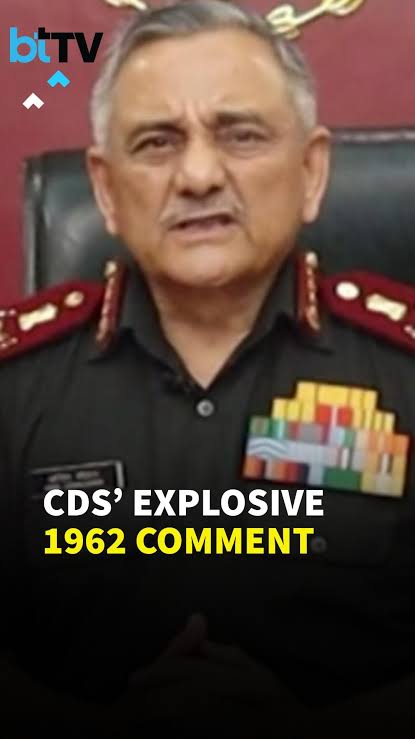
Chief of Defence Staff General Anil Chauhan has said the use of Air Force would have slowed the Chinese offensive considerably during the 1962 Sino-Indian war, and it may have been termed as “escalatory” then, but that is not the case now as seen in Operation Sindoor.
Air Force Use Would Have Slowed Chinese Offensive in 1962 War: What Gen. Chauhan Said, and Why It Matters
In a pointed reflection on India’s military and strategic posture during the Sino-Indian War of 1962, Chief of Defence Staff (CDS) General Anil Chauhan has described the decision not to deploy the Indian Air Force (IAF) then as a “critical missed opportunity.” He stated that using air power could have significantly slowed — if not halted — the Chinese offensive, giving Indian ground forces more time to prepare.
Key Points From Gen. Chauhan’s Remarks
1. Air power as a game-changer
Chauhan argued that the IAF, if employed, would have had advantages: shorter turnaround times, favourable geography, ability to bring substantial payloads against enemy positions.
He suggested that such deployment might have “slowed the Chinese offensive considerably, if not stymied it completely.”
2. “Escalatory” concerns then vs now
The reason for not using air power in 1962, according to Chauhan, was the fear that doing so would be seen as escalation.
He contrasted that with Operation Sindoor (May 2025), where air power was used decisively without triggering undesirable escalation.
3. Critique of the “Forward Policy” and its Uniform Application
Chauhan also questioned the uniform application of India’s Forward Policy in both Ladakh and NEFA (North-East Frontier Agency, now Arunachal Pradesh), arguing these regions had very different terrain, histories, and security/territorial legitimacy conditions.
He said that in Ladakh, China had already occupied large areas, whereas in NEFA, India’s claim was stronger. Treating both regions in the same way was, in his view, a flawed strategic choice.
4. Lt Gen S. P. P. Thorat’s role
Chauhan’s remarks were delivered at the event for the release of the revised autobiography of Lt Gen S. P. P. Thorat, Reveille to Retreat.
Thorat, who was GOC-in-C, Eastern Command, in the run-up to the 1962 war, apparently had considered using the IAF, but was overruled by then-government authorities.
Context: 1962 and Strategic Choices
What was “Forward Policy”: India’s Forward Policy involved positioning troops in forward locations near the border to preempt or deter Chinese intrusion. These forward posts were often lightly supplied, in difficult terrain, and stretched supply lines.
In 1962, the Indian government decided not to use the Indian Air Force overtly in combat against Chinese forces, largely due to diplomatic, political, and perceived escalation risks.
The terrain, logistics, intelligence shortcomings, and command structure challenges further magnified India’s difficulties. Using air power effectively in mountainous terrain with underdeveloped infrastructure is no small task. However, Chauhan’s point is that even limited use might have changed the tempo.
Implications of Gen. Chauhan’s Observations
1. Re-evaluating Historical Decisions
His comments re-open debates around whether certain strategic choices in 1962 were avoidable mistakes. By highlighting that the non-use of air power was more a policy choice than a capability constraint, Chauhan is suggesting that there were missed options.
2. Modern Military Doctrine and Deterrence
Today’s military doctrines are more accepting of limited strikes, air support, cross-border action, etc., when used judiciously. Chauhan’s invoking of Operation Sindoor serves to show that what was once “escalatory” may now be considered acceptable within strategic thresholds.
3. Policy Uniformity vs Tailored Strategy
The notion that a one-size-fits-all policy (such as the Forward Policy) applied uniformly across diverse border regions is flawed is significant. Terrain, history, geography, occupation status matter hugely in border conflicts. This could influence how current and future border policy is formulated.
4. Learning from Lt Gen Thorat’s Warnings
The recognition of Thorat’s assessments and warnings is also important: that even within Indian military leadership there were voices urging more caution, better preparation, better strategy before the war. These historical lessons are being revived in strategic discourse.
What This Means Going Forward
Strategic Preparedness: Military strategy and planning will likely continue to emphasize flexible deployment of air power, including in frontier or mountainous regions, to ensure response time and deterrence capability.
Policy Adjustments: The government may be more open to combining diplomatic, military, and political tools in planning, seeing air power not just as escalation but as a calibrated tool of defence.
Revisionist HisItory / Public Memory: Such statements help shape public understanding of historical conflicts. They prompt re-assessment of what could have been done, and strengthen arguments for increased investment in frontier infrastructure, intelligence, airbases, air logistics, etc.
Operational Signalling: By publicly acknowledging these “missed opportunities,” defence leadership may also be sending signals — to allies, adversaries, and domestic institutions — that India will be more assertive in its defence posture, using its full capabilities.
Counterpoints / Challenges to the Argument
Risks of Escalation: In 1962, the strategic environment, diplomatic balance, and risk calculations were different. Using air power might have provoked an even larger response, or expanded the war, with uncertain outcomes.
Logistical & Technological Constraints: Air operations in mountainous terrain require very good reconnaissance, logistics, and suitable aircraft. India’s infrastructure, readiness, and intelligence in 1962 may not have been sufficient to support widespread air operations.
Political Will: The decision wasn’t only military, but political. The government’s risk aversion, chain of command, international pressures mattered a lot.
Conclusion
Gen. Chauhan’s recent remarks are more than historical commentary; they serve as a reflection on how strategy, policy, and capability must interact in modern defence thinking. By pointing out what was arguably a missed tactical / strategic opportunity in 1962 — namely, the non-use of air power — he underscores the need for flexibility, realism, and readiness in defence policy.
Yuvamorcha.com , Creditmoneyfinance.com, Startupindia.club, Economiclawpractice.com





Thank you for your sharing. I am worried that I lack creative ideas. It is your article that makes me full of hope. Thank you. But, I have a question, can you help me?