




Sharing is caring!
J
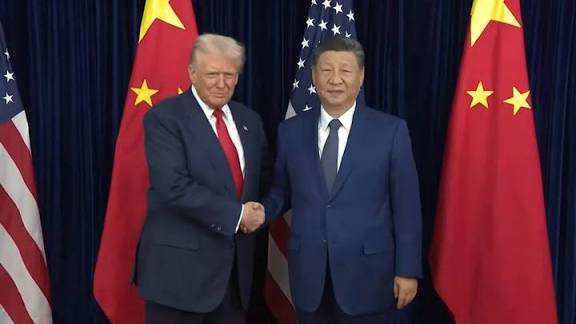
Sorry, Mr. President — But Xi Runs the World Now
As global power dynamics shift, the contest between the U.S. and China has evolved far beyond trade wars and tariffs. While former U.S. President Donald Trump celebrates visible, short-term “wins” — such as tariffs, reshoring supply chains, and manufacturing incentives — Chinese President Xi Jinping plays a longer, quieter, and far more strategic game.
1. Endurance Over Optics
Trump’s trade bravado centers on immediate results. In contrast, Xi’s strategy is rooted in endurance — building parallel systems that reduce China’s dependence on the U.S. while making other economies increasingly reliant on Beijing.
2. The Rise of De-Dollarization
Through BRICS, yuan-based trade settlements, and bilateral energy deals, China is gradually eroding the dollar’s global dominance. The U.S. sanctions playbook — once a powerful deterrent — now drives nations to seek financial insulation from Washington.
3. Manufacturing Power Remains in Asia
Despite Washington’s “Make America Build Again” push, global production still gravitates toward East and Southeast Asia. Even U.S. companies depend heavily on China’s industrial ecosystem — a testament to Beijing’s deep-rooted manufacturing leverage.
4. The Tech Shift Eastward
While the U.S. restricts chip and AI exports, China doubles down on domestic innovation — investing billions in semiconductors, quantum computing, and technological self-sufficiency. Xi’s long-term vision aims to secure strategic autonomy in the world’s most crucial sectors.
5. The Global South Leans Toward Beijing
China’s Belt and Road Initiative (BRI) and BRICS expansion continue to attract nations wary of Western conditionalities. Across Africa, Latin America, and the Middle East, Beijing’s influence now extends beyond finance — shaping political and developmental agendas.
6. U.S. Isolationism Creates a Vacuum
America’s “America First” stance fosters global vacuums in multilateral leadership. Xi Jinping fills these spaces with institutional persistence and predictability. From climate diplomacy to trade frameworks, China projects continuity where Washington projects uncertainty.
7. Strategic Patience vs. Political Cycles
Xi operates without the constraints of election cycles or populist pressures, enabling decades-long planning. In contrast, U.S. policy is often dictated by short-term optics — a structural weakness Beijing has learned to exploit effectively.
8. Geopolitical Chess, Not Checkers
While Washington views global competition as zero-sum, Beijing treats it as systems redesign — reshaping norms in finance, AI governance, and infrastructure standards. By setting the rules in emerging technologies, Xi positions China as an indispensable player in the global order.
9. Soft Power Through Stability
Amid U.S. polarization, China markets its model as stable, predictable, and results-driven. Xi’s narrative of “efficient governance” resonates with developing nations that view China’s control mechanisms as a source of security in an unstable world.
10. The Uneasy Truth
Trump may dominate headlines and rallies, but Xi dominates the architecture of global power — the supply chains, financial networks, and diplomatic loyalties that define lasting influence.
The optics of power may still lie in Washington. But the blueprint of power — the architecture of victory — now lies in Beijing.
Author’s Note:
In the evolving 21st-century world order, power is no longer measured by military might alone. It’s defined by who sets the rules, who controls production, and who writes the future of finance and technology. On all three fronts, Xi’s China is already a step ahead.
Team: Yuvamorcha.com
www.StartupStreets.com, www.GrowMoreLoans.com, www.GrowMoreFranchisees.com, www.intellexCFO.com, www.CreditMoneyFinance.com, www.StartupIndia.Club, www.EconomicLawsPractice.com




I don’t think the title of your article matches the content lol. Just kidding, mainly because I had some doubts after reading the article.