


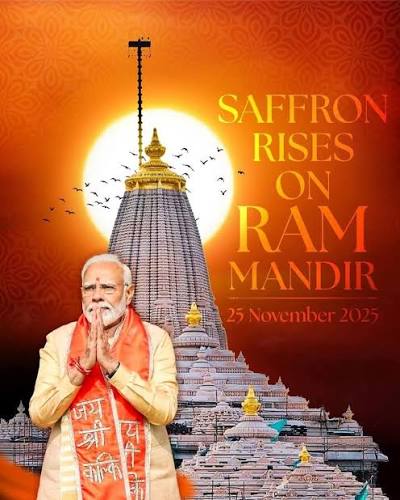


Ayodhya’s Civilisational Reawakening: The Rise of India’s Eternal Cultural Capital
Ayodhya: The Eternal Civilisational Pulse of India Reawakens
A 2000-word magazine feature on the rise of India’s civilisational capital
“Today is history breathing. Ayodhya rises not as a monument of stone, but as a testament to India’s unbroken civilisational soul.”
I. A New Dawn Over an Ancient City
Ayodhya has risen again.
But this is not the rise of a city alone, it is the reawakening of a civilisation.
For centuries, the sacred birthplace of Maryada Purushottam Shri Ram has lived in the hearts, prayers, and memories of millions. Today, as Ayodhya reclaims its place as India’s civilisational capital, it signals a profound transformation in the nation’s cultural psyche.
This moment is not merely architectural or political; it is deeply civilisational, carrying with it the weight of 500 years of struggle, resilience, and faith.
II. Five Centuries of Trials: Empires, Battles, and Unbroken Devotion
“Empires came and went. Faith did not.”
Since 1528, the Indian subcontinent has witnessed the rise and fall of empires, the Mughals, Portuguese, Dutch, French, Afghans, Persians, and finally, the British. Each carried its own worldview, its own methods, and its own ambitions.
Yet something remarkable happened.
Despite invasions, forced conversions, cultural distortions, and ideological battles, the essence of Indian civilisation remained intact. While other ancient civilisations perished or transformed beyond recognition, India’s spiritual DNA, its Sanatan ethos continued uninterrupted.
Why India Endured When Others Fell
Other civilisations fell to:
aggressive cultural assimilation
ideological replacement
religious conquest
colonial erasure
But India did not.
Because India was and is not merely a geopolitical entity.
It is a civilisation anchored in dharma, philosophy, community, and memory.
III. Ayodhya: More Than a Place, A Civilisational Ideal
Ayodhya is geography, yes but far more importantly, it is an idea.
Why the World Reveres Shri Ram
Shri Ram is not celebrated as a warrior or conqueror.
He is revered because he represents the highest human values:
Integrity
Compassion
Sacrifice
Duty (Dharma)
Humility
Justice
Leadership
In countless homes across India, the Ramayana is not just read it is lived.
This makes Ayodhya not just a site of pilgrimage, but a repository of moral and cultural identity.
IV. The Struggle Across Generations: A Civilisational Saga
“Structures were destroyed. Civilisation was not.”
The journey toward Ayodhya’s resurgence spans centuries and involves:
invasions
temple destruction
plunder
colonial-era distortions
legal battles
political upheavals
social movements
generational sacrifices
1. Medieval Upheaval
The original temple at Ayodhya was replaced in 1528. But despite political suppression, the memory of Ram Janmabhoomi survived through:
folk songs
poetry
festivals
oral tradition
pilgrimages
the undying devotion of ordinary Indians
2. The Colonial Agenda
The British did not rebuild temples, but they attempted something more insidious:
rewriting India’s civilisational narrative.
Yet even the might of the British Empire could not erase:
Ramlila performances
recitations of Tulsidas
sacred traditions and rituals
India’s cultural memory
3. The Post-Independence Era
For decades after 1947, India’s political and intellectual establishment adopted frameworks inherited from colonial rulers. The Ram Mandir movement simmered, slowly and steadily powered by the emotional and civilisational conviction of millions.
4. A Democratic Victory
The Ayodhya issue was fought not with swords, but with:
legal arguments
archaeological evidence
democratic mobilization
constitutional processes
The 2019 Supreme Court verdict marked a turning point historic, peaceful, constitutional.
And the path to rebuilding began.
V. Ayodhya Today: A Symbol of Civilisational Confidence
“Ayodhya rises as India rises, rooted in memory, moving with confidence.”
Ayodhya’s transformation is staggering, yet deeply spiritual. It is:
a cultural renaissance
an economic catalyst
a spiritual milestone
a symbol of national unity
a tribute to civilisational endurance
What Ayodhya Represents Today
Reclaimed Identity reconnecting India with its spiritual roots
Restored Dignity correcting a historical dislocation
Renewed Cultural Confidence embracing heritage proudly
Global Recognition positioning India as a cultural superpower
The city is witnessing massive development, including:
new museums
heritage centers
improved connectivity
modern infrastructure
global religious tourism projects
But at its heart, Ayodhya remains spiritual, serene, and timeless.
VI. Sanatan Dharma: The Thread That Never Breaks
“Sanatan survives because it evolves without losing essence.”
Sanatan Dharma is not a religion in the Western sense; it is a civilisational ecosystem.
Why Sanatan Endures
Because it is:
inclusive
adaptive
philosophical
experiential
timeless
It does not enforce dogma. It encourages exploration.
It does not break under pressure. It bends, adapts, renews.
Ayodhya’s restoration symbolizes the renewal of Sanatan consciousness not just for Hindus, but for all who identify with India’s civilisational heritage.
VII. Ayodhya and the Future of Indian Civilisation
India stands today at a unique crossroads modern, confident, self-aware, and deeply rooted in civilisational memory.
1. A Global Civilisational Model
Modernity elsewhere often means severing roots.
In India, Ayodhya proves modernity can coexist with timeless tradition.
2. Cultural Education for Future Generations
Ayodhya’s revival opens new doors for:
classical arts
Vedic learning
Sanskrit revival
temple architecture
oral storytelling traditions
historical literacy
3. Economic Revival and Tourism
Ayodhya is expected to become one of the world’s largest spiritual tourism centers, bringing:
jobs
investment
infrastructure
global attention
4. Healing and Unity
The temple is a symbol not of division, but of civilisational healing.
It encourages India to move forward
not with anger, but with remembrance.
Not with triumphalism, but with cultural pride.
VIII. Why Ayodhya Matters, A Civilisational Perspective
Ayodhya is not just a historic correction.
It is a civilisational awakening.
It represents the triumph of:
truth over tyranny
memory over erasure
identity over distortion
resilience over oppression
“Ayodhya teaches us that civilisations do not die when attacked they die when they forget.”
India has remembered.
IX. Conclusion: The Rise of Ayodhya, The Rise of Bharat
Ayodhya’s resurgence is more than the building of a temple it is the rebuilding of civilisational confidence.
India stands among the rare civilisations that:
remember their ancient past
live their traditions
preserve their spiritual foundations
continue their cultural lineages across millennia
As Ayodhya rises, so does Bharat eternal, resilient, and ever-renewing.
India is witnessing not the construction of a structure, but the rebirth of a sentiment, a memory, a timeless civilisational heartbeat.
Today, Ayodhya breathes.
And through it, India’s civilisation breathes anew.
Sudheendra Kumar





Your point of view caught my eye and was very interesting. Thanks. I have a question for you.