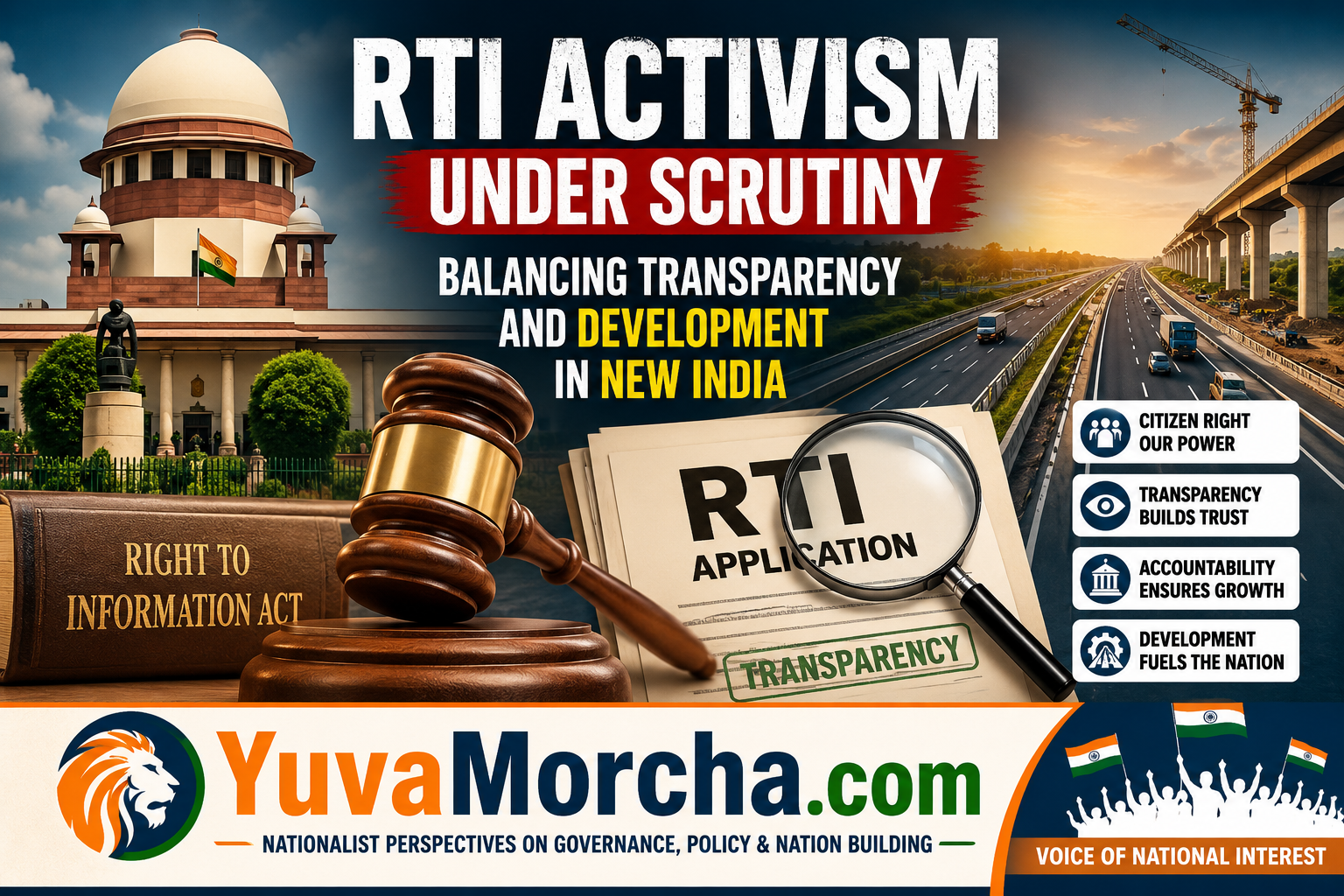


Supreme Court’s Sharp Remarks on RTI Activism: Protecting Transparency or Preventing Misuse? A National Perspective on Accountability and Governance.
The Supreme Court’s recent observations on RTI activism have sparked a nationwide debate on transparency, accountability, and the misuse of the Right to Information Act. Explore the implications for governance, infrastructure development, and citizen participation in India.
Supreme Court’s Sharp Remarks on RTI Activism: Protecting Transparency or Preventing Misuse? A National Perspective on Accountability and Governance.
India’s Right to Information (RTI) Act, enacted in 2005, is widely regarded as one of the most powerful democratic tools available to citizens. It has enabled millions of Indians to seek information from public authorities, expose corruption, improve service delivery, and hold governments accountable.
However, a recent observation by the Supreme Court has reignited an important national debate regarding the role, scope, and limitations of RTI activism in modern India.
While hearing a case involving an RTI activist and his associate, the Supreme Court reportedly remarked that “RTI activism has become a new business” and questioned whether self-appointed activists have the authority to monitor infrastructure projects being executed by government agencies. The Court subsequently refused anticipatory bail to the accused individuals.
The remarks have generated widespread discussion among legal experts, policymakers, civil society organizations, and ordinary citizens. At the heart of the debate lies a critical question:
How can India preserve transparency and accountability while preventing the misuse of public-interest mechanisms?
Understanding the RTI Act: A Pillar of Indian Democracy
The RTI Act was introduced to empower citizens by granting them access to information held by public authorities.
The objectives were clear:
- Promote transparency in governance
- Reduce corruption
- Increase accountability
- Strengthen democratic participation
- Improve public service delivery
Over the last two decades, RTI applications have exposed numerous irregularities in government departments, public sector undertakings, municipal administrations, and local governance institutions.
Many genuine RTI activists have played a significant role in uncovering corruption and safeguarding public resources.
The Supreme Court’s Concerns
The recent observations by the Supreme Court highlight concerns that have been growing within administrative and legal circles for several years.
These concerns include:
1. Commercialization of Activism
Authorities have often alleged that some individuals use RTI applications not for public interest but as tools for:
- Personal gain
- Extortion
- Harassment of officials
- Creating unnecessary obstacles in project execution
The Court’s remark suggesting that RTI activism has become a “business” reflects concerns about such alleged misuse.
2. Interference in Development Projects
India is currently undertaking massive infrastructure development initiatives including:
- Expressways
- Highways
- Railway corridors
- Airports
- Industrial parks
- Urban redevelopment projects
Government agencies argue that excessive interference by individuals lacking technical expertise can sometimes delay important national projects.
The Court’s questioning of activists monitoring road construction projects appears connected to this broader concern.
3. Balancing Rights and Responsibilities
While citizens possess the right to seek information, the judiciary appears to be emphasizing that accountability mechanisms must operate within legal and institutional frameworks.
The debate is no longer simply about access to information but about responsible use of that information.
Why Transparency Remains Essential
Despite concerns regarding misuse, transparency remains fundamental to democratic governance.
India’s development journey cannot be separated from public accountability.
Citizens have a legitimate interest in knowing:
- How public funds are spent
- Whether projects meet quality standards
- If contracts are awarded fairly
- Whether environmental norms are followed
- Whether taxpayer money is being utilized efficiently
Strong oversight often leads to:
Better Project Outcomes
Projects subjected to scrutiny generally demonstrate:
- Improved compliance
- Better quality control
- Reduced leakages
- Higher efficiency
Reduced Corruption
Transparency discourages corrupt practices and creates a culture of accountability.
Increased Public Trust
When governments proactively disclose information, public confidence in institutions increases significantly.
The National Development Imperative
India is currently pursuing one of the most ambitious infrastructure expansion programs in its history.
Major initiatives include:
- Bharatmala Project
- Dedicated Freight Corridors
- Smart Cities Mission
- PM Gati Shakti
- High-speed transportation corridors
- Urban infrastructure modernization
These projects are vital for:
- Economic growth
- Employment generation
- Global competitiveness
- National security
- Regional development
From a nationalist perspective, efficient execution of these projects is essential to realizing India’s vision of becoming a developed nation.
However, rapid development must also maintain transparency and accountability.
The challenge is finding the correct balance.
The Difference Between Constructive Oversight and Obstruction
A mature democracy distinguishes between legitimate oversight and obstructionist behavior.
Constructive Oversight
Constructive citizen engagement includes:
- Seeking factual information
- Reporting genuine irregularities
- Supporting accountability
- Encouraging compliance with regulations
Obstructionist Practices
Problematic conduct may include:
- Filing repetitive complaints without evidence
- Targeting officials for personal reasons
- Using RTI mechanisms for coercion
- Deliberately delaying projects of public importance
A strong democracy must encourage the former while discouraging the latter.
Lessons for Policymakers
The controversy presents an opportunity for policy reform.
Potential measures could include:
Strengthening Proactive Disclosure
Government departments should publish more information online, reducing the need for repetitive RTI applications.
Digital Transparency Platforms
Infrastructure projects can be monitored through publicly accessible dashboards displaying:
- Project progress
- Expenditure details
- Completion timelines
- Contractor information
Protection for Genuine Whistleblowers
While preventing misuse, India must continue protecting citizens who expose corruption and wrongdoing.
Faster Disposal of Frivolous Complaints
Mechanisms can be developed to identify and address complaints that lack merit while ensuring legitimate concerns receive prompt attention.
The Role of Responsible Citizenship
Nation-building requires active participation from citizens.
However, participation should be:
- Fact-based
- Responsible
- Constructive
- Solution-oriented
Citizens should remain vigilant regarding public expenditure and governance while recognizing the importance of timely execution of projects that benefit the nation.
Transparency and development are not opposing goals. They are complementary pillars of good governance.
What This Means for India’s Future
The Supreme Court’s remarks have opened an important discussion that extends beyond one particular case.
The larger issue concerns the future relationship between:
- Citizen activism
- Government accountability
- Infrastructure development
- Judicial oversight
- National progress
India’s democratic framework must continue to empower citizens while ensuring that public-interest laws are not misused for personal agendas.
As India moves toward becoming a global economic powerhouse, governance systems must evolve to ensure both transparency and efficiency.
The success of India’s development story will depend not merely on building roads, bridges, and industrial corridors, but also on maintaining public trust through accountable governance.
Conclusion
The Supreme Court’s observations regarding RTI activism underscore the need for a balanced approach to transparency and development. While the Right to Information remains one of India’s most significant democratic achievements, concerns about its misuse cannot be ignored.
For a rising India focused on infrastructure growth, economic expansion, and national development, the path forward lies in strengthening accountability while preventing abuse of public-interest mechanisms.
A strong nation requires both efficient governance and informed citizens. The objective should not be to weaken transparency but to ensure that transparency serves the national interest, promotes good governance, and contributes to India’s long-term progress.
Published by YuvaMorcha.com
Nationalist Perspectives on Governance, Development, Policy, and Nation Building 🇮🇳
More Featured Articles:
The Ultimate Guide to Collateral-Free Business Finance: Scaling Beyond Physical Assets.
SIDBI – Powering India’s MSME Growth: Funding, Schemes & Business Support.
SME IPO in India 2025: Complete Guide for Investors & Growing Businesses
CFO Services for Startups: Why Virtual CFOs are Becoming a Game-Changer in India
Top 10 Angel Investment Networks in India (2026): The Ultimate Founder’s Guide to Fundraising.