

India’s Biggest Indigenous Naval Expansion: Indian Navy to Induct Five Made-in-India Warships in a Historic Month for Maritime Power.
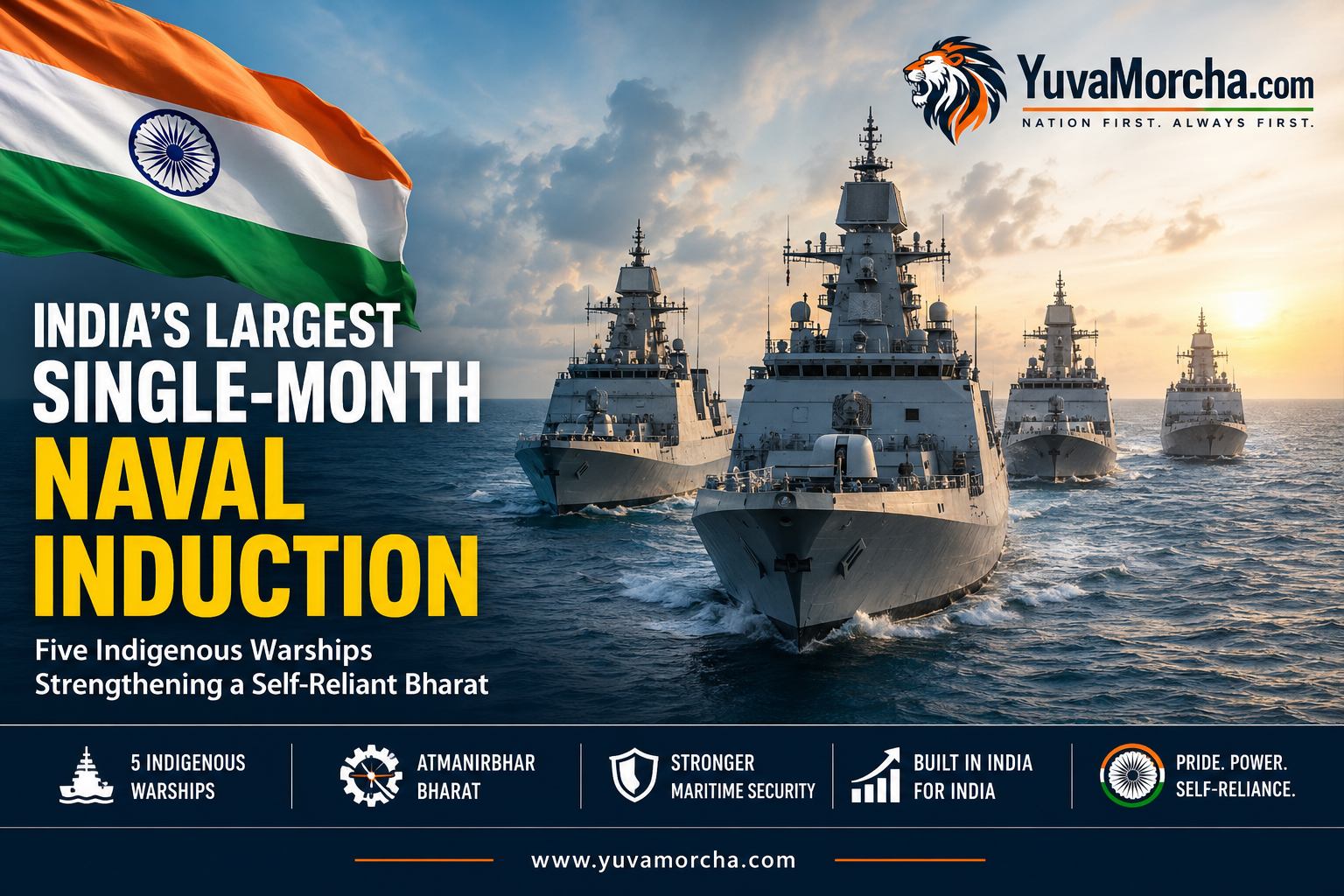
India is set to witness its largest single-month naval induction with five indigenous warships joining the Indian Navy. Explore how this milestone strengthens Atmanirbhar Bharat, boosts maritime security, and positions India as a major naval power in the Indo-Pacific.
A Landmark Moment in India’s Naval History
India is poised to achieve a major milestone in its journey toward becoming a leading maritime power as the Indian Navy prepares to induct five indigenous naval platforms in a single month. This unprecedented development marks the largest single-month induction of domestically built naval assets in the nation’s history and reflects the remarkable success of India’s defence manufacturing ecosystem.
The induction is not merely a ceremonial event; it symbolizes the emergence of a self-reliant India capable of designing, developing, and producing advanced military platforms that meet global standards. It also demonstrates the country’s growing determination to safeguard its strategic interests in the Indian Ocean Region and the broader Indo-Pacific.
As geopolitical competition intensifies across maritime domains, India’s naval modernization has become a critical pillar of national security. The addition of five indigenous warships significantly strengthens the Navy’s operational capabilities while reinforcing the vision of Atmanirbhar Bharat.
The Rise of Indigenous Naval Manufacturing
For decades, India depended heavily on foreign suppliers for sophisticated naval platforms and critical defence technologies. However, sustained investment in domestic shipbuilding infrastructure, research capabilities, and strategic planning has transformed the landscape.
Today, Indian shipyards are producing world-class naval vessels equipped with advanced combat systems, modern sensors, missile capabilities, and integrated electronic warfare suites.
Government initiatives such as:
- Make in India
- Atmanirbhar Bharat
- Defence Production and Export Promotion Policy
- Positive Indigenization Lists
have accelerated indigenous defence production and reduced reliance on imports.
The upcoming induction of five naval platforms serves as a testament to these policy successes.
Why This Induction Is Historically Significant
The induction of five naval assets within a single month is significant for several reasons:
1. Demonstrates Self-Reliance
The vessels have been designed and built primarily by Indian shipyards and supported by domestic defence industries.
2. Strengthens Maritime Deterrence
A stronger Navy ensures India can effectively secure its maritime borders, trade routes, and strategic interests.
3. Enhances Force Readiness
The addition of multiple platforms simultaneously improves operational flexibility and combat preparedness.
4. Supports Economic Growth
Indigenous shipbuilding creates thousands of skilled jobs and strengthens India’s industrial base.
5. Boosts Defence Exports
Success in domestic production enhances India’s credibility as a defence exporter in global markets.
India’s Maritime Challenges Demand a Strong Navy
India’s strategic location places it at the center of some of the world’s most important sea lanes.
Nearly:
- 95% of India’s trade by volume
- More than 70% of trade by value
moves through maritime routes.
Any disruption to these sea lanes can have severe economic and security consequences.
Additionally, India faces growing challenges including:
Expanding Chinese Presence
China’s increasing naval deployments in the Indian Ocean have raised strategic concerns across the region.
Protection of Energy Routes
India relies heavily on energy imports transported through critical maritime chokepoints.
Maritime Terrorism
The threat of terrorism originating from sea-based routes remains a significant concern.
Regional Stability
India has assumed a larger role in maintaining stability and security across the Indian Ocean Region.
The induction of new warships directly enhances India’s ability to respond to these challenges.
Strengthening India’s Position in the Indo-Pacific
The Indo-Pacific has emerged as the world’s most strategically important maritime theater.
Major powers including:
- United States
- India
- Japan
- Australia
- China
are increasingly focused on ensuring freedom of navigation and maintaining regional stability.
India’s growing naval capabilities allow it to:
- Conduct extended maritime patrols
- Support friendly nations
- Participate in multinational exercises
- Protect sea lines of communication
- Provide humanitarian assistance and disaster relief
The induction of indigenous warships strengthens India’s role as a net security provider in the region.
The Strategic Value of Indigenous Warships
Indigenous warships offer several advantages over imported platforms.
Greater Operational Independence
India can maintain, upgrade, and modify domestically built vessels without dependence on foreign suppliers.
Cost Efficiency
Domestic production reduces long-term acquisition and maintenance costs.
Technology Development
Local shipbuilding fosters innovation and enhances technological expertise.
Supply Chain Security
Indigenous manufacturing minimizes vulnerability to geopolitical disruptions.
Rapid Modernization
Future upgrades can be implemented more efficiently when design knowledge remains within the country.
A Major Boost for Atmanirbhar Bharat
The upcoming naval induction aligns perfectly with Prime Minister Narendra Modi’s vision of Atmanirbhar Bharat.
India’s defence sector has undergone substantial reforms, including:
- Increased private sector participation
- Foreign investment incentives
- Defence innovation initiatives
- Export promotion measures
- Indigenous procurement mandates
The naval sector has emerged as one of the most successful examples of this transformation.
Indian shipyards are now capable of producing:
- Aircraft carriers
- Destroyers
- Frigates
- Corvettes
- Patrol vessels
- Submarines
- Auxiliary support ships
This capability places India among a select group of nations with advanced naval shipbuilding expertise.
Economic Impact Beyond Defence
The benefits of indigenous naval construction extend beyond military preparedness.
The shipbuilding ecosystem generates opportunities for:
Manufacturing
Thousands of domestic companies contribute components, electronics, steel, propulsion systems, and software.
Employment
Large-scale shipbuilding projects create direct and indirect employment opportunities.
Research and Development
Collaboration among defence laboratories, academic institutions, and industry drives innovation.
Export Potential
India’s growing reputation in defence manufacturing creates new export opportunities.
The defence sector increasingly serves as an engine of economic growth and technological advancement.
Building a Future-Ready Navy
The Indian Navy is pursuing a long-term vision of becoming a technologically advanced and network-centric force.
Future priorities include:
- Artificial intelligence integration
- Unmanned maritime systems
- Advanced missile technologies
- Cyber warfare capabilities
- Enhanced surveillance networks
- Indigenous aircraft carrier programs
- Next-generation submarines
The induction of five indigenous warships is another important step toward realizing this vision.
National Pride and Strategic Confidence
Beyond military considerations, the induction carries immense symbolic value.
It demonstrates that India possesses the technological expertise, industrial capacity, and strategic vision necessary to protect its national interests independently.
Every indigenous warship entering service reflects the dedication of:
- Indian engineers
- Naval architects
- Defence scientists
- Shipyard workers
- Armed forces personnel
Their collective efforts are transforming India into a major maritime power capable of shaping regional security dynamics.
Conclusion
The Indian Navy’s largest-ever single-month induction of five indigenous naval platforms marks a defining moment in India’s defence modernization journey. It showcases the success of Atmanirbhar Bharat, strengthens maritime security, boosts economic development, and enhances India’s stature as a leading power in the Indo-Pacific.
As India’s strategic responsibilities continue to expand, a stronger and more technologically advanced Navy will remain essential for safeguarding national interests. The induction of these warships is more than a military achievement—it is a powerful symbol of a confident, self-reliant, and rising Bharat prepared to secure its future on the world’s oceans.
For millions of Indians, this historic milestone serves as yet another reminder that India’s emergence as a global maritime power is no longer a distant aspiration—it is becoming a reality. 🇮🇳⚓
Published by: YuvaMorcha.com
Category: Defence | National Security | Strategic Affairs | Maritime Power | Atmanirbhar Bharat
More Featured Articles:
Putin’s Praise for Indian Coders Signals India’s Rise as a Global Technology Superpower
UAE’s $3.5 Billion Demand from Pakistan: Geopolitical Shockwaves and the Emerging India Factor.
The Ultimate Guide to Collateral-Free Business Finance: Scaling Beyond Physical Assets.
SIDBI – Powering India’s MSME Growth: Funding, Schemes & Business Support.
SME IPO in India 2025: Complete Guide for Investors & Growing Businesses
Summary of Borivali East (Mumbai) Real Estate project on Joint Venture basis:
Top 10 Angel Investment Networks in India (2026): The Ultimate Founder’s Guide to Fundraising.