


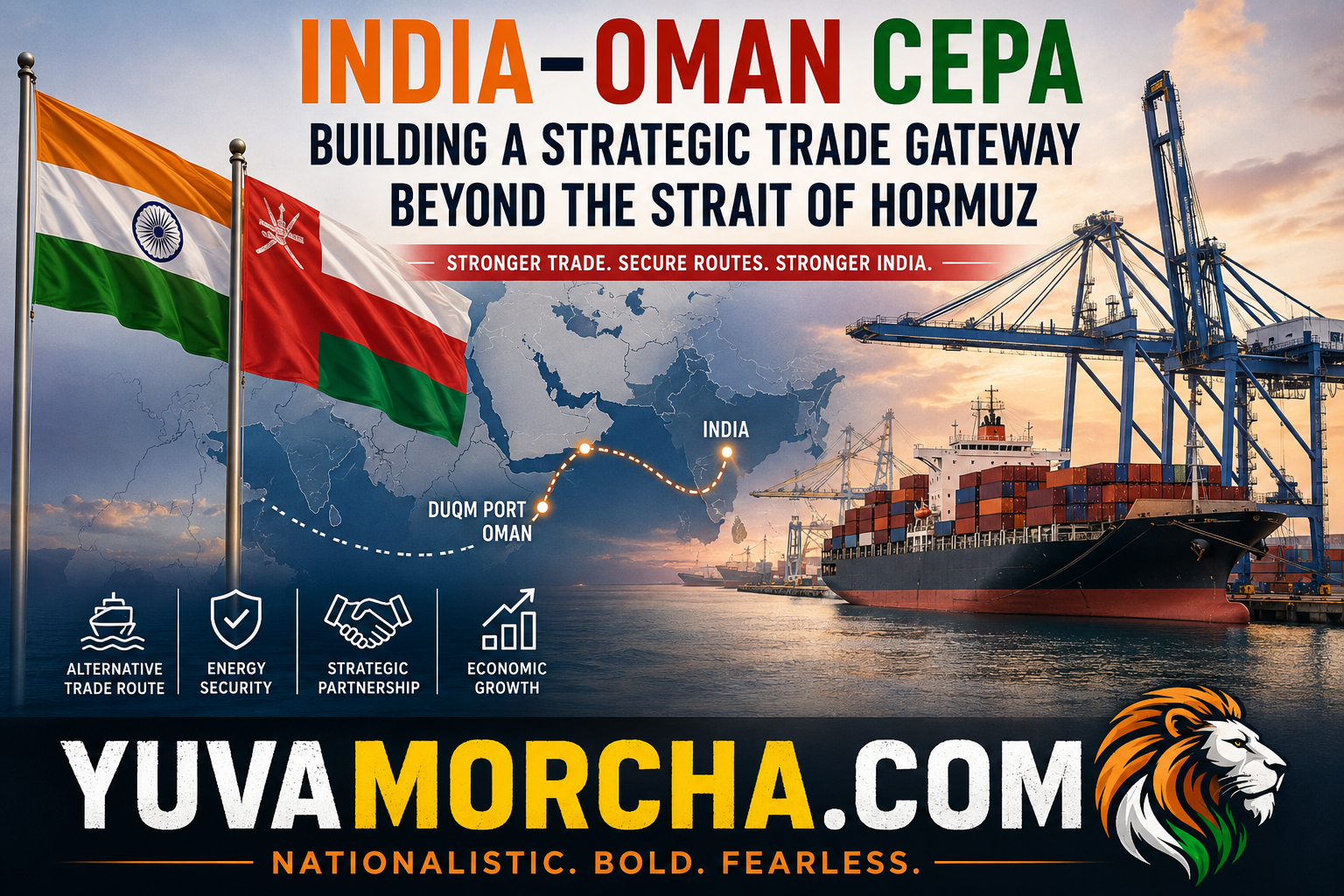


India -Oman CEPA: How New Delhi Is Building a Strategic Trade Gateway Beyond the Strait of Hormuz and Reshaping Gulf Connectivity.
India’s Comprehensive Economic Partnership Agreement (CEPA) with Oman marks a major strategic shift in Gulf trade. Discover how the pact strengthens India’s economic security, expands exports, reduces dependence on the Strait of Hormuz, and enhances New Delhi’s influence in West Asia.
India-Oman CEPA: How New Delhi Is Building a Strategic Trade Gateway Beyond the Strait of Hormuz and Reshaping Gulf Connectivity
Introduction
At a time when geopolitical tensions in West Asia continue to threaten global trade routes, India has moved decisively to safeguard its economic interests through deeper engagement with Oman. The India–Oman Comprehensive Economic Partnership Agreement (CEPA) represents far more than a conventional trade deal. It is a strategic economic and geopolitical initiative designed to strengthen India’s access to the Gulf region while reducing vulnerabilities arising from disruptions in the Strait of Hormuz.
As regional conflicts, maritime security concerns, and global supply chain uncertainties reshape international commerce, India is pursuing a long-term vision that combines economic growth, energy security, maritime influence, and strategic diplomacy.
The India–Oman CEPA could emerge as one of the most significant trade agreements for India in the coming decade, reinforcing New Delhi’s position as a leading economic power in the Indo-Pacific and West Asian regions.
Understanding the Importance of Oman for India


Oman occupies a unique geographical position on the southeastern coast of the Arabian Peninsula.
Unlike several Gulf countries whose maritime access is heavily dependent on the Strait of Hormuz, Oman possesses extensive coastline directly connected to the Arabian Sea and the Indian Ocean. This geographical advantage makes Oman a critical partner for India.
Key advantages include:
- Direct access to major shipping routes.
- Strategic location linking Asia, Africa, and Europe.
- Reduced exposure to geopolitical disruptions in the Persian Gulf.
- Growing logistics and industrial infrastructure.
- Strong historical ties with India dating back centuries.
For India, Oman serves as a natural maritime partner capable of supporting long-term trade and connectivity ambitions.
Why the Strait of Hormuz Matters
The Strait of Hormuz remains one of the world’s most important maritime chokepoints.


Approximately one-fifth of global petroleum shipments pass through this narrow waterway.
Any conflict involving regional powers can lead to:
- Increased freight costs.
- Delayed shipments.
- Higher energy prices.
- Supply chain disruptions.
- Insurance premium spikes for shipping companies.
For India, which imports a substantial portion of its energy requirements from the Gulf region, prolonged disruptions in Hormuz can significantly affect economic stability.
This reality has accelerated New Delhi’s efforts to diversify trade routes and strengthen partnerships with countries capable of offering alternative logistics pathways.
India–Oman CEPA: More Than a Trade Agreement
The proposed CEPA goes beyond tariff reductions.
The agreement is expected to cover:
Trade Liberalisation
Reduced duties on thousands of product categories, improving market access for Indian exporters.
Investment Promotion
Encouraging bilateral investments in:
- Manufacturing
- Renewable energy
- Infrastructure
- Logistics
- Technology sectors
Services Sector Expansion
Indian companies in:
- Information Technology
- Financial Services
- Healthcare
- Education
could gain greater access to Omani markets.
Supply Chain Integration
The agreement aims to integrate Indian and Omani industrial ecosystems, creating efficient regional value chains.
Strategic Importance of Duqm Port
One of the most critical aspects of India–Oman cooperation is the development of the Port of Duqm.
Port of Duqm has emerged as a major strategic asset for India.
Benefits include:
Alternative Maritime Access
Duqm lies outside the Strait of Hormuz, providing uninterrupted access to international waters.
Logistics Hub
The port is developing into a major logistics and industrial centre connecting:
- India
- Africa
- Middle East
- Europe
Strategic Cooperation
India has secured access arrangements that can support commercial and maritime operations.
Energy Security
The port could facilitate storage and transportation of strategic energy resources.
For India, Duqm represents an important pillar of future maritime security architecture.
Economic Opportunities for Indian Businesses
The CEPA could unlock substantial opportunities across multiple sectors.
Engineering Goods
India’s engineering exports can gain easier entry into Gulf markets.
Pharmaceuticals
Indian pharmaceutical companies are likely to benefit from streamlined regulations and reduced barriers.
Food Processing
Growing Gulf demand for food products presents significant opportunities for Indian exporters.
Textiles
Indian textile manufacturers can strengthen their regional presence.
Renewable Energy
India and Oman can collaborate in:
- Green hydrogen
- Solar energy
- Sustainable industrial projects
Strengthening India’s West Asia Strategy
The agreement aligns with India’s broader West Asia policy.
New Delhi has successfully cultivated strong relations with:
- United Arab Emirates
- Saudi Arabia
- Oman
- Qatar
- Bahrain
This approach focuses on:
- Economic diplomacy
- Energy partnerships
- Counter-terror cooperation
- Maritime security
- Infrastructure development
The Oman CEPA strengthens India’s role as a trusted and reliable partner across the Gulf region.
A National Interest Perspective
From a national security standpoint, the agreement delivers several strategic benefits.
Reduced Trade Vulnerability
Alternative logistics routes improve resilience against regional conflicts.
Energy Security
Diversified transport options strengthen India’s energy supply chains.
Maritime Influence
Expanded presence in key ports enhances India’s role in the Indian Ocean Region.
Economic Growth
Increased exports and investments support domestic employment and industrial expansion.
Strategic Autonomy
India gains greater flexibility in navigating complex geopolitical challenges.
These advantages align with India’s long-term objective of becoming a leading global economic and maritime power.
Challenges Ahead
While the opportunities are significant, several challenges remain.
Regional Instability
West Asia remains vulnerable to geopolitical tensions.
Global Economic Uncertainty
Slowing growth in major economies can affect trade volumes.
Competition
Other countries are also seeking deeper engagement with Gulf markets.
Implementation
Successful execution of CEPA provisions will determine the agreement’s ultimate impact.
India and Oman will need strong institutional cooperation to realise the full benefits of the partnership.
The Road Ahead
The India–Oman CEPA reflects a broader transformation in India’s foreign and economic policy.
Rather than merely reacting to geopolitical developments, India is proactively creating alternative trade corridors, securing strategic partnerships, and building resilient supply chains.
As global commerce becomes increasingly influenced by security considerations, partnerships such as the India–Oman CEPA will become essential pillars of national economic strategy.
For India, the agreement is not just about boosting trade volumes. It is about securing maritime access, strengthening energy resilience, expanding regional influence, and ensuring that the nation’s economic growth remains protected from external disruptions.
The emerging India–Oman partnership demonstrates how strategic diplomacy and economic vision can work together to advance national interests while contributing to regional stability and prosperity.
Conclusion
The India–Oman CEPA represents a landmark opportunity for India to deepen its presence in West Asia while reducing dependence on vulnerable maritime chokepoints such as the Strait of Hormuz. By leveraging Oman’s strategic location, world-class port infrastructure, and longstanding friendship with India, New Delhi is laying the foundation for a more secure, resilient, and globally connected future.
In an era of uncertainty, this agreement highlights India’s growing confidence as a nation capable of shaping regional economic architecture and safeguarding its long-term strategic interests.
YuvaMorcha.com
More Featured Articles:
The Ultimate Guide to Collateral-Free Business Finance: Scaling Beyond Physical Assets.
India’s Rise as a Global Superpower: How Narendra Modi’s Leadership Is Shaping the 21st Century.
IIT Bombay Launches First-of-Its-Kind ₹250 Crore Deep-Tech VC Fund to Empower Early-Stage Startups
CFO Services for Startups: Why Virtual CFOs are Becoming a Game-Changer in India
Singapore has introduced a new tax on sale of foreign capital assets with effect from 1st Jan, 2024
India-UAE Strategic Defense Pact: A New Geopolitical Axis Redefining West Asia.
Top 10 Angel Investment Networks in India (2026): The Ultimate Founder’s Guide to Fundraising.


Performance-wise this platform is solid — loads fast even on mobile, responsive design works great accross all devices, clean UI without bloated animations, and teh login system is smooth. Definitely one of teh better optimised sites ive used. [url=https://9winz-online-casino.com/]9winz login[/url]