

Great Nicobar, Vietnam and the Indo-Pacific Power Shift: Why India Must Stand Firm Against Chinese Expansionism.
India’s Great Nicobar project is emerging as a strategic counter to China’s expansionism in the Indo-Pacific. Discover how India and Vietnam are strengthening maritime security, defending sovereignty, and reshaping Asian geopolitics against Beijing’s growing influence.
The recent DW analysis on Great Nicobar Island has once again brought global attention to a geopolitical reality that many in Asia already understand: the Indo-Pacific is becoming the central theatre of 21st century power politics.
For decades, China has steadily expanded its military, naval and economic footprint across Asia — from the South China Sea to the Indian Ocean. Today, nations like India and Vietnam are increasingly seen as the natural balancing forces against Beijing’s growing assertiveness.
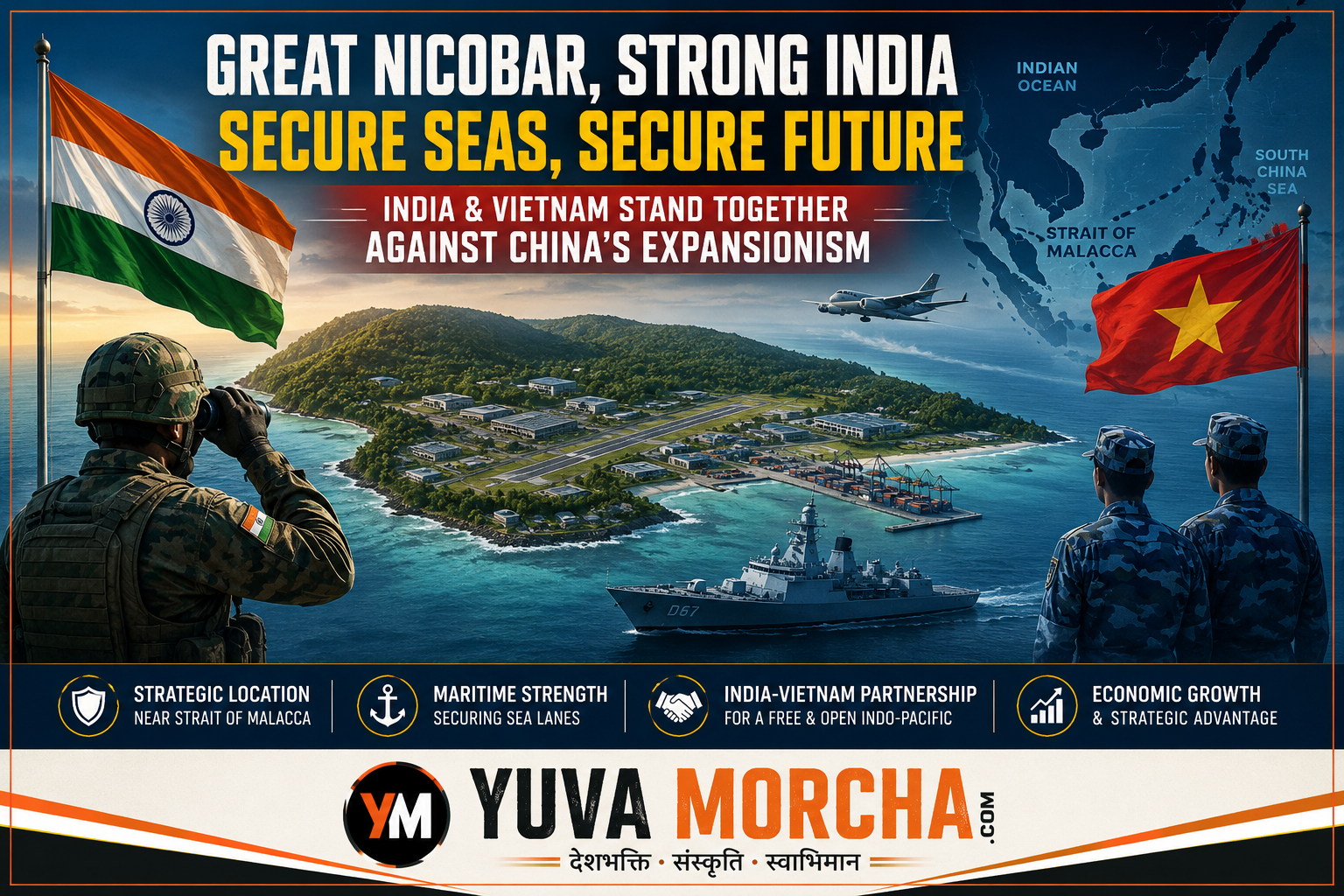
The development of Great Nicobar Island is not merely an infrastructure project. It is India’s strategic declaration that the Indian Ocean cannot become China’s backyard.
Why Great Nicobar Matters So Much


Great Nicobar sits near the Strait of Malacca — one of the world’s most critical maritime choke points. Nearly all major East Asian economies depend upon this route for energy imports and trade.
Most importantly:
- A massive percentage of China’s oil imports pass through this corridor.
- Chinese commercial and naval shipping activity in the region has surged dramatically in the last decade.
- Control, surveillance and deterrence capability near Malacca gives India enormous strategic leverage.
India’s long-neglected island territories are now becoming strategic assets. This shift reflects a deeper transformation in Indian geopolitical thinking — from a traditionally land-focused military doctrine to a maritime power projection strategy.
China’s Expansion Strategy Across Asia
China’s geopolitical strategy has become increasingly aggressive in multiple regions:
1. South China Sea Militarisation
China has:
- Built artificial islands,
- Established military airstrips,
- Expanded naval patrols,
- Claimed maritime zones belonging to neighbouring countries.
This directly impacts Vietnam, the Philippines and other ASEAN states.
Vietnam, in particular, has repeatedly resisted Chinese encroachments in the South China Sea and has emerged as one of the strongest regional opponents of Beijing’s maritime ambitions.
2. “String of Pearls” Strategy Around India
China’s investments in:
- Pakistan’s Gwadar Port,
- Sri Lanka’s Hambantota Port,
- Djibouti naval base,
- Myanmar infrastructure projects,
have raised major concerns in Indian strategic circles.
India increasingly sees these developments not as isolated commercial ventures, but as elements of a long-term encirclement strategy.
The Great Nicobar project is India’s answer.
Why Vietnam and India Are Natural Strategic Partners


India and Vietnam share several common concerns:
| Strategic Concern | India | Vietnam |
|---|---|---|
| Chinese territorial pressure | Yes | Yes |
| Maritime security concerns | High | High |
| Indo-Pacific trade dependency | Major | Major |
| Need for defence modernisation | Ongoing | Ongoing |
| Support for multipolar Asia | Strong | Strong |
Vietnam has historically demonstrated exceptional resilience against larger powers, including China. Its strategic posture is admired across Asia because Hanoi has consistently defended sovereignty despite economic pressure from Beijing.
India and Vietnam increasingly cooperate through:
- Naval exercises,
- Defence agreements,
- Energy exploration,
- Maritime security cooperation,
- Indo-Pacific diplomacy.
This partnership could become one of Asia’s most important balancing alliances in the coming decade.
Great Nicobar: India’s “Unsinkable Aircraft Carrier”
Several Indian strategic experts now describe the Andaman & Nicobar chain as India’s “unsinkable aircraft carrier.”
That phrase is not mere rhetoric.
The geography gives India advantages that China cannot easily replicate:
- Proximity to critical sea lanes,
- Surveillance dominance,
- Faster naval deployment,
- Submarine tracking capability,
- Strategic air operations capability.
Unlike aircraft carriers, islands cannot be sunk.
This gives India a permanent strategic foothold in the eastern Indian Ocean.
The Economic Dimension: More Than Just Military Strategy
The Great Nicobar project is also about economics.
India currently loses substantial transshipment business to ports like:
- Singapore,
- Colombo,
- Port Klang.
A world-class transshipment hub in Great Nicobar could:
- Reduce logistics costs,
- Strengthen India’s maritime economy,
- Increase trade competitiveness,
- Create a strategic commercial gateway into Southeast Asia.
China understood decades ago that maritime infrastructure equals geopolitical power. India is finally beginning to act on the same realization.
The Vietnam Lesson India Must Learn
Vietnam’s approach toward China offers several lessons for India:
Strategic Clarity
Vietnam recognizes Chinese expansionism as a long-term challenge, not a temporary diplomatic issue.
Economic Engagement Without Strategic Submission
Vietnam trades heavily with China but refuses to surrender strategic autonomy.
Military Preparedness
Vietnam continuously strengthens deterrence despite asymmetry in power.
National Resolve
Vietnam’s political establishment largely speaks with one voice on sovereignty issues.
India can benefit enormously from adopting similar consistency in long-term strategic planning.
Environmental Concerns Cannot Be Ignored


Supporting India’s strategic rise does not mean ignoring environmental realities.
Critics of the project raise valid concerns regarding:
- Deforestation,
- Ecological damage,
- Indigenous tribal protection,
- Seismic vulnerability.
Even strong national security advocates acknowledge that India must avoid repeating the environmentally destructive models seen elsewhere in Asia.
A truly powerful India must combine:
- strategic strength,
- ecological responsibility,
- indigenous protection,
- sustainable infrastructure.
Nationalism without sustainability becomes self-destructive.
China’s Biggest Fear: A Strong Indo-Pacific Coalition
China’s long-term strategic concern is not one country alone.
It is the emergence of a coordinated Indo-Pacific balancing network involving:
- India,
- Vietnam,
- Japan,
- Australia,
- ASEAN democracies,
- and increasingly the United States.
The Indo-Pacific is gradually moving toward a multipolar security architecture designed specifically to prevent unilateral Chinese dominance.
India’s rise as a maritime power is central to that transformation.
Final Analysis
The Great Nicobar project represents a turning point in India’s geopolitical evolution.
For decades, China expanded aggressively across Asia while many regional powers reacted cautiously. That phase is ending.
India is beginning to understand the value of:
- maritime power,
- strategic geography,
- logistics dominance,
- and long-term deterrence.
Vietnam has already demonstrated what determined resistance against Chinese pressure looks like.
Together, India and Vietnam represent two of the strongest Asian civilizational states capable of resisting authoritarian expansionism while preserving regional balance.
The Indo-Pacific’s future may ultimately depend on whether nations like India and Vietnam possess the strategic courage, economic strength and political will to stand firm against coercive power politics.
And Great Nicobar may become one of the defining symbols of that resistance.
Sources & References
- DW Report on Great Nicobar
- India Today Analysis
- NDTV Strategic Opinion
- Hindustan Times Defence Analysis
Team : Yuvamorcha.com
More Featured Articles:
UAE’s $3.5 Billion Demand from Pakistan: Geopolitical Shockwaves and the Emerging India Factor.
India’s Rise as a Global Superpower: How Narendra Modi’s Leadership Is Shaping the 21st Century.
India Stops Ravi River Water Flow to Pakistan: Impact and Details of the Shahpur Kandi Project.
The Mother of All Deals: Decoding the Historic India-Europe Free Trade Agreement of 2026.
India-UAE Strategic Defense Pact: A New Geopolitical Axis Redefining West Asia.
SME IPOs in India: Insights from Regulators, Bankers & Advisors
How Ex-Bankers Can Build a High-Income Second Career Through a Corporate DSA Partner Program