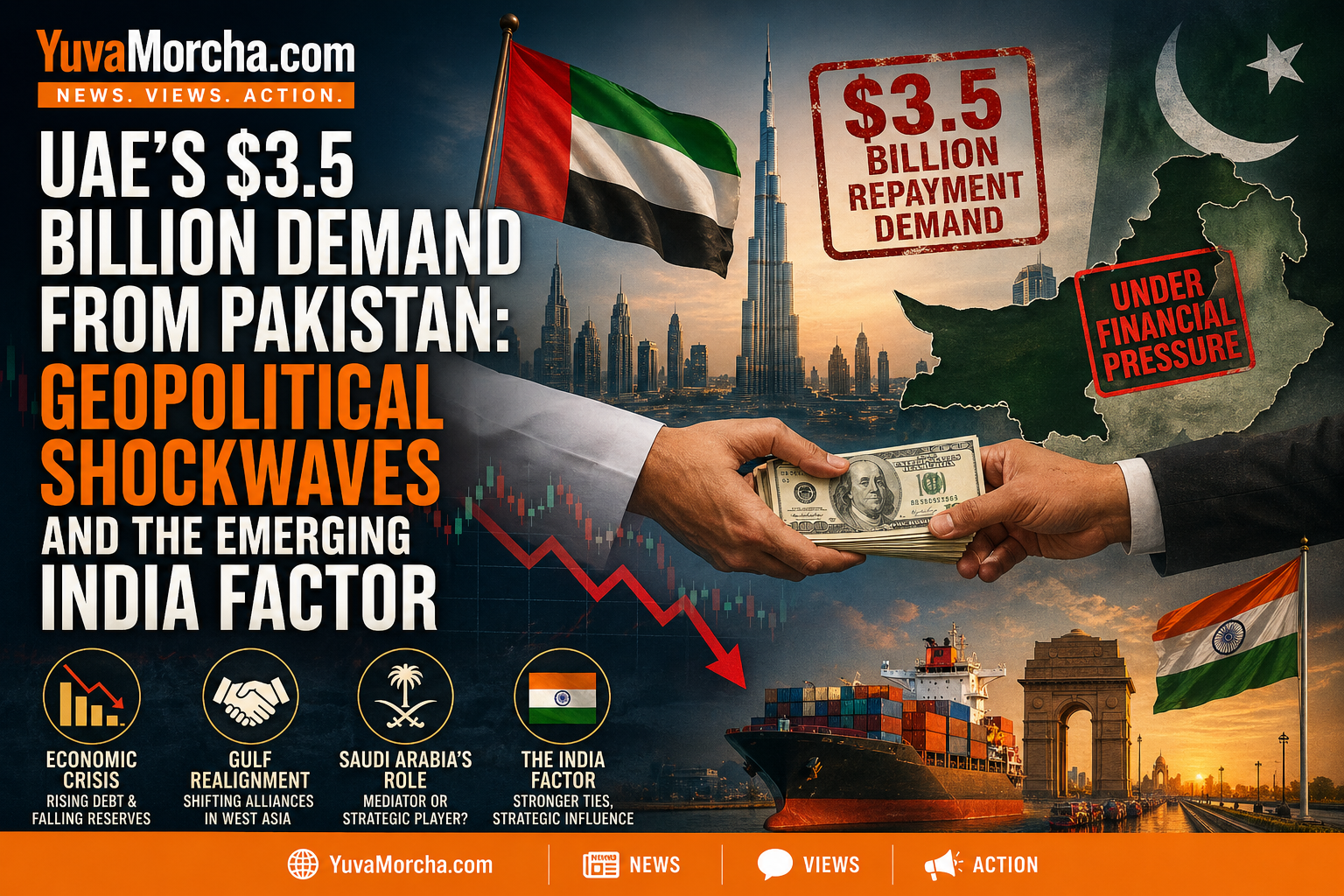


UAE’s $3.5 Billion Demand from Pakistan: Geopolitical Shockwaves and the Emerging India Factor.
A deep dive into the UAE’s $3.5 billion repayment demand from Pakistan, its economic impact, Gulf geopolitics, Saudi Arabia’s role, and the growing India factor reshaping regional alliances.
Introduction: A Sudden Financial Shock with Strategic Implications
In a development that has stirred both economic and geopolitical discussions, the United Arab Emirates (UAE) has reportedly sought repayment of approximately $3.5 billion from Pakistan. While on the surface this may appear to be a routine financial transaction, the timing and context suggest a deeper strategic recalibration in West Asia and South Asia.
Pakistan, already navigating a fragile economic recovery marked by dwindling foreign reserves and reliance on international bailouts, now faces renewed fiscal pressure. More importantly, this move signals shifting alliances within the Gulf, where economic decisions are increasingly intertwined with geopolitical considerations, including the rising influence of India.
Pakistan’s Economic Vulnerability: A Crisis Intensifies
Pakistan’s economy has been under sustained stress for several years, characterized by:
- Low foreign exchange reserves
- Persistent current account deficits
- Heavy reliance on external financing
- Frequent engagement with the International Monetary Fund (IMF)
The UAE’s demand for repayment adds immediate pressure on Islamabad’s already strained finances. Such deposits, often parked by Gulf nations in Pakistan’s central bank, act as critical buffers to stabilize currency and maintain import cover. Their withdrawal or recall can trigger currency depreciation, inflation spikes, and investor anxiety.
This development could potentially force Pakistan to:
- Seek emergency funding from allies
- Re-enter or renegotiate IMF programs
- Tighten domestic fiscal measures
Why Did the UAE Make This Move?
While official explanations may frame this as a financial adjustment, analysts point toward broader strategic motivations:
1. Reassessment of Financial Exposure
The UAE, like other Gulf nations, is increasingly cautious about extending financial lifelines without clear economic reforms and repayment assurances.
2. Strategic Realignment in the Region
The Gulf is undergoing a transformation where economic partnerships are being recalibrated based on long-term returns and geopolitical stability.
3. Signaling Fiscal Discipline
By demanding repayment, the UAE may be sending a signal to regional partners about accountability and financial discipline.
Saudi Arabia’s Role: Mediator or Strategic Player?
The involvement of Saudi Arabia adds another layer of complexity. Historically, Riyadh has played a crucial role in supporting Pakistan during financial crises. However, Saudi Arabia itself is redefining its foreign policy under economic diversification goals and strategic autonomy.
There are indications that Saudi Arabia may:
- Act as a mediator between UAE and Pakistan
- Offer conditional financial support
- Align its decisions with broader Gulf cooperation frameworks
This suggests that Pakistan can no longer rely on unconditional backing from traditional allies.
The India Factor: A Silent but Significant Shift
Perhaps the most intriguing aspect of this development is the growing influence of India in Gulf geopolitics.
Over the past decade, India has significantly strengthened ties with the UAE and Saudi Arabia through:
- Trade partnerships
- Energy cooperation
- Strategic investments
- Diaspora engagement
India’s economic stability, large market size, and geopolitical positioning make it an increasingly attractive partner for Gulf nations.
Key Indicators of India’s Rising Influence
- UAE-India Comprehensive Economic Partnership Agreement (CEPA)
- Increasing bilateral trade volumes
- Strategic investments in infrastructure and technology
- Enhanced defense and security cooperation
As Gulf nations diversify their alliances, India emerges as a reliable and growth-oriented partner, potentially overshadowing Pakistan’s traditional strategic importance.
Geopolitical Implications: A Shifting Balance of Power
The UAE’s financial move is not isolated. It reflects a broader transformation:
1. Decline of Traditional Alliances
Long-standing relationships based on political alignment are giving way to economically driven partnerships.
2. Rise of Economic Diplomacy
Financial decisions are now tools of strategic influence.
3. Multipolar Regional Dynamics
The Middle East and South Asia are moving toward a more complex, multipolar order where no single alliance dominates.
What Lies Ahead for Pakistan?
Pakistan faces a critical juncture. Its options include:
- Accelerating economic reforms
- Strengthening domestic revenue systems
- Diversifying foreign partnerships beyond traditional allies
- Enhancing trade and investment frameworks
Failure to adapt could deepen economic instability and reduce geopolitical leverage.
Conclusion: More Than Just a Financial Transaction
The UAE’s $3.5 billion repayment demand from Pakistan is far more than a fiscal issue. It is a reflection of changing geopolitical realities where economic strength, strategic alignment, and reliability define partnerships.
For Pakistan, this serves as a wake-up call to recalibrate both its economic policies and foreign relations. For India, it underscores a growing influence in a region that is rapidly redefining its alliances.
As the situation evolves, one thing remains clear: in today’s interconnected world, financial decisions are rarely just about money—they are powerful instruments shaping the future of global geopolitics.
YuvaMorcha.com
More Featured Articles:
India-UAE Strategic Defense Pact: A New Geopolitical Axis Redefining West Asia.
UAE issues guidelines to determine corporate tax liability for individuals
The Mother of All Deals: Decoding the Historic India-Europe Free Trade Agreement of 2026.
SME IPOs in India: Insights from Regulators, Bankers & Advisors
How Ex-Bankers Can Build a High-Income Second Career Through a Corporate DSA Partner Program