




Sharing is caring!

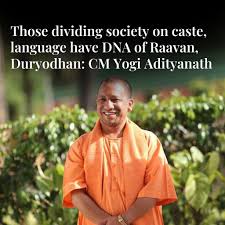
From Monk to Chief Minister: The Life and Leadership of Yogi Adityanath.
Early Life and Spiritual Roots.
Born on June 5, 1972, in Panchur, Pauri Garhwal (then Uttar Pradesh, now Uttarakhand), as Ajay Mohan Singh Bisht (also known as Ajay Singh Bisht), Yogi Adityanath grew up in a humble household. His father, Anand Singh Bisht, worked as a forest ranger, while his mother, Savitri Devi, was a homemaker .
A bright student, he earned a Bachelor’s degree in Mathematics from Hemwati Nandan Bahuguna Garhwal University. Despite his academic promise, at the age of 21, Ajay took a transformative path by joining the Gorakhnath Math in Gorakhpur under the guidance of Mahant Avaidyanath, marking the beginning of his spiritual and political trajectory.
His deep involvement in the Nath Sampradaya, a tradition steeped in yoga and Shaivism, shaped his persona as a resolute monk committed to spiritual discipline and social service. In September 2014, he succeeded his guru and became the mahant (head priest) of the Gorakhnath Temple—a role blending spiritual leadership with social influence.
Entry into Politics and Rise to Prominence
Yogi’s entry into politics came under his mentor’s wing. In 1996, he architected political strategies for Mahant Avaidyanath. Two years later, in 1998, Avaidyanath retired from electoral politics and handpicked Ajay as his successor in the Gorakhpur Lok Sabha constituency.
At just 26 years old, he became one of India’s youngest parliamentarians, winning a seat in the 12th Lok Sabha. From 1998 to 2017, he secured re-election five consecutive times, establishing himself as a formidable BJP leader from eastern Uttar Pradesh.
Parallelly, in 2002, he founded the Hindu Yuva Vahini (HYV), a Hindu nationalist organization aimed at fostering a united Hindu identity. Though presented as cultural and social activism, critics claim it functioned with a strong Hindutva agenda.
Chief Minister of Uttar Pradesh (2017–Present).
On March 19, 2017, Yogi Adityanath was sworn in as the Chief Minister of Uttar Pradesh, succeeding Akhilesh Yadav. He became the first CM in the state’s history to complete two consecutive full terms, making him UP’s longest-serving chief minister.
Governance and Key Achievements.
His tenure is marked by several signature developments and policy initiatives:
Law & Order Improvements.
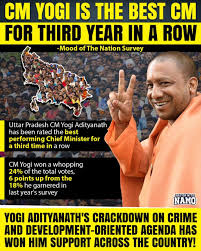
Credited with restoring safety, Yogi implemented a strict anti-crime approach, sometimes referred to as an “encounter policy.” This earned him the nickname “Bulldozer Baba”—due to the use of bulldozers to clear illegal properties.
Infrastructure and Connectivity.
Major projects include the Purvanchal Expressway, Bundelkhand Expressway, and initiation of the Jewar International Airport near Delhi. These have ambitiously aimed at improving connectivity and economic growth across UP.
Industrial Expansion & Investment Drives
The government has attracted significant investments, developing industrial corridors and facilitating ease of doing business. A prominent example is the Samsung smartphone manufacturing plant in Noida, supported by 50 MW power and infrastructure built in four months.
Agriculture & Farmer Support.
His admin honored sugarcane payments, waived small and marginal farmers’ loans, and launched Kisan Samman Nidhi varieties of schemes to uplift agricultural communities.
Social Welfare & Zero Poverty Campaign
Under the Zero Poverty Campaign (initiated October 2024), UP identified 13.3 lakh poor families and delivered aid—including housing, healthcare, and education—to over 3.72 lakh families, aiming to eradicate poverty by 2027.
Education Upliftment.
Launched Operation Kayakalp and Project Alankar to upgrade school infrastructure, and introduced Udgam, a digital platform to enhance teaching practices and teacher resources.
Industrial Empowerment in Eastern UP
In Gorakhpur Industrial Development Authority, he inaugurated ₹2,251 crore projects, including a Coca-Cola plant and a plastic packaging facility, generating local jobs and infrastructure.
Modernizing Law Enforcement:
India’s largest police recruitment—60,244 constables including 12,000 women—modernized with AI tools, mobile labs, and improved infrastructure. Home Minister Amit Shah praised the strengthened law and order under Yogi.
Personality, Ideology, and Capabilities
Spiritual Anchor: Even as a politician, Yogi remains rooted in his ascetic lifestyle, rising at 3 a.m., following simple meals, and staying disciplined in routine and conduct.
Hindutva Nationalism: His political ideology is firmly grounded in Hindutva. From cow-protection drives to social campaigns like love jihad and ghar wapsi, his spiritual beliefs influence his policies.
Strong Leadership: His decisive action and “bulldozer” symbolism convey his ability to implement swift and visible changes, appealing to voters who demand security and order. His mix of religious devotion and political assertiveness marks him as a compelling leader.
Development-Oriented and Visionary: Yogi has demonstrated a forward-looking vision—focusing on infrastructure, connectivity, industrialization, and poverty eradication—aligning UP toward becoming the modern industrial powerhouse envisioned in the “Viksit Bharat” framework.
Future Potential and What Lies Ahead.
Role at the National Stage
While Yogi Adityanath himself asserts that politics isn’t his full-time profession—stating “I am a Yogi at heart”—his growing popularity keeps speculation alive about his future in national politics. For now, his focus remains firmly on UP’s development.
Vision for 2047.
His ambitious drive to connect every district with air services by 2047, through the “One Division, One International Airport” policy, reflects a long-term strategic approach to elevate UP into a prime logistics and aviation hub.
Sustainability and Social Justice.
The state’s Zero Poverty mission, coupled with universal development schemes—including health, education, and digital empowerment—may serve as a model for inclusive governance that balances Hindu nationalist rhetoric with welfare delivery.
Conclusion:
Yogi Adityanath’s journey—from Ajay Singh Bisht, a young mathematician, to the Mahant of Gorakhnath Math, and ultimately to the Chief Minister of Uttar Pradesh—is marked by strong ideological conviction and governance ambition.
He has succeeded in blending spirituality with administrative rigor, delivering infrastructure megaprojects, law and order reforms, and welfare initiatives. His potential lies in balancing development and Hindu nationalist politics, forging a governance model that resonates with both his religious identity and promises of modernization.
Depending on how effectively he can steer Uttar Pradesh toward comprehensive growth while maintaining social harmony, his trajectory may well influence not just state politics, but potentially India’s future political canvas.
Sudheendra Kumar ( Mobile /WhatsApp: 91-9820088394)
Follow us on LinkedIn:
https://www.linkedin.com/
https://www.linkedin.com/
https://www.linkedin.com/





Thanks for sharing. I read many of your blog posts, cool, your blog is very good.
Can you be more specific about the content of your article? After reading it, I still have some doubts. Hope you can help me.
Thanks for sharing. I read many of your blog posts, cool, your blog is very good.
Thanks for sharing. I read many of your blog posts, cool, your blog is very good.