




Sharing is caring!
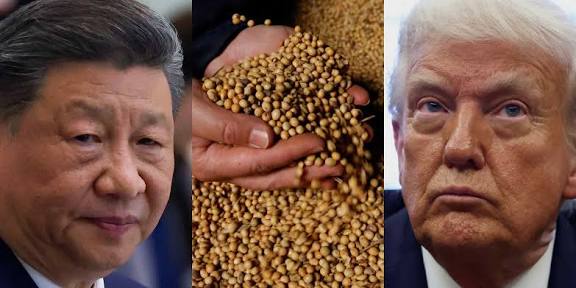
Headache for Trump: US Soyabean farmers face worst crisis in decades as China halts imports
Retaliatory tariffs leave growers with no market for $12 billion exports, industry warns of “five-alarm fire.
American soyabean farmers are facing mounting uncertainty after China halted purchases of the crop in retaliation for U.S. tariffs, leaving producers with no access to their biggest foreign buyer. Soyabean plants are ripe for harvest in the US but farmers don’t know where they will sell their crop because China has stopped buying, the Associated Press reported on Saturday.
Beijing, which typically accounts for at least a quarter of U.S. soyabean sales, stopped imports in May after President Donald Trump imposed steep tariffs on Chinese goods. China responded with duties of up to 34% on American soyabeans, making South American supply cheaper. “This is a five-alarm fire for our industry,” said Caleb Ragland, who heads the American Soyabean Association trade group.
Last year, the U.S. exported nearly $24.5 billion worth of soyabeans, with China purchasing $12.5 billion-by far the largest share. This year, the New York Times reported, the figure has dropped to zero. The European Union, the second-largest buyer, accounted for just $2.45 billion in purchases last year.
Jim Sutter, CEO of the U.S. Soyabean Export Council, voiced concern over the approaching harvest season. “I’m honestly getting worried that the time is running out,” he said, adding that no progress on soyabean trade has emerged despite four rounds of talks between May and September.
The heartland of America is in turmoil. For generations, U.S. soybean farmers have been the silent backbone of the nation’s agricultural exports, sending millions of tons of crops overseas each year. But today, silos across Iowa, Illinois, and Indiana are overflowing with unsold soybeans, prices have collapsed to decade lows, and thousands of farm families are on the brink of bankruptcy.
The reason: China—the world’s largest soybean importer and once the most dependable market for American farmers—has halted U.S. imports altogether in response to escalating trade tensions with Washington. This shift has triggered the worst soybean crisis in decades, upending rural economies and creating a political nightmare for former U.S. President Donald Trump.
Soybeans: The Lifeblood of U.S. Agriculture
Soybeans are more than just another crop. They are America’s second-largest cash crop, covering over 80 million acres of farmland. Valued for their use in animal feed, cooking oil, and biofuels, soybeans represent nearly $40 billion annually in U.S. agricultural exports.
For decades, China accounted for nearly 60% of U.S. soybean exports, making it the single largest customer. The relationship was so strong that farmers often joked that “American soybeans are grown in Iowa but consumed in Beijing.”
That relationship has now collapsed.
How the Trade War Escalated
The crisis traces back to Trump’s tariff-centered trade policy. In an effort to pressure Beijing into negotiating more favorable trade terms, Trump imposed tariffs on hundreds of billions of dollars’ worth of Chinese goods.
China retaliated with its own tariffs—hitting U.S. agricultural products the hardest. Soybeans, being America’s top agricultural export to China, became the prime target of Beijing’s countermeasures.
Initially, China reduced purchases. But as trade talks collapsed and rhetoric hardened, Beijing decided to halt U.S. soybean imports completely, turning instead to Brazil, Argentina, and even Russia.
“This was not just about economics—it was about politics,” says Dr. Emily Harrington, an international trade analyst at Georgetown University. “China knew that by targeting soybeans, it would hit Trump’s strongest political base in the Midwest.”
Farmers’ Voices: “We’re Paying the Price for Washington’s War”
In rural towns across the Midwest, frustration is boiling over. Farmers say they’ve become pawns in a geopolitical battle that has left their livelihoods in jeopardy.
“We’ve worked these lands for three generations, and I’ve never seen it this bad,” says Tom Larson, a farmer from Indiana. “The government tells us to be patient, but patience doesn’t pay the bills.”
Storage bins are full, transportation contracts have dried up, and the Chicago Board of Trade soybean prices have slumped below $9 a bushel, far below the break-even point for most farmers. Many are now relying on government aid just to survive.
Financial Fallout: Debt, Bankruptcies, and Rural Distress
The economic damage is staggering:
Farm bankruptcies have surged by over 20% in the last year, according to the American Farm Bureau Federation.
Farm debt has reached record highs, with the USDA estimating that total farm debt will exceed $500 billion this year.
With global buyers shifting away, U.S. soybean stockpiles have ballooned to historic levels, further depressing prices.
Many farmers had borrowed heavily to finance planting seasons, confident that Chinese demand would remain steady. Now, they are drowning in debt, struggling to pay back loans, and in some cases, forced to auction off family land.
Political Blowback in Trump’s Heartland
The soybean crisis poses a unique political dilemma. States like Iowa, Illinois, Indiana, Missouri, and Ohio—the core of the soybean belt—were key to Trump’s electoral victories. Farmers overwhelmingly supported him, believing he would protect their interests.
Now, many feel betrayed.
“We voted for Trump because he promised to fight for us,” says an Iowa soybean grower. “But instead, we’re the ones fighting for survival.”
Democrats have seized on the issue, using it as evidence that Trump’s trade war strategy has “backfired,” punishing Americans instead of compelling China to compromise. With rural America traditionally leaning Republican, the farm crisis could reshape electoral dynamics in 2026 and beyond.
Global Soybean Trade Shifts Permanently
Perhaps the most worrying development is the structural shift in global soybean trade. China, once reliant on American soybeans, has successfully diversified its imports. Brazil has emerged as the biggest winner, with its soybean exports to China surging by over 30% year-on-year. Argentina and even smaller producers like Russia and Ukraine have also stepped in to fill the void.
Analysts warn that even if trade tensions ease, China may never fully return to U.S. soybeans. The reliability of supply is more valuable than price, and Beijing now views Brazil as its long-term strategic partner in agriculture.
This permanent shift threatens to erode America’s dominance in the global soybean market—a dominance built over four decades.
Government Bailouts: A Band-Aid Solution
In an attempt to soften the blow, Washington has rolled out billions of dollars in farm aid packages. While these subsidies provide short-term relief, many farmers say they are no substitute for stable markets.
“We don’t want government checks; we want customers,” says Jennifer Morales, a soybean farmer in Illinois. “Subsidies are a band-aid, not a cure.”
Critics argue that taxpayer-funded bailouts are unsustainable, especially when trade wars show no sign of ending. Without long-term access to international markets, U.S. agriculture risks losing its competitive edge.
Experts Warn of Long-Term Consequences
Agricultural economists are sounding alarms about the long-term implications:
1. Reduced planting – Many farmers are already planning to cut soybean acreage next season, switching to corn, wheat, or other crops.
2. Consolidation – Small and medium farms may not survive, leading to further consolidation of farmland under large agribusiness corporations.
3. Rural decline – With farming incomes shrinking, small towns across the Midwest face economic stagnation, declining populations, and loss of community services.
4. Geopolitical vulnerability – America’s weakened agricultural position could undermine its leverage in future trade negotiations.
Can U.S. Farmers Recover?
The path to recovery will be long and uncertain. Experts suggest that rebuilding trust with China will take years, and even then, the U.S. may never regain its previous market share. Diversifying export markets—toward Europe, Southeast Asia, and Africa—could offer some relief, but none of these regions match the scale of Chinese demand.
Domestically, investment in biofuels, plant-based protein industries, and alternative supply chains could help absorb some of the surplus. But these solutions require time, innovation, and significant government support.
“The U.S. needs a comprehensive agricultural strategy, not just reactionary tariffs,” argues Dr. Harrington. “Without it, farmers will continue to bear the brunt of political miscalculations.”
Conclusion: A Political and Economic Storm
The U.S. soybean crisis is more than a story about falling crop prices. It is a tale of how global politics can upend local livelihoods, how trade wars reshape entire industries, and how rural America—once seen as Trump’s strongest base—is now questioning the very policies it supported.
For farmers, the road ahead is uncertain. For Washington, the stakes are higher than ever. If the crisis persists, it could not only reshape the global soybean trade but also redraw America’s political map.
Yuvamorcha.com, Creditmoneyfinance.com, Startupindia.club, Economiclawpractice.com





Thank you for your sharing. I am worried that I lack creative ideas. It is your article that makes me full of hope. Thank you. But, I have a question, can you help me?