




Sharing is caring!
Why Seoul Says “No Way” to Trump’s $350 Billion Cash Demand — The Realities Behind Korea’s Trade Stand.
South Korea differs from Trump, says can’t pay $350 billion to US in cash for tariff deal.
The two countries reached a handshake agreement in July to cut US tariffs on South Korean goods to 15 per cent from 25 per cent.
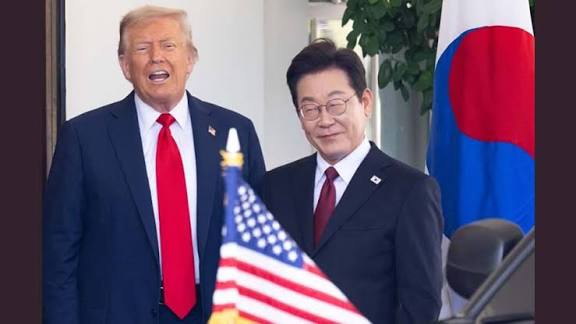
South Korea cannot pay $350 billion in cash to the United States (US) under a tariff deal proposed by President Donald Trump and is looking for an alternative, a top presidential aide said on Saturday.
The two countries reached a handshake agreement in July to cut US tariffs on South Korean goods to 15 per cent from 25 per cent. At the time, Seoul pledged $350 billion in investment for US projects, saying the funds would come through loans, loan guarantees, and equity.
South Korean President Lee Jae Myung told Reuters that such a payment could destabilise the country’s economy, which has foreign exchange reserves of about $410 billion. He said safeguards such as a currency swap would be needed to avoid a crisis.
When former President Donald Trump proposed that South Korea pay $350 billion in cash upfront in exchange for lower U.S. tariffs, he triggered a dramatic backlash from Seoul. South Korea’s government emphatically rejects the demand, arguing it is “objectively and realistically not a level we are able to handle.”
This stand is not just rhetoric — it speaks volumes about South Korea’s economic constraints, diplomatic posture, and how trade deals must be built on realism, not grandiose demands.
The Context: From 25% Tariffs to a $350 B Commitment
Earlier this year, Trump’s administration threatened to impose a 25% tariff on South Korean goods under a sweeping protectionist agenda.
In July, Seoul and Washington struck a handshake agreement: South Korea would see tariffs reduced to 15%, and in return, South Korea would commit to $350 billion in U.S. investments over time.
However, Trump later insisted that the $350 billion be provided “upfront” in cash, a demand that Seoul says it cannot meet.
In short: the original deal was intended as a structured, long-term investment package (equity, loans, guarantees). The sudden demand for upfront cash disrupted expectations and exposed deeper tensions.
Why Seoul Objects: Economic, Financial & Strategic Realities
1. Liquidity Limits & Risk to Stability
South Korea’s foreign exchange reserves stand around $410 billion.
A sudden outflow of $350 billion would threaten currency stability, prompt capital flight, and risk a financial crisis comparable to the 1997 Asian financial crisis. President Lee has warned just that scenario.
Seoul insists that paying such a sum in cash isn’t mere negotiation posturing — it’s “objectively and realistically not a level we are able to handle.”
2. Control Over Funds & Sovereignty Concerns
U.S. negotiators want control over how the money is used. Seoul balks: handing over that power undermines South Korea’s economic sovereignty.
Instead, Korea proposes mechanisms such as loans, guarantees, equity stakes, or an MOU (non-binding memorandum) to stipulate rules and safeguards.
3. Currency Swap Safeguards & Financial Architecture
Seoul demands a currency swap agreement with the U.S. to mitigate exchange rate stress when executing large capital transfers. Without it, the risk is too high.
Any structural investment package needs embedded protections — including phased disbursements, performance-linked triggers, profit-sharing rules — not a lump sum dump.
4. Market Reactions & Currency Pressure
The Korean won has already weakened past critical thresholds (1,400/KRW per USD) amid the uncertainty and trade tensions.
Investors are wary: they see that Seoul’s stand reflects not just negotiation strategy, but real market risk inherent in that level of cash demand.
Implications: What This Standoff Means for U.S.–Korea Relations
• Deal Breakdown Risk
If no compromise emerges, the tariff deal could collapse. That may force South Korean goods to face the original 25% rate again — hurting exporters and trade volumes.
• Precedent for Other Nations
If Washington succeeds in extracting upfront payments from Korea, it could set a new template for demanding cash from other trade partners — a dangerous trend for global trade norms.
• Domestic Political Backlash in Korea
South Korea’s government faces internal pressure. Accepting a huge cash demand could be sold domestically as capitulation. Rejecting it risks retaliation from the U.S. — a tough balancing act.
• Strategic Leverage in Negotiations
Seoul’s rejection forces Washington to negotiate more realistically — the U.S. may have to shift toward phased investment plans, legal safeguards, or adjust control demands.
Conclusion: Negotiated Realism, Not Grandiose Demands
Seoul’s firm refusal — “we are not able to pay $350 billion in cash” — is more than a diplomatic posture. It signals that trade must be built on financial realism, economic constraints, and mutual trust, not unrealistic ultimata.
Unless both sides shift from brinksmanship to pragmatism, this confrontation could derail one of the most ambitious trade-investment deals in recent memory. The world is watching whether the superpower’s demands or the smaller country’s constraints will win out.
Yuvamorcha.com, Creditmoneyfinance.com, Startupindia.club, Economiclawpractice.com

I don’t think the title of your article matches the content lol. Just kidding, mainly because I had some doubts after reading the article. https://www.binance.info/register?ref=IXBIAFVY
I don’t think the title of your article matches the content lol. Just kidding, mainly because I had some doubts after reading the article.
pre filled thc vape pens for easy convenient use