




Sharing is caring!
8India’s Export Rebound: Riding the Global Wave Beyond the unreliable U.S.
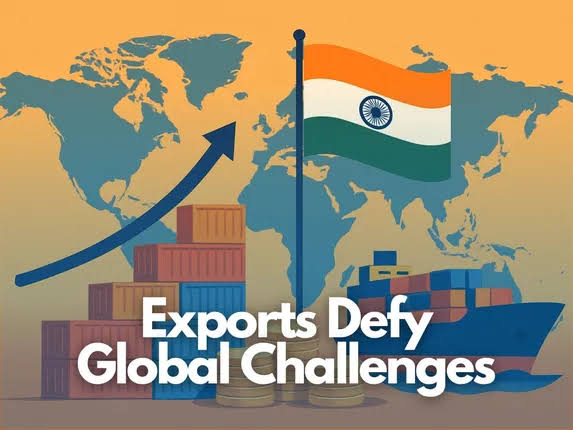
India’s recent export rebound is being significantly driven by a deliberate strategy of market diversification into non-US destinations, which is helping to offset some slowdown in the US market. Key high-growth markets beyond the US include the UAE, Netherlands, China, Germany, and South Korea.
Introduction
In the face of steep trade headwinds with the United States, India is showing resilience: its exporters are increasingly turning to non-U.S. markets and cushioning the blow of declining export shipments to the U.S. With growth elsewhere helping sustain overall figures, this pivot may signal a more diversified and robust future for Indian trade.
U.S. Pressure and the Export Slide
Exports from India to the U.S. have taken a noticeable hit. Between May and September 2025, shipments to the U.S. fell by about 37.5 %, largely due to the steep tariffs imposed by Washington.
In September alone, merchandise exports to the U.S. dropped 11.9 % year-on-year to US $5.46 billion. The U.S. still accounts for around 18-20 % of India’s total merchandise exports, underscoring the market’s importance and the risk from its contraction.
For certain labour-intensive sectors:
60% of carpet exports
50% of made-ups
30% of gems & jewellery
40% of apparel exports
are destined for the U.S. market.
These dependencies made India vulnerable to external shock when U.S. tariffs rose steeply.
The Diversification Strategy Kicks In:
Rather than relying solely on traditional destination markets, India is pursuing a broader export orientation — reaching out to Asia, Europe, West Asia, Latin America and Africa. This is not a new ambition, but recent data suggest the execution is bearing fruit.
Evidence of substitution:
In September 2025, India’s total merchandise exports rose 6.7 % year-on-year to US $36.38 billion, despite the drop in U.S. shipments.
Export shipments to non-U.S. markets expanded by 10.9 % year-on-year in September, while U.S. shipments fell.
Key sectors like textiles, marine products, gems and jewellery recorded strong growth in non-U.S. markets:
Marine exports up 15.6 % overall in Jan–Sept 2025 to US $4.83 billion, with large gains in Vietnam (100 %), Belgium (73 %) and Thailand (54.4 %).
Textile exports modestly up 1.23 % to US $28.05 billion in Jan–Sept; driven by growth to UAE (+8.6 %), Netherlands (+11.8 %), Poland (+24.1 %), Spain (+9.1 %) and Egypt (+24.5 %).
Structural supports:
Free-trade and preferential trade agreements (such as with the ASEAN region) and production-linked incentive schemes are helping Indian exporters get access and scale.
The government has identified about 40 key importing countries in North America, Europe, Asia, Africa and Latin America that together account for nearly three-quarters of global textile & apparel demand.
Why This Matters – And What It Means
1. Resilience through diversification: By reducing reliance on one market (the U.S.), India is shielding its export earnings from regional policy risk and market-specific shocks.
2. Opportunity in emerging markets: Countries in Southeast Asia, West Asia, Africa and Latin America present growth potential with rising consumption and import demand — India is increasingly tapping into these.
3. Sectoral transformation: While traditional sectors like textiles and gems face headwinds in the U.S., gains in non-U.S. markets signal that Indian exporters are adapting, upgrading product quality, complying with global standards and leveraging new supply-chains.
4. Global supply-chain repositioning: As global firms rethink sourcing and trading blocs amid protectionism and supply-chain disruptions, India’s pivot may attract new orders and partnerships.
5. Challenges remain:
The U.S. drop isn’t fully offset yet: Some sectors remain heavily exposed to U.S. demand, and the pace of expansion in alternative markets must accelerate.
Non-U.S. markets might demand different standards, logistics, marketing, and distribution setups — not a simple plug-and-play.
Domestic capacity, infrastructure, export financing, quality compliance and competitiveness will matter more than ever.
Outlook & Strategic Considerations
For FY 2025-26, the target of US $1 trillion in exports set by the government remains ambitious but plausible if the non-U.S. momentum sustains.
Policymakers and exporters should focus on:
Deepening existing non-U.S. markets and identifying next-tier markets in Latin America and Africa
Upgrading logistics, compliance, digital export platforms, brand-building and value-added manufacturing
Mitigating risks of currency volatility, shipping/logistics disruptions, and trade-policy shocks in any region
Industry sectors with high dependency on the U.S. must fast-track diversification and innovation (for example, shifting to newer markets or introducing higher-value product lines)
Monitoring the U.S.–India trade negotiation process remains important: a revival in U.S. demand or a new agreement could change the comparative dynamics.
Conclusion
The headline story is clear: while exports to the United States have faltered, India’s overall export performance has held up better than many feared, thanks to significant gains in non-U.S. markets. This transition from “one large market” dependency to a more plural and globally dispersed export base is important — not just as a defensive move, but as a strategic opportunity.
If Indian exporters and policymakers continue to build on the momentum, the export sector could emerge stronger and more globally integrated. The challenge now is to convert this diversification into sustainable growth, elevated value-added exports, and resilient supply-chain participation. In a world of rising trade frictions and shifting global demand, India appears to be turning vulnerability into opportunity.
Team: Yuvamorcha.com





Can you be more specific about the content of your article? After reading it, I still have some doubts. Hope you can help me.