




From Nuclear-Capable Agni to Battlefield Prithvi: How India Quietly Built One of the World’s Most Diverse Missile Arsenals:
India may not always make headlines for its missile program but behind the scenes, it has been steadily building one of the world’s most sophisticated, flexible, and layered missile arsenals.
From long-range nuclear deterrents to tactical battlefield rockets, India’s missile capabilities span multiple domains and its strategic reach is growing.
A Quiet Revolution: The Origins of India’s Missile Program:
India’s foray into missile technology began decades ago under the Integrated Guided Missile Development Programme (IGMDP), launched in the early 1980s with the goal of making India self-reliant in missile technology.
Under the IGMDP, India set out to develop a full spectrum of missile systems:
Prithvi, a short-range ballistic missile
Agni, a medium- to long-range ballistic missile
Trishul, Akash, and Nag, covering anti-air and anti-tank roles
By 2008, DRDO formally announced the successful completion of the IGMDP, declaring that India had achieved its indigenous missile-development goals.
The Strategic Backbone: Agni Series — Fire Across the Spectrum
The Agni missile family is the centerpiece of India’s long-range strike and nuclear deterrence capability.
Agni-I: The short-to-medium range version with a range of 700–1,200 km, capable of carrying conventional or nuclear warheads.
Agni-II: A medium-range ballistic missile, road-mobile, with a reach of about 2,000–3,500 km.
Agni-III and Agni-IV: Extended-range missiles, filling in the higher-range spectrum.
Agni-V: A long-range, intercontinental-capable missile, with a range over 5,000 km. It has been tested with MIRV (Multiple Independently Targetable Re-entry Vehicle) technology, meaning it can deliver multiple warheads to different targets.
Agni-P (Prime): The next-gen missile — two-stage, canister-launched, mobile, with a 1,000–2,000 km range. It is designed to replace older Agni-I and II and feature modern guidance systems.
Agni-VI: Reportedly under development, with projected ranges up to 10,000 km and MIRV capability.
This progression shows how India has methodically built a layered strategic deterrent, from relatively short-range threats to true intercontinental capability.
Battlefield Precision: Prithvi and Tactical Missiles:
While Agni secures India’s long-range deterrent, its Prithvi family handles the shorter, tactical end of the spectrum.
Prithvi-I, II, III: Tactical ballistic missiles developed for different services — Army, Air Force, and Navy — with ranges between ~150 km and ~350 km.
Dhanush: A ship-launched derivative of Prithvi, giving India naval ballistic strike capability.
Prahaar: A solid-fuel, road-mobile tactical missile with high accuracy (CEP ~10 m) and a 150 km range.
These battlefield systems give India a rapid, flexible strike capability that can be deployed in high-threat regions — not just for deterrence, but for battlefield dominance.
Beyond Ballistic — Cruise, Air-Defense & Submarine Missiles
India’s missile diversity doesn’t end with ballistic rockets. Its arsenal includes cruise, surface-to-air, and submarine-launched missiles, making it truly multidomain.
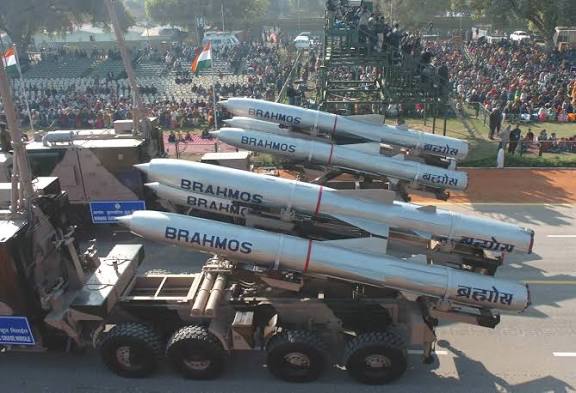
BrahMos: A supersonic cruise missile developed jointly with Russia, deployable from land, sea, air, and submarine platforms.
Nirbhay: An indigenously-developed subsonic cruise missile, touted to be nuclear-capable, with very low radar detection and long range.
Akash: Surface-to-air missile developed under IGMDP, for air defense roles.
K-series (SLBMs): Including K-6, a submarine-launched ballistic missile reportedly under development, designed for long-range deterrent from sea.
By spanning multiple domains — land, sea, air — India ensures its missile force is resilient and flexible.
Modern Advances: MIRVs, Mobility, and Credible Deterrence:
India’s more recent missile developments hint at a strategic leap:
1. MIRV Technology: Tests of Agni-V with MIRV capability mean India could target multiple sites with a single missile a force multiplier and deterrent.
2. Canisterisation & Mobility: With Agni-P, India is enhancing road-mobile, canister-launched systems increasing survivability, reducing launch preparation time.
3. Strategic Doctrine: India follows a “credible minimum deterrence” doctrine with a declared no-first-use nuclear policy.
These advances strengthen India’s second-strike capability and make its deterrent more credible.
Why This Arsenal Matters: Geopolitics & Strategy:
Regional Deterrence: Against Pakistan and China, India’s layered missile forces allow it to threaten both regional and strategic targets.
Strategic Autonomy: Indigenous development reduces dependence on foreign powers, aligning with India’s “Make in India” and self-reliance goals.
Global Standing: By mastering MIRV, long-range missiles, and multidomain deployment, India is establishing itself among the top-tier nuclear-capable nations.
Export Potential: Systems like BrahMos already have export appeal; with more advanced systems, India might become a major missile exporter.
Risks & Challenges:
Arms Race: More capable missiles may spur adversaries to respond, escalating regional tensions.
Cost & Maintenance: Advanced systems are expensive; sustaining them demands high investment.
Safety & Command: Ensuring secure and safe control of nuclear and multi-warhead missiles remains a major strategic challenge.
From the early days of the IGMDP to the present, India has quietly but systematically built one of the world’s most diverse and capable missile arsenals. With systems like Agni-V, Agni-P, Prithvi, BrahMos and Nirbhay, it has layered its strategic posture across range, domain, and mission. This isn’t just about deterrence ratherb it’s about achieving strategic autonomy, operational flexibility, and global relevance.
As India continues to test and refine next-generation systems, the world is watching and so should defence analysts everywhere. Because behind its calm exterior, India’s missile force is fast becoming one of the most formidable in the world.
Team: Yuvamorcha.com





I don’t think the title of your article matches the content lol. Just kidding, mainly because I had some doubts after reading the article.
I don’t think the title of your article matches the content lol. Just kidding, mainly because I had some doubts after reading the article.
Your point of view caught my eye and was very interesting. Thanks. I have a question for you.