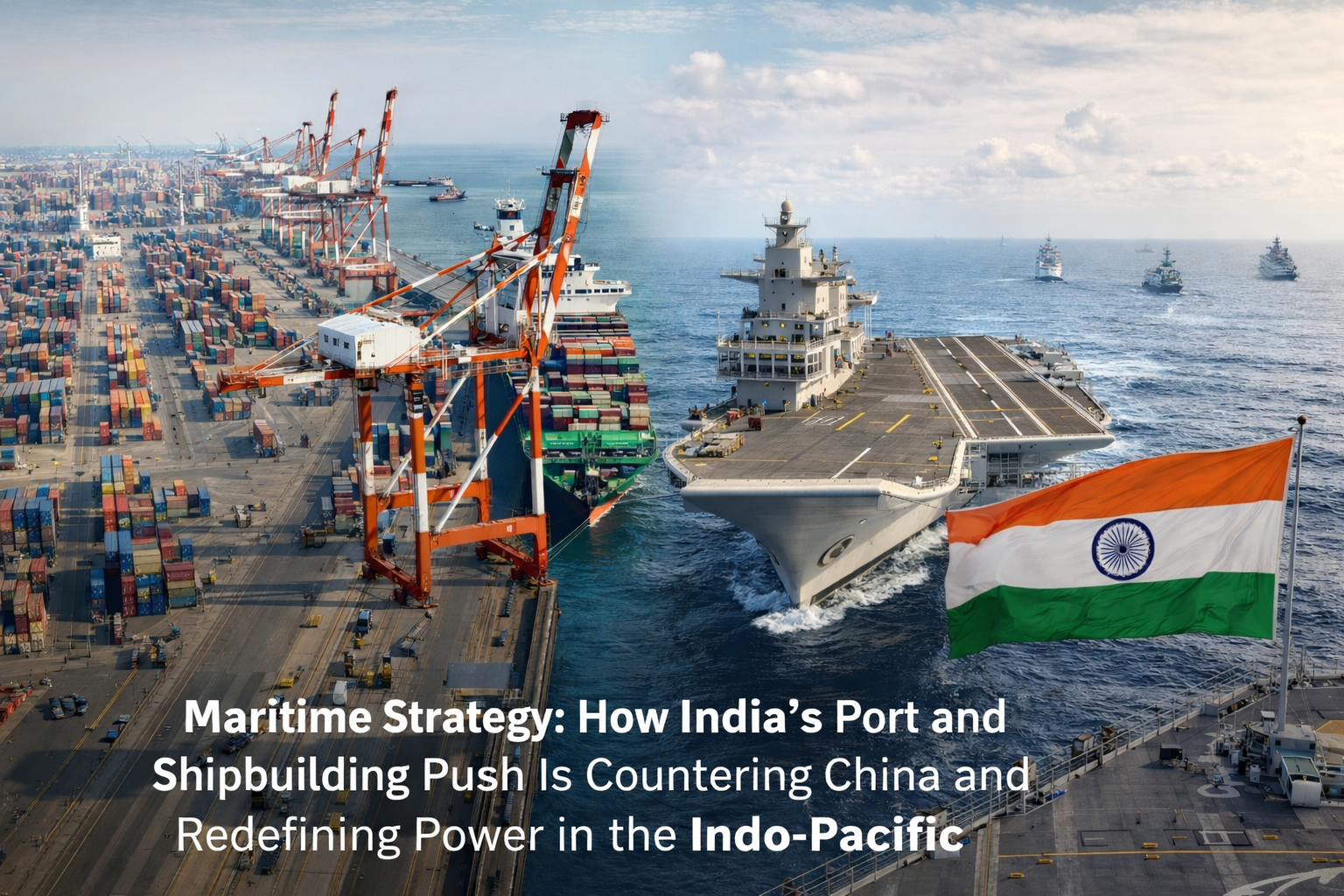


India’s Maritime Moment: Ports, Power, and the Quiet Strategy Reshaping the Indo-Pacific.
India’s port modernization and shipbuilding expansion are reshaping Indo-Pacific geopolitics, strengthening naval power, and unlocking massive economic and business opportunities while countering China’s maritime dominance..
India Is Rediscovering the Power of the Sea.
For decades, India’s strategic imagination remained largely land-centric, focused on borders, mountains, and continental threats. That mindset is changing.
Quietly but decisively, India is executing a maritime pivot that blends national security, economic ambition, and industrial strategy into a single vision..
From deep-sea ports and logistics corridors to indigenous shipbuilding and naval modernization, India’s maritime push is not merely about infrastructure, it is about power projection, economic resilience, and strategic autonomy in an Indo-Pacific increasingly shaped by China’s rise.
This is India’s maritime moment and it is unfolding with far-reaching implications for defence planners, global investors, and regional geopolitics alike.
The Indo-Pacific Reality: Where Economics and Security Converge.
The Indo-Pacific is no longer an abstract diplomatic construct. It is the world’s most critical economic and security theatre:
Over 60% of global trade transits these waters
Nearly 70% of global energy flows depend on its sea lanes
Key chokepoints, Malacca, Hormuz, Bab-el-Mandeb define global stability.
China understands this better than anyone. Its vast shipbuilding capacity, expanding naval footprint, and control over overseas ports reflect a deliberate strategy to dominate maritime supply chains and strategic waterways.
India’s response is neither loud nor reckless, but it is structural.
Ports as Power: India’s Infrastructure-Led Strategic Doctrine.
Beyond Cargo: Why Ports Are Strategic Assets.
Modern ports are no longer passive trade gateways. They are:
Logistical command centers,
Dual-use military enablers,
Anchors of industrial ecosystems,
Instruments of geopolitical influence.
India’s accelerated port development under initiatives such as Sagarmala recognizes this reality.
Strategic Port Projects Changing the Map.
Vizhinjam Deep Sea Port: A transshipment challenger to Colombo and Singapore.
Vadhavan Port: Designed for scale, automation, and global competitiveness.
JNPT, Paradip, Kandla: Capacity expansion and digitization.
Andaman & Nicobar Islands: Forward maritime positioning near critical sea lanes.
Collectively, these projects enhance India’s ability to move goods, deploy naval assets, and sustain long-duration maritime operations.
Shipbuilding: The Industrial Backbone of Maritime Power.
No country can be a maritime power without control over shipbuilding.
China dominates global shipbuilding through scale, state subsidies, and vertical integration.
India, learning from this asymmetry, is now treating shipbuilding and ship repair as strategic industries, not niche sectors.
Why Shipbuilding Matters:
Reduces dependence on foreign yards
Secures defence supply chains,
Creates high-skill manufacturing jobs,
Attracts global shipping and leasing firms,
Public and private shipyards from Cochin Shipyard to L&T and Mazagon Dock are expanding capacity across:
Naval vessels,
Commercial ships,
LNG and green-fuel vessels,
Offshore and repair services,
For investors and businesses, this represents a long-term industrial opportunity aligned with national strategy.
Naval Power and Strategic Depth: The Security Multiplier:
Ports and shipyards directly translate into combat readiness and strategic depth.
The Indian Navy’s doctrine emphasizes:
Sea control in the Indian Ocean,
Sea denial against hostile forces,
Protection of Sea Lines of Communication (SLOCs),
Indigenous aircraft carriers, nuclear submarines, surveillance networks, and logistics agreements are only effective if backed by robust coastal and port infrastructure.
In this sense, India’s port-led growth model doubles as a force multiplier for national defence.
Also Read: India Enters the Hypersonic Elite: DRDO’s ET-LDHCM Missile Test Redefines Future Warfare
Countering China Without Copying China.
China’s maritime strategy relies on:
Debt-driven overseas port acquisitions
Militarization of commercial assets
Centralized, opaque financing.
India’s approach is structurally different and deliberately so.
India emphasizes:
Transparent port development,
Respect for host-nation sovereignty,
Capacity building, not dependency,
Partnerships over coercion.
This model resonates strongly with Indian Ocean nations wary of strategic overreach, positioning India as a credible and trusted maritime partner.
The Business Case: Why Markets Should Pay Attention.
India’s maritime transformation is unlocking massive commercial upside:
Lower logistics costs for exporters
Faster supply-chain turnaround times
Growth in coastal manufacturing clusters
Expansion of maritime finance, insurance, and leasing,
Rising demand for green shipping technologies,
As global companies diversify supply chains away from China, India’s ports and shipyards could become critical nodes in future trade architecture.
This is not just a defence story , it is a once-in-a-generation economic rebalancing opportunity.
Challenges That Will Define Success.
Despite momentum, execution risks remain:
Regulatory delays and coastal clearances,
Skill shortages in advanced shipbuilding,
Competition from heavily subsidized Chinese firms,
Environmental sustainability pressures,
Whether India can maintain policy consistency and delivery speed will determine whether this maritime push becomes transformational or merely incremental.
Conclusion: India’s Quiet Return as a Maritime Power.
India’s maritime resurgence is neither accidental nor cosmetic. It reflects a deeper strategic realization: the future of power, prosperity, and security lies at sea.
By integrating ports, shipbuilding, naval capability, and business strategy, India is crafting a uniquely balanced response to China’s maritime dominance, one rooted in sustainability, partnerships, and strategic patience.
The Indo-Pacific’s next chapter will not be written only by fleets and flags, but by ports, shipyards, and supply chains. India has finally stepped into that reality and the ripple effects will shape geopolitics and global business for decades to come.
Team: YuvaMorcha.com
More Featured Articles:
Israel Turns to India to Rebuild Defence Supply Chains Amid Tightening European Export Restrictions
SIDBI – Powering India’s MSME Growth: Funding, Schemes & Business Support.
SME IPO in India 2025: Complete Guide for Investors & Growing Businesses
Birla Open Minds – Pre-School and K-12 School franchise opportunity in India and Worldwide